In a groundbreaking revelation that rewrites cosmic history, astronomers using the Hobby-Eberly Telescope Dark Energy Experiment (HETDEX) have discovered tens of thousands of colossal hydrogen gas halos—dubbed 'Lyman-alpha nebulae'—surrounding galaxies that existed between 10 billion and 12 billion years ago. This epoch, known as 'Cosmic Noon,' marked a period when the universe's galaxies were growing at their most rapid pace, fueled by vast reservoirs of hydrogen, the fundamental building block of stars. Until now, scientists had only identified a mere handful of these essential structures, leaving critical gaps in our understanding of early galaxy formation. The new findings, published in The Astrophysical Journal, triple the known number of these halos from approximately 3,000 to over 33,000, providing astronomers with an unprecedented statistical dataset to unravel the mysteries of the universe’s adolescence.
How HETDEX Revolutionized Our View of the Early Universe
The Hobby-Eberly Telescope, perched atop the Davis Mountains in West Texas at the McDonald Observatory, has become one of astronomy’s most powerful tools for peering into the distant past. Operated by The University of Texas at Austin, HETDEX is not merely observing the cosmos—it is conducting a census of over one million galaxies, mapping their positions and the vast intergalactic spaces between them. 'We’ve captured nearly half a petabyte of data,' said Karl Gebhardt, HETDEX’s principal investigator and chair of UT Austin’s astronomy department. 'Our observations span a region of the sky equivalent to more than 2,000 full moons—a scale so vast it was previously unthinkable.' This expansive dataset has enabled researchers to detect structures that were once invisible, including the faint, sprawling halos of hydrogen gas that once eluded detection due to their low luminosity.
The Instrument Behind the Discovery: A Technological Marvel
At the heart of HETDEX’s capabilities is the Hobby-Eberly Telescope itself, one of the largest optical telescopes in the world with an 11-meter primary mirror. What sets it apart, however, is the specialized instrument designed for the Dark Energy Experiment: a suite of spectrographs capable of producing 100,000 spectra in a single observation. 'Each spectrum is like a fingerprint,' explained Dustin Davis, a postdoctoral fellow at UT Austin and HETDEX scientist. 'We’re not just seeing galaxies; we’re seeing the very fabric of the early universe—hydrogen gas clouds glowing in the ultraviolet light of young stars.' This technological leap has transformed HETDEX into a cosmic detective, uncovering structures that were previously hidden in plain sight.
Cosmic Noon: The Golden Age of Galaxy Growth
Cosmic Noon, spanning roughly 3 billion to 5 billion years after the Big Bang, was a transformative era in cosmic history. During this period, galaxies were forming stars at rates up to 20 times faster than today’s Milky Way, fueled by an abundance of hydrogen gas. Yet, despite its significance, this epoch remained shrouded in mystery due to the scarcity of direct observations. Hydrogen gas itself is notoriously difficult to detect because it emits little to no light on its own. However, when illuminated by the intense ultraviolet radiation from young, massive stars, the gas fluoresces, creating the telltale glow of Lyman-alpha nebulae. 'These halos are like cosmic breadcrumbs,' said Erin Mentuch Cooper, HETDEX data manager and lead author of the study. 'They tell us where the hydrogen was—and where the stars were about to be born.'
From a Handful to a Treasure Trove: The Tenfold Leap in Discovery
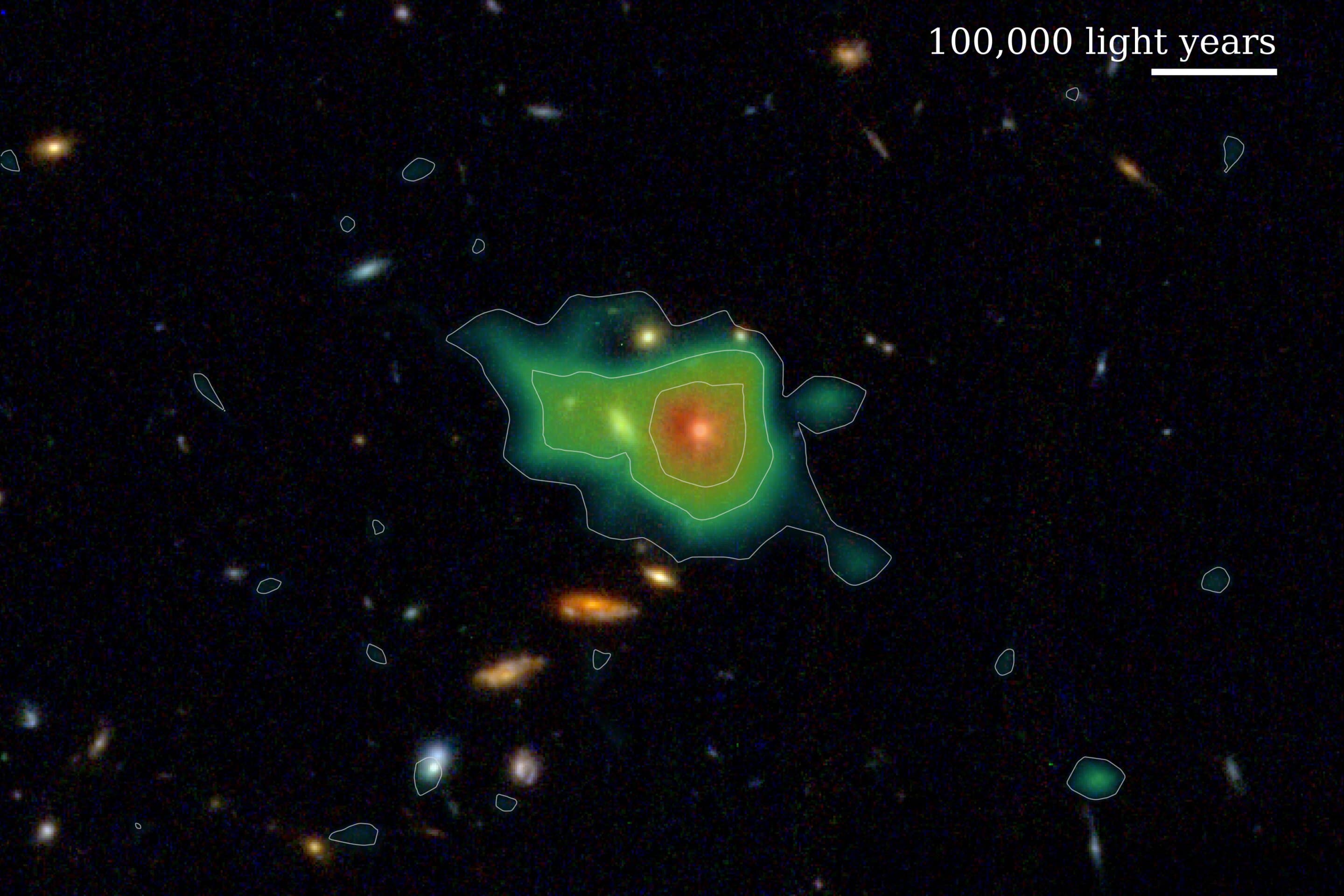
Before HETDEX, astronomers had identified only about 3,000 Lyman-alpha nebulae, a number so small that it left researchers questioning whether these structures were rare anomalies or common features of the early universe. The new study, led by Mentuch Cooper, has shattered that assumption by tripling the known population to over 33,000 halos. This monumental increase was made possible by HETDEX’s ability to detect fainter, smaller, and more irregularly shaped halos that previous surveys missed. 'For the past 20 years, we’ve been analyzing the same few objects,' Mentuch Cooper noted. 'HETDEX has allowed us to create an amazing statistical catalog, revealing the true diversity of these halos—from compact, football-shaped clouds to sprawling, amoeba-like structures stretching hundreds of thousands of light-years.'
The Hidden Giants: Measuring the Scale of the Discovery
The newly revealed halos vary dramatically in size, ranging from tens of thousands to hundreds of thousands of light-years across. Some envelop individual galaxies in a symmetrical glow, while others form irregular, tendril-like structures that weave through space, encompassing multiple galaxies. 'The irregular ones are the most fascinating,' Mentuch Cooper said. 'They look like giant amoebas with tendrils stretching into the cosmic void, revealing the chaotic, dynamic environment of the early universe.' To identify these halos, the team focused on the 70,000 brightest early galaxies detected by HETDEX, using supercomputers at the Texas Advanced Computing Center to analyze their spectra. Nearly half showed evidence of surrounding hydrogen halos, though researchers suspect this fraction is an underestimate, as the faintest systems may not reveal their full extent.
Why Hydrogen Halos Matter: Fueling the Birth of Stars
Hydrogen gas is the raw material from which stars are forged. During Cosmic Noon, galaxies required vast reservoirs of this gas to sustain their rapid star formation. However, detecting this gas was a persistent challenge because it emits no light of its own. 'We knew hydrogen had to be there, but we couldn’t see it,' explained Davis. 'Now, for the first time, we have a comprehensive map of where this gas was located in the early universe.' The discovery of these halos provides astronomers with a critical piece of the puzzle, allowing them to study how galaxies accreted gas, how matter was distributed, and how the first large-scale structures of the universe took shape. With 33,000 halos to explore, researchers are no longer constrained by scarcity but by choice—deciding which halos to study in greater detail to refine existing models of galaxy formation.
The Road Ahead: Refining Our Understanding of the Early Universe
The discovery of 33,000 Lyman-alpha nebulae marks a turning point in cosmological research, but it is only the beginning. 'There are various models for galaxies in this epoch that largely work and seem to make sense, but there are gaps and holes,' Davis said. 'Now we can focus on individual halos and see the physics and mechanics in greater detail.' Researchers plan to use these halos to test existing theories, refine simulations of early galaxy formation, and potentially uncover new phenomena that defy current understanding. 'We’re not just confirming what we thought we knew,' Mentuch Cooper added. 'We’re opening doors to questions we haven’t even asked yet.'
Key Takeaways: What the Discovery Means for Astronomy
- HETDEX has identified over 33,000 Lyman-alpha nebulae—hydrogen gas halos surrounding early galaxies—which is a tenfold increase from previous estimates.
- Cosmic Noon, a period 10-12 billion years ago, was a peak era of galaxy growth, requiring vast hydrogen reservoirs for star formation.
- The Hobby-Eberly Telescope’s advanced spectrographs and data processing capabilities enabled the detection of previously invisible halos.
- The discovery provides astronomers with an unprecedented statistical dataset to study galaxy evolution, matter distribution, and the early universe’s structure.
- Researchers can now focus on individual halos to refine models of early galaxy formation and uncover new cosmic phenomena.
Frequently Asked Questions About Hydrogen Halos and the Early Universe
Frequently Asked Questions
- What are Lyman-alpha nebulae?
- Lyman-alpha nebulae are vast clouds of hydrogen gas that emit a specific wavelength of ultraviolet light called the Lyman-alpha line. They are often found surrounding early galaxies and are illuminated by the intense radiation from young stars.
- Why was hydrogen gas so important during Cosmic Noon?
- Hydrogen gas is the fundamental building block of stars. During Cosmic Noon, galaxies were forming stars at unprecedented rates, requiring massive reservoirs of hydrogen to sustain this growth.
- How did HETDEX detect these halos?
- HETDEX used the Hobby-Eberly Telescope’s advanced spectrographs to capture 100,000 spectra per observation. By analyzing the light from early galaxies, researchers identified the faint glow of hydrogen halos illuminated by nearby stars.