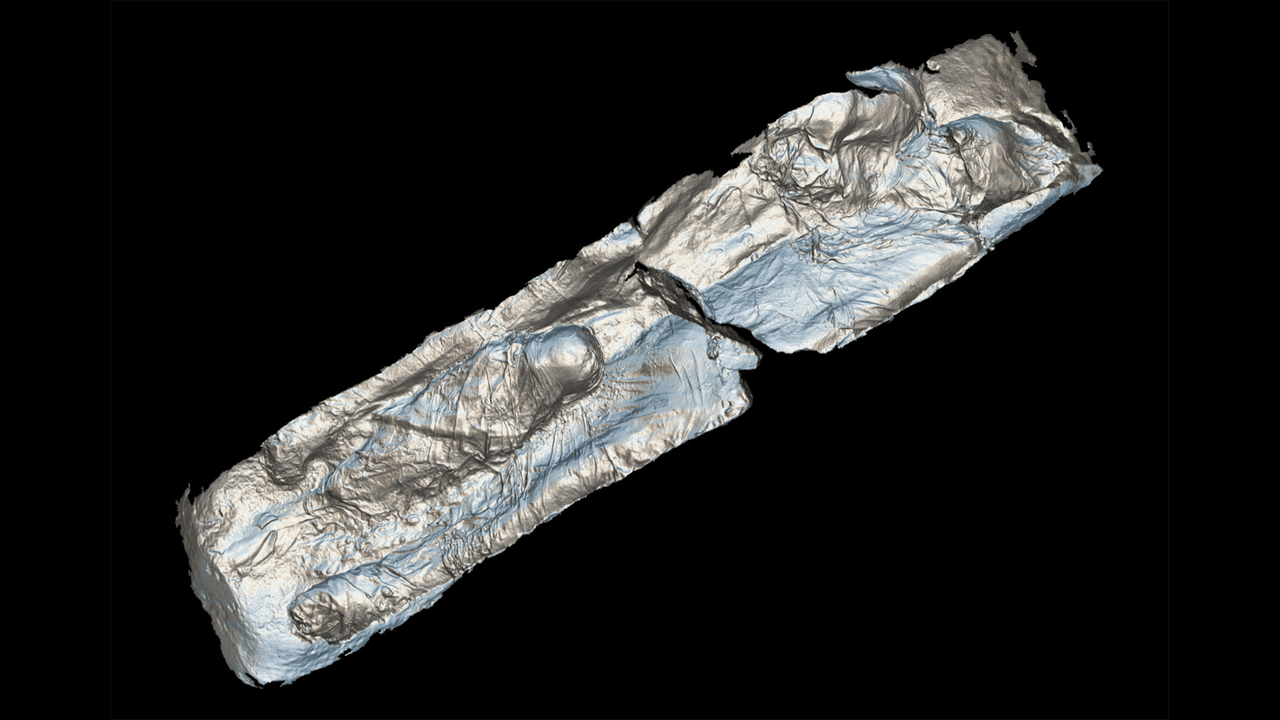
Despite historical records saying otherwise, Roman babies were mourned at death, research into unique plaster burials from York reveals.
When you purchase through links on our site, we may earn an affiliate commission. Here’s how it works.
Unlock instant access to exclusive member features.
By submitting your information you agree to the Terms & Conditions and Privacy Policy and are aged 16 or over. You are now subscribed
Once a week Life's Little Mysteries Feed your curiosity with an exclusive mystery every week, solved with science and delivered direct to your inbox before it's seen anywhere else.
Get full access to premium articles, exclusive features and a growing list of member rewards.
The mysterious Roman-era burial rite of pouring liquid gypsum over the dead wasn't limited to elite adults as previously thought; it was also performed on children, including babies as young as 1 month old, researchers have found.
The finding contradicts Roman-era legal sources who wrote that infants under 12 months old were not supposed to be mourned at all, according to two blog posts published by the Seeing the Dead project, a collaboration between the University of York and the York Museums Trust. Their team is investigating the discovery of children among the rare "gypsum burials" found in York, in northern England.
Liquid-gypsum burials have long confounded researchers. The enigmatic practice involved placing the deceased in a stone or lead sarcophagus and then pouring liquid gypsum over them. The plaster-of-paris-like substance hardened over their bodies, preserving traces of high-status clothing. But new research found that even the youngest members of ancient society were mourned.
- 'They had not been seen ever before': Romans made liquid gypsum paste and smeared it over the dead before burial, leaving fingerprints behind, new research finds
- Eerie 'sand burials' of elite Anglo-Saxons and their 'sacrificed' horse discovered near UK nuclear power plant
- Diarrhea and stomachaches plagued Roman soldiers stationed at Hadrian's Wall, discovery of microscopic parasites finds
"Infants were the most vulnerable members of Roman society," Maureen Carroll, a Roman archaeologist at the University of York, wrote in a Feb. 18 blog post, particularly given the high infant mortality rate of around 30%. But even though historical records say babies younger than 1 year old were not to be mourned because infant deaths were commonplace, Carroll has found that these restrictions applied only to public mourning.
"They had no bearing on sentiments such as grief or the sense of loss felt and expressed by the surviving family in private," she wrote.
Among the more than 70 gypsum burials Carroll has studied, at least seven belonged to children, including three infants under 4 months old. The practice of liquid-gypsum burial seems to have been reserved for the Roman elite in York, and it was usually employed on adults. Infants were more often buried in large jars called amphorae; ceramic tile boxes; or small, wooden coffins.
One remarkable infant burial was found in 1892 during the construction of the York Railway. The newborn, just 1 or 2 months old, was covered with a cloak of purple-dyed wool decorated with gold thread and tassels, before being placed in a lead sarcophagus and covered in liquid gypsum.
Get the world’s most fascinating discoveries delivered straight to your inbox.
Although nothing remains of the infant's bones today, impressions of the brilliant purple-and-gold cloak can still be seen. This is the only gypsum burial with dyed fabric ever found, Sarah Hitchens, an archaeological textile expert at the University of York, wrote in a Feb. 23 blog post.
"It is likely that the purple textile was made from an animal fibre such as wool," Hitchens wrote, and the cloak was likely draped over the infant's body as a burial shroud.
Chemists on the project team are now analyzing the hardened gypsum covering to glean more information about Romano-British burial practices.
- A coffin holding a dead 'princess' fell from an eroded cliff over 100 years ago — archaeologists just solved a major mystery about her
- Eerie 'sand burials' of elite Anglo-Saxons and their 'sacrificed' horse discovered near UK nuclear power plant
- Diarrhea and stomachaches plagued Roman soldiers stationed at Hadrian's Wall, discovery of microscopic parasites finds
"We are testing the gypsum casing for evidence of aromatic substances, such as frankincense or mastic," dried tree sap and resin, respectively, Carroll told Live Science in an email. They also plan to test the purple dye to determine whether it came from murex, a type of snail from which the ancient Romans extracted a natural reddish-purple dye. The gold threads will be analyzed as well, Carroll said.
Other liquid-gypsum burials found in York include a child of about 4 months old discovered wrapped between the legs of two adults. It's unclear if these three people constituted a family, "but it is evident that they were closely associated in life and in death," Carroll wrote.
In another case, a girl who was between 7 and 9 years old when she died was buried with an array of gold, silver, copper, jet, glass and coral jewelry. Two pairs of boots and a pair of sandals were discovered near her feet, and the bones of what was likely a pet chicken were found in her coffin as well.
—'Extremely rare' and 'highly unusual' Roman-era tomb in Germany is completely empty
—Mass grave of Roman-era soldiers discovered beneath soccer field in Vienna
—In a 'race against time,' archaeologists uncovered Roman-era footprints from a Scottish beach before the tide washed them away