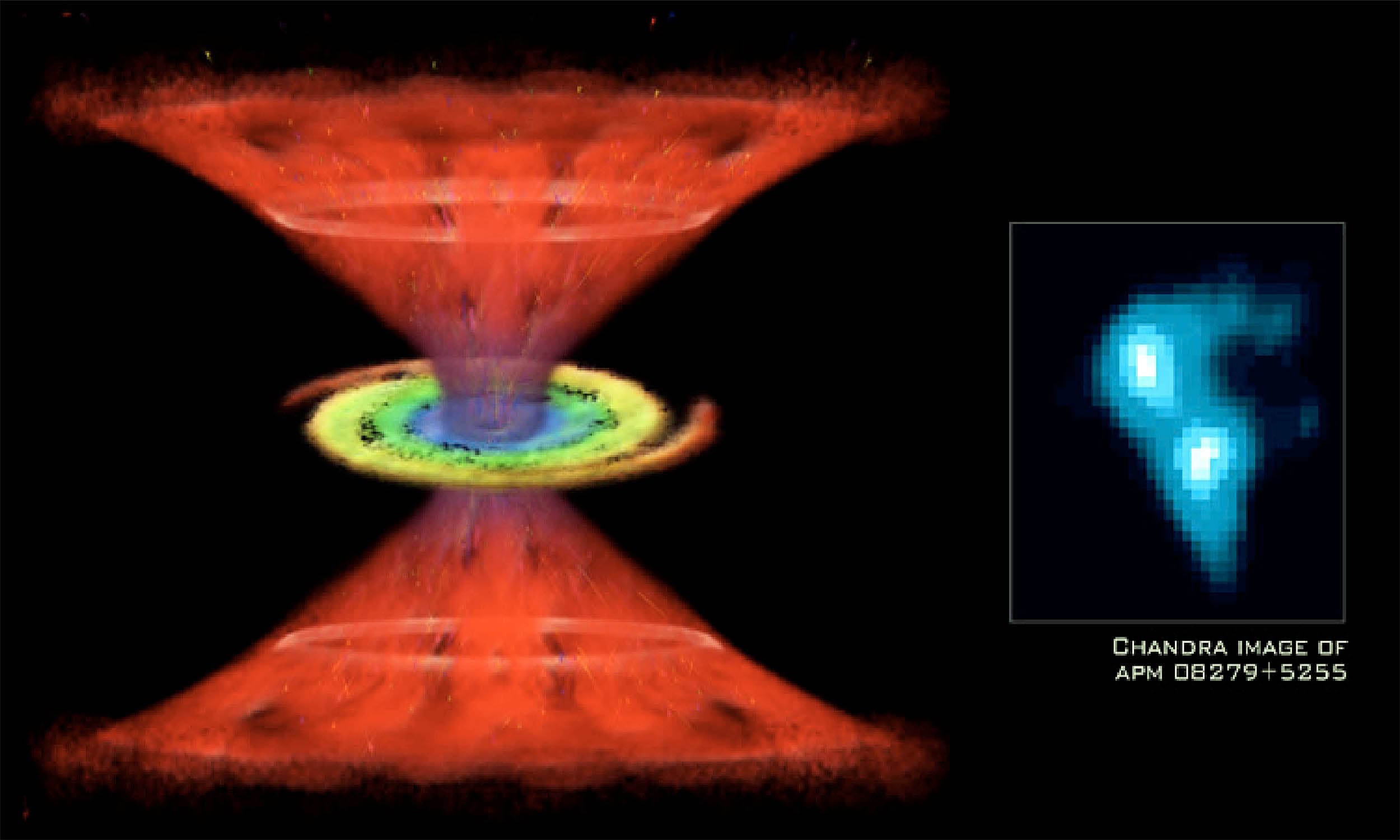
Astronomers enjoy it when the universe throws a curveball, and this object does exactly that. Working in two teams, they have found the largest, most distant stash of water ever seen in the cosmos. APM 08279+5255 is a quasar an active galaxy whose central supermassive black hole feeds on gas and releases huge amounts of light.
It contains about 140 trillion times the amount in all of Earth’s oceans swaddling a ravenous, supermassive black hole (a quasar) more than 12 billion light-years away.
Its measured redshift is z ≈ 3.87, so we see it as it looked more than ten billion years ago, when galaxies and black holes were still growing up.
For an object that distant, it looks unusually bright in both visible light and the far‑infrared. That suggests that more than one physical process is boosting the light we record.
The environment around this quasar is very unique in that its producing this huge mass of water, said Matt Bradford, a scientist at NASAs Jet Propulsion Laboratory in Pasadena, Calif.
Its another demonstration that water is pervasive throughout the universe, even at the very earliest times. Bradford leads one of the teams that made the discovery.
A second team, led by Dariusz Lis senior research associate in physics at Caltech and deputy director of the Caltech Submillimeter Observatory used the Plateau de Bure Interferometer in the French Alps to spot water.
They serendipitously detected water in APM 8279+5255 via a single spectral signature. Bradford’s team later picked up multiple water lines, which revealed far more detail including the cloud’s enormous mass.
Redshift helps us read the expanding universe. As space itself stretches, light traveling through it stretches too, shifting toward redder colors.
A redshift near 3.9 puts this quasar in the early universe and lets us estimate a look‑back time of over ten billion years. At that epoch, many galaxies were small, dusty, and faint.
Yet APM 08279+5255 breaks the pattern. Its brilliance across the spectrum tells us that some extra “help” must be amplifying its light before it reaches us.
This quasar belongs to the BAL class short for broad absorption line quasar. In practice, that means its spectrum shows wide dips carved out by fast winds.
Gas races outward from the central region at thousands of kilometers per second and absorbs some of the light behind it.
These winds give us a direct view of feedback: water vapor and other material falling toward the black hole can also launch outward, heating and pushing the surrounding gas. That activity shapes how stars form and how the host galaxy evolves.
How energetic is APM 08279+5255?
Initial estimates put the bolometric luminosity the total power across all wavelengths in the range of several quadrillion times the Sun’s luminosity.
Numbers like that demand a second look. Is the quasar really that powerful, or does something along the line of sight boost its apparent brightness?
When objects look too bright for their distance, astronomers check for gravitational lensing. Massive objects bend space‑time and can magnify background sources.
If a galaxy sits almost directly between us and a distant quasar, the quasar’s light can get amplified or even split into multiple images.
Images of APM 08279+5255 show a source that is not perfectly point‑like; it looks slightly elongated, as if two close images blur together.
A simple, first‑order lens model what you might call a “starter” model for a plausible foreground galaxy suggests the optical light could be magnified by a factor of about 40.
That is a large boost. Even after we correct for this and demagnify the observed flux, the quasar still shines with tremendous intrinsic power at least on the order of one hundred trillion Suns.
Lensing does not create energy; it redirects and concentrates it. The black hole and its fuel already produce prodigious power, and the lens allows more of that power to reach our detectors.
Brightness alone never tells the whole story, so we compare the quasar’s light at many wavelengths. The spectral energy distribution (SED) shows strong output in the far‑infrared as well as the optical.
That pattern signals a dust‑rich system: dust near the active nucleus soaks up energetic radiation and re‑emits it at longer wavelengths.