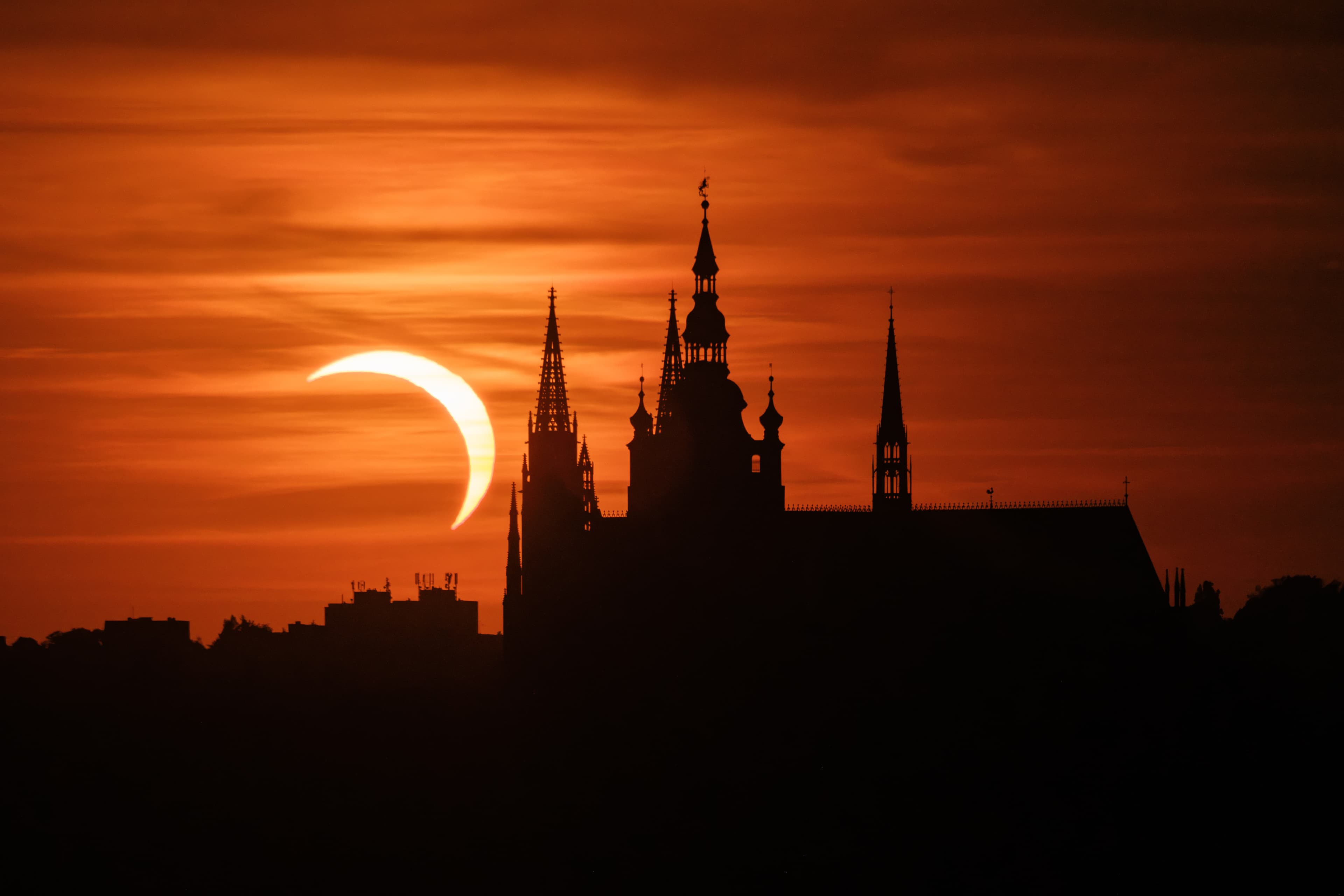
A striking blood moon will close out the summer sky on Aug. 27, when a lunar eclipse sends 96% of the full moon into Earth’s shadow. The event will be visible across large parts of Europe, Africa, North and South America, and western Asia. The eclipse will unfold over more than five hours, although viewing conditions will vary by location. In the United States, the moon will rise already eclipsed in many areas, making a clear horizon especially important.
The August Blood Moon
A lunar eclipse happens when Earth moves between the sun and the full moon, blocking sunlight from directly reaching the lunar surface. The moon does not simply disappear. During the eclipse, sunlight passing through Earth's atmosphere loses much of its blue light through scattering and absorption. Red wavelengths remain, giving the moon its distinctive orange-red glow. That is why a total lunar eclipse is commonly called a blood moon.
The Eclipse Timeline
The full event will last five hours and 38 minutes, beginning on the evening of Aug. 27 and continuing into the early hours of Aug. 28. The eclipse will move through three stages. The penumbral phase will last one hour and 10 minutes, followed by a partial phase lasting one hour and 39 minutes. The maximum phase will also last one hour and 39 minutes, with the moon 96% obscured. Maximum eclipse will occur at 12:12 a.m. ET. The moon will then move back through the partial and penumbral phases before leaving Earth's shadow.
Best Viewing Conditions in the U.S.
In the United States, the eclipse will begin at 9:23 p.m. ET on Aug. 27 and end at 3:01 a.m. ET on Aug. 28. Because the moon will be close to the horizon in many locations, buildings, trees and other obstacles could block the view. A flat location with a clear sight line may offer the best chance of seeing the eclipse. Observers across the Americas will see the moon rise while the eclipse is already underway. Elsewhere, the moon may set before the full event is finished or rise after the eclipse has begun.
Why Lunar Eclipses Do Not Happen Every Month
The moon completes an orbit around Earth in about 27.3 days, so it might seem as though a lunar eclipse should occur every month. The catch is the moon's orbital tilt. Its path around Earth is tilted by about five degrees compared with Earth's orbit around the sun. Because of that tilt, the moon often passes above or below Earth's shadow during a full moon. An eclipse occurs only when the alignment is right. Lunar eclipses happen roughly two to three times a year, but total lunar eclipses make up only about 29% of those events.
The Eclipse Season Connection
The August lunar eclipse arrives during an eclipse season, a period when the positions of the sun, Earth and moon create opportunities for both solar and lunar eclipses. A total solar eclipse occurred Aug. 12, visible in Spain, Portugal, Iceland, Greenland and Siberia. The lunar eclipse follows just over two weeks later. Eclipse seasons occur twice a year, during periods when the moon reaches points in its orbit where the necessary alignment becomes possible.
What Comes Next
Skywatchers who miss the August event will have a long wait for another total lunar eclipse. The next one is not expected until Dec. 31, 2027, into Jan. 1, 2028. That makes the Aug. 27 blood moon a particularly notable summer finale. For viewers in the right locations, the combination of a low full moon, Earth's shadow and the resulting red glow should make for a memorable night in the sky.
FAQ
When is the 2026 blood moon lunar eclipse?
The lunar eclipse begins on the evening of Aug. 27, 2026, and continues into the early hours of Aug. 28.
How much of the moon will be eclipsed?
About 96% of the moon's face will be covered by Earth's shadow during the maximum phase.
What time does the lunar eclipse start in the U.S.?
In the United States, the eclipse will begin at 9:23 p.m. ET on Aug. 27 and end at 3:01 a.m. ET on Aug. 28.
Why does the moon turn red during an eclipse?
Sunlight passing through Earth's atmosphere loses much of its blue light through scattering and absorption. Red wavelengths remain and illuminate the moon, creating the orange-red appearance.
Where will the August 2026 lunar eclipse be visible?
The eclipse will be visible in Europe, Africa, North and South America, and western Asia, although local viewing times will differ.