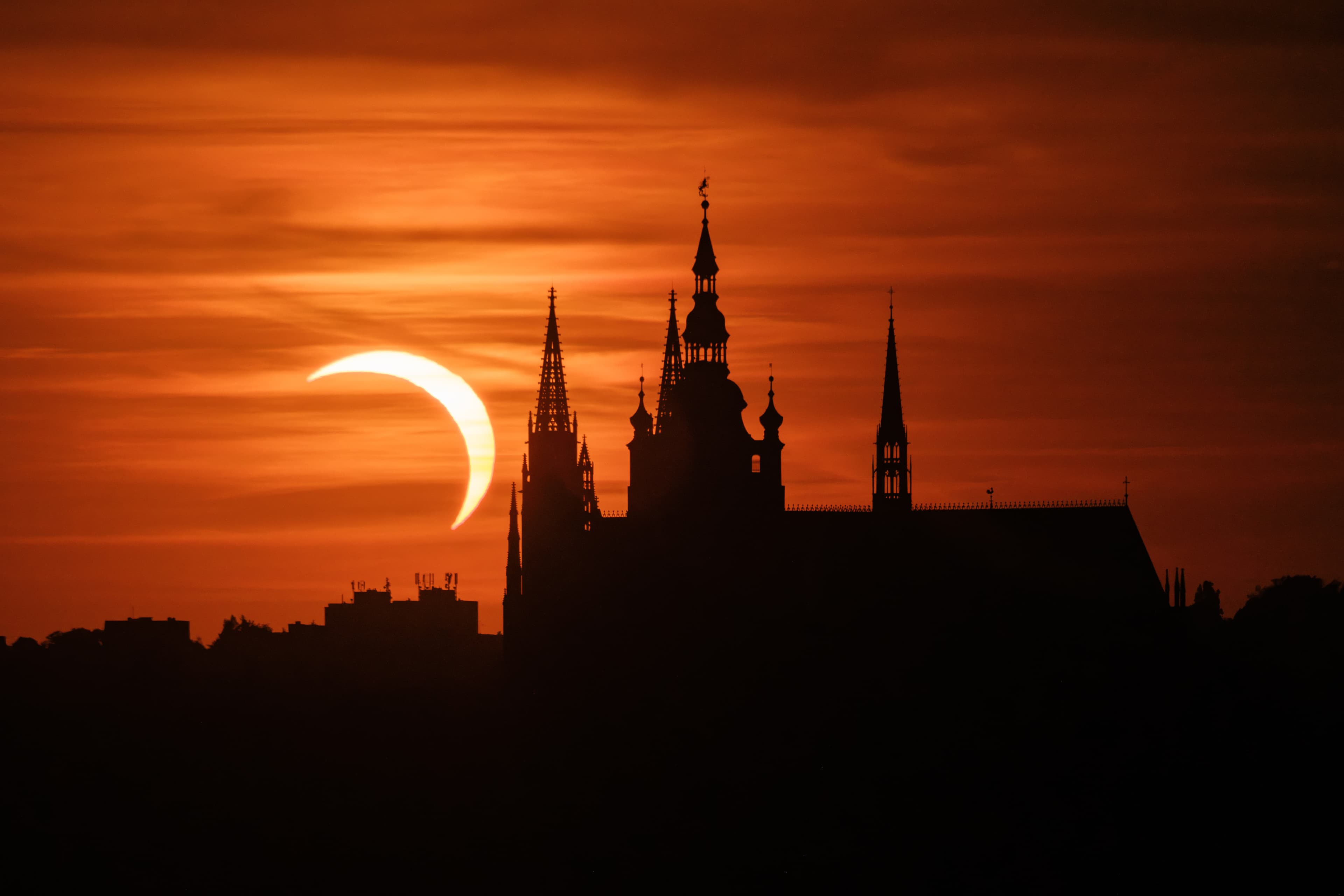
Where Totality Hit
The moon's shadow traced an unusual east-to-west arc, starting over a remote slice of northern Russia, crossing eastern Greenland and western Iceland, then sweeping over the Atlantic into northern Spain and the extreme northeast of Portugal before ending over the Mediterranean.
The longest darkness, about 2 minutes and 18 seconds, occurred just off Iceland's west coast, according to eclipse path data. By the time the shadow reached Spain shortly before sunset, totality had shrunk to roughly a minute in most places.
Cities inside the path included A Coruña, Bilbao, Zaragoza, Valencia and Palma. Madrid and Barcelona sat just outside it, close enough for a deep partial eclipse but not the full show.
A Century of Waiting in Spain
Spanish cities and towns along the path filled with crowds carrying lawn chairs, umbrellas and eclipse glasses. Authorities had expected at least an additional half-million visitors, and hotel demand in northern cities such as A Coruña, Bilbao and Santiago de Compostela surged in the weeks before the event.
The celebration came against a tense backdrop. Spain has been battling scorching summer heat and wildfires, and officials ran a broad public safety campaign around the eclipse, from eye protection to traffic management on rural roads.
In Iceland, it was the island's first total solar eclipse since 1954, and the first visible from Reykjavík in centuries. Clouds and rain threatened viewing in parts of the country during the afternoon, though the weather there is famous for turning quickly.
What Americans Saw
The United States sat far from the path of totality, but the eclipse still took a visible bite out of the sun across the northern half of the country, from Alaska to the East Coast.
According to NASA figures, Fairbanks, Alaska saw the deepest coverage at 37 percent, with Anchorage at 28 percent. On the East Coast, Bangor, Maine reached 24 percent and Boston 16 percent. New York City peaked at 9 percent at 1:54 p.m. Eastern, and Philadelphia at 7 percent. Washington, D.C. managed just 4 percent.
Elsewhere in Europe, outside the band of totality, the partial eclipse was dramatic: cities like Paris and Berlin saw most of the sun covered, and much of Ireland, Great Britain, France and Italy watched more than 90 percent of the solar disk disappear.
What Comes Next
Skywatchers will not have to wait long. On August 2, 2027, another total solar eclipse crosses southern Spain, North Africa and the Middle East, according to the European Space Agency. An annular "ring of fire" eclipse follows on January 26, 2028, visible from South America, Portugal and Spain.
For the United States, the wait is longer. The next total solar eclipse over the Lower 48 does not arrive until the 2040s, which makes the memory of April 2024, and the partial glimpse this week, the closest thing for now.
Frequently Asked Questions
- Where was the August 12, 2026 total solar eclipse visible?
- The path of totality crossed northern Russia, eastern Greenland, western Iceland, northern Spain and a tiny corner of northeastern Portugal. Most of Europe, plus parts of the northern US and Canada, saw a partial eclipse.
- How long did totality last?
- Up to 2 minutes and 18 seconds at the point of greatest eclipse, just off Iceland's west coast. In Spain, totality lasted about one to two minutes depending on location.
- How much of the sun was covered in New York City?
- About 9 percent at the peak, which occurred at 1:54 p.m. Eastern, according to NASA. Boston saw 16 percent and Bangor, Maine about 24 percent.
- Why was this eclipse a big deal for Spain?
- It was Spain's first total solar eclipse in more than a century, and authorities expected at least half a million extra visitors along the path.
- When is the next total solar eclipse?
- August 2, 2027, when totality crosses southern Spain, North Africa and the Middle East.