Starship’s heavy lift capacity, in orbit refueling, and potential aerobraking role could significantly accelerate a long-awaited mission to Uranus.
The solar system’s ice giants continue to rank among the most compelling targets for planetary science. Uranus has attracted renewed attention in recent years, particularly after the 2022 Decadal Survey from the National Academies identified it as the top priority for a flagship mission.
Even so, no fully developed mission plan is yet in place for the launch opportunities expected in the 2030s. That delay may ultimately prove useful, as emerging launch technologies could significantly reshape how such a mission is designed.
Following a series of increasingly successful test flights, SpaceX’s Starship has entered the conversation. In a paper presented at the IEEE Aerospace Conference, researchers at MIT explored how this more powerful launch system could influence plans for the proposed Uranus Orbiter and Probe (UOP) recommended by the Decadal Survey.
Despite its scientific importance, Uranus has received remarkably little direct exploration. The only spacecraft to visit was Voyager 2, which flew past the planet four decades ago without entering orbit. Neither Uranus nor Neptune has ever hosted an orbiter or sustained mission, making them the only planets in the solar system that have not been examined up close over an extended period.
The limited exploration is not due to a lack of scientific curiosity. Uranus presents several enduring mysteries. The planet rotates on its side, possesses an unusually tilted and offset magnetic field, and is surrounded by a diverse system of moons that may conceal subsurface oceans beneath icy crusts.
In addition, planets similar in size and composition to Uranus are among the most frequently detected exoplanets in our galaxy. A dedicated mission to Uranus would therefore not only clarify the dynamics of our own solar system but also deepen our understanding of distant planetary systems.
The problem is that Uranus is far away. It’s 19 times farther from the Sun than Earth is, and it took Voyager more than nine and a half years to reach the system, and that probe didn’t even attempt to slow down to stay in it. Previous calculations done during the decadal survey used a Falcon Heavy booster and several gravitational assists from other planets, but ultimately took over 13 years to reach Uranus.
That’s time the mission has to be maintained, both operationally and financially, and also time that critical personnel might move on, or, if recent NASA history is any guide, furloughed. So getting UOP to its final destination faster is inarguably better.
Fraser discusses the difficulties in planning a mission to Uranus.
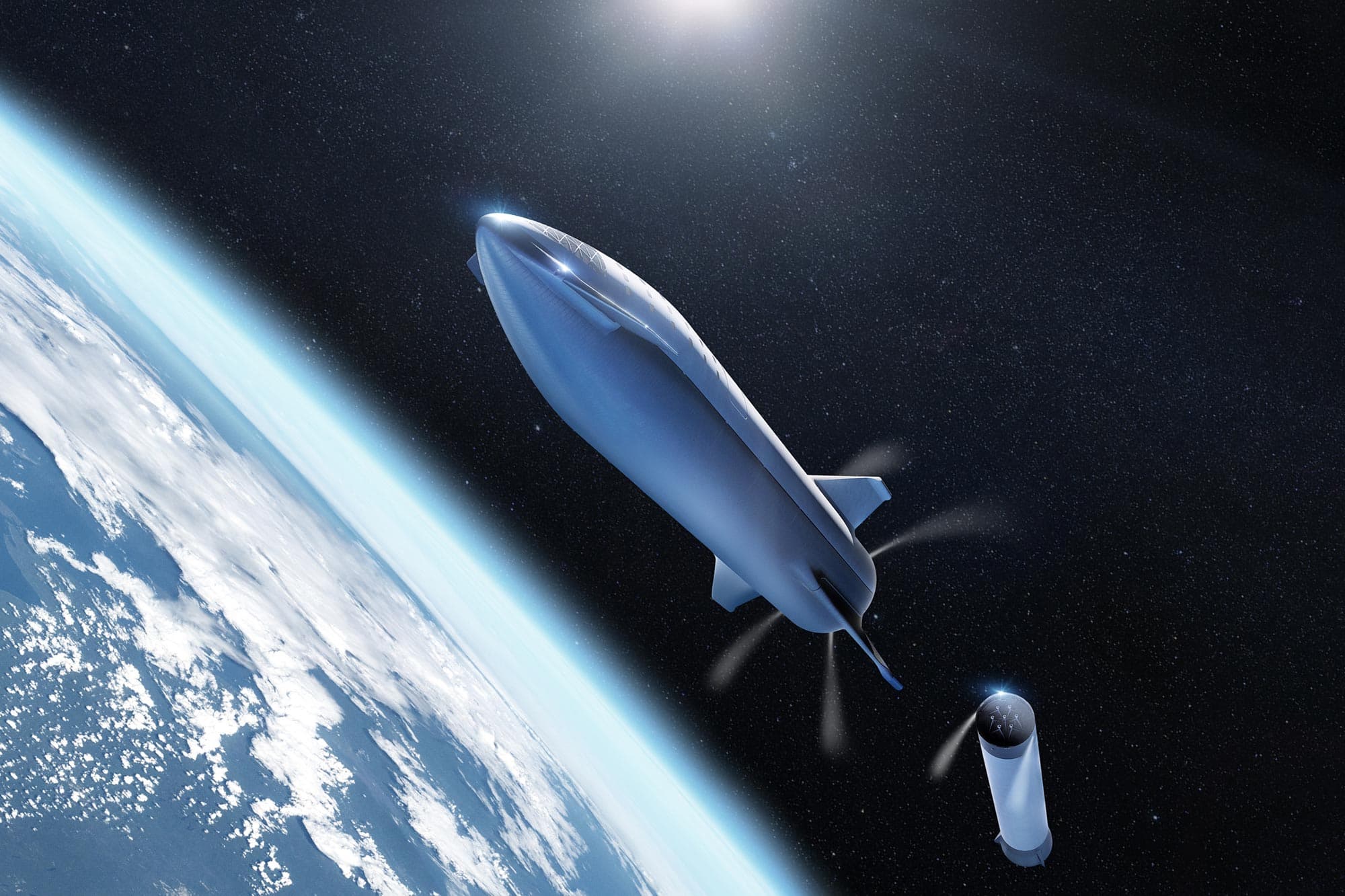
Enter Starship. Despite a series of testing mishaps earlier in the year, SpaceX’s game-changing rocket system is finally coming into its own with a successful test earlier this week. Assuming it continues its positive trajectory, it could be ready for regular use by the end of the decade, making it a viable option for use as UOP’s launch vehicle.
In addition to its increased lifting capability, two other aspects of Starship’s capabilities make it interesting for a UOP mission. First is its ability to refuel in orbit. SpaceX has made sure to design the system so that it can store and take fuel in orbit, allowing it to reach destinations much faster than other systems, whose fuels has to be lifted exclusively from the ground. While this capability hasn’t been demonstrated yet, further tests of Starship will undoubtedly begin to do so, unlocking whole new speed possibilities for probes to the furthest reaches of the solar system.
The other capability is to use Starship itself as an aerobraking shield. In the paper, the researchers examined the idea of using Starship, which itself is already designed to deal with the heat of reentry on both Earth and Mars, as a shield against the heat caused by aerobraking in Uranus’ atmosphere. They found that, with a little modification, the basic principle could work. Instead of separating from the probe once its boost was provided, in this case the Starship would accompany UOP to the Uranus system, using its thermal protective system as an air brake to slow the probe down from its interplanetary speed and remain in the system.
From calculations in the paper, the combination of being refueled in space and also using Starship as an aerobrake could cut the time to the Uranus system in half, to six and a half years. It also wouldn’t require any gravitational assists from any other planets on the way. Even with the added cost of taking a Starship along for the ride, this would dramatically decrease the operational cost of the mission by literally halving its travel time.
With all that being said, UOP is still a far way from reality, nor is Starship ready for aerobraking a probe into an ice giant’s atmosphere yet. Despite being the highest priority to come out of the decadal survey, it’s unclear whether UOP will even get a funding green light at this point, and given the current turmoil and NASA it will likely remain unclear for some time.
If we miss the launch windows in the 2030s, the next opportune launch window would be the mid-2040s, meaning it would be almost 70 years between missions to this most interesting of worlds. All planetary science and space exploration enthusiasts should hope that the organizations that would potentially support such a mission get their act together and support a trip back there, whether it uses Starship or not.
Reference: “Starship as an Enabling Option for a Uranus Flagship Mission” by Daniel Gochenaur, Chloe Gentgen and Olivier de Weck, 01-08 March 2025, 2025 IEEE Aerospace Conference. DOI: 10.1109/AERO63441.2025.11068722
Adapted from an article originally published in UniverseToday.