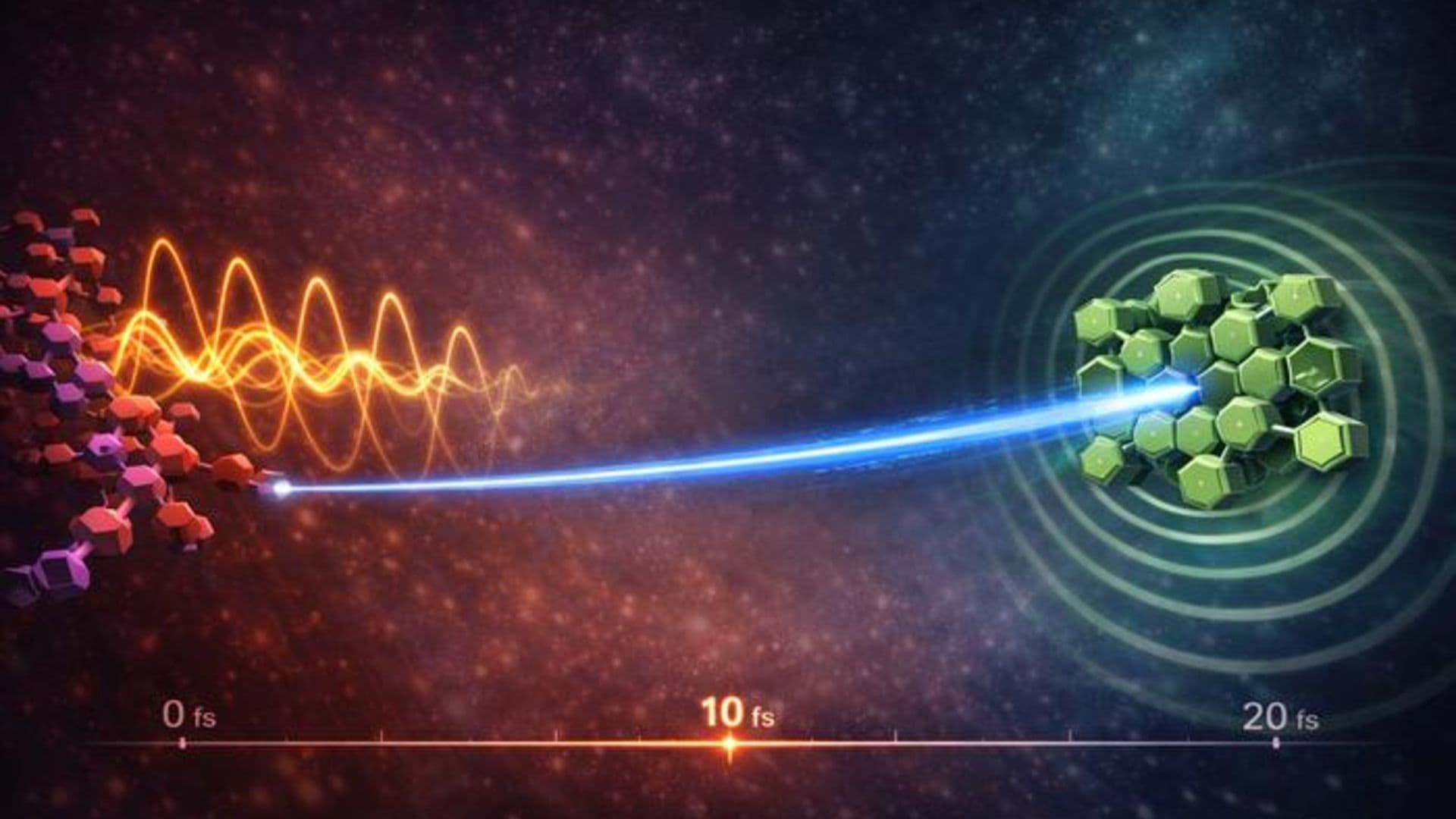
In a groundbreaking study published March 5 in Nature Communications, physicists have achieved a remarkable feat: they have accelerated the transfer of electrons across solar materials to an unprecedented speed of quadrillionths of a second. This innovation holds the potential to significantly enhance the efficiency of organic solar cells, which could revolutionize the renewable energy landscape and address growing concerns over rising energy costs and climate change.
- Physicists have discovered a method to 'catapult' electrons across solar materials in quadrillionths of a second.
- This breakthrough could lead to more efficient organic solar cells, reducing the cost of solar energy.
- The study reveals that molecular vibrations play a crucial role in accelerating electron transfer.
- The findings challenge conventional wisdom about charge transfer in solar cells and open new avenues for material design.
- This research could pave the way for more sustainable and cost-effective energy solutions.
The Race for Efficient Solar Energy Conversion
The quest for efficient solar energy conversion has been ongoing for decades, driven by the need to reduce reliance on fossil fuels and mitigate the impacts of climate change. Organic solar cells, which use carbon-based molecules instead of silicon, have long been touted as a promising alternative to traditional solar cells due to their potential for lower production costs and greater flexibility. However, their efficiency has lagged behind silicon-based counterparts, limiting their widespread adoption.
Understanding Organic Solar Cells: How They Work
Organic solar cells operate on the principle of converting sunlight into electrical energy through the interaction of electron donors and acceptors. When sunlight hits the cell, it generates an exciton, or an electron-hole pair. These excitons split at the interface between the donor and acceptor materials, generating an electrical current. However, the efficiency of this process is often hindered by the need for strong electronic coupling and a large energy difference between the donor and acceptor molecules, which can limit the voltage output of the device.
The Electron 'Catapult': A Breakthrough in Charge Transfer
The recent study, led by researchers from the University of Cambridge, has revealed a new mechanism for ultrafast charge transfer in organic solar cells. By using a short laser pulse to excite an electron donor, a polymer called TS-P3, and then measuring the system's changes with a different laser, the team observed charge transfer occurring in just 18 femtoseconds—about as fast as an individual molecule vibrates. This timescale is significantly faster than other known systems without strong driving forces, which typically take 100 to 200 femtoseconds, and much faster than conventional systems that can take ten to a thousand times longer.
The Role of Molecular Vibrations
The researchers found that molecular vibrations in the polymer donor molecule played a crucial role in accelerating the electron transfer. These vibrations acted like a molecular catapult, launching the electron across the junction to the acceptor molecule with remarkable speed. When the electron arrived, it triggered overlapping vibrations in the acceptor molecule, further facilitating the charge transfer process. This discovery challenges the conventional understanding of charge transfer in solar cells and opens new possibilities for material design.
Seeing it happen on this timescale within a single molecular vibration is extraordinary. Instead of drifting randomly, the electron is launched in one coherent burst. The vibration acts like a molecular catapult. The vibrations don't just accompany the process, they actively drive it.
Implications for Solar Energy Technology
The findings of this study have far-reaching implications for the development of more efficient solar energy technologies. By understanding and harnessing the power of molecular vibrations, scientists can design new materials that optimize the charge transfer process, leading to more efficient organic solar cells. This could result in lower production costs and greater flexibility, making solar energy more accessible and affordable for a wider range of applications.
The Future of Organic Solar Cells
As the world continues to seek sustainable energy solutions, the development of efficient organic solar cells could play a pivotal role. With their potential for lower production costs and greater flexibility, organic solar cells could revolutionize the renewable energy landscape. The discovery of the electron 'catapult' mechanism represents a significant step forward in this endeavor, offering new strategies for designing materials that maximize energy efficiency and minimize environmental impact.
The Science Behind the Discovery
The research team, led by Pratyush Ghosh and Akshay Rao from the University of Cambridge, conducted a series of laser experiments to observe the charge transfer process in organic solar cells. By exciting the electron donor with a short laser pulse and measuring the system's changes with a different laser, they were able to capture the ultrafast charge transfer in real-time. The results of their study, published in Nature Communications, provide valuable insights into the mechanisms that control the speed of charge transfer and establish new strategies for designing more efficient organic solar cells and materials.
Key Contributors and Their Expertise
Pratyush Ghosh, a researcher at the University of Cambridge, was instrumental in conducting the laser experiments and analyzing the data. His expertise in ultrafast spectroscopy and molecular dynamics has been crucial in unraveling the complex processes involved in charge transfer. Akshay Rao, a physicist at Cambridge, co-authored the study and provided valuable insights into the design of materials that can harness molecular vibrations for efficient charge transfer. The research team also included contributions from other renowned institutions, highlighting the collaborative nature of this groundbreaking discovery.
The study, titled Vibronically assisted sub-cycle charge transfer at a non-fullerene acceptor heterojunction, was published in Nature Communications and is available for further reading.
Frequently Asked Questions
- What are organic solar cells and how do they work?
- Organic solar cells use carbon-based molecules to convert sunlight into electricity. They operate by generating excitons when sunlight hits the cell, which then split at the interface between the donor and acceptor materials to produce an electrical current.
- How does the electron 'catapult' mechanism improve solar energy conversion?
- The electron 'catapult' mechanism accelerates the transfer of electrons across solar materials in quadrillionths of a second, significantly improving the efficiency of charge transfer and potentially leading to more efficient organic solar cells.
- What are the potential applications of this discovery?
- This discovery could lead to the development of more efficient and cost-effective organic solar cells, making solar energy more accessible and affordable for a wider range of applications, from residential to industrial settings.