For decades, astronomers have theorized that the universe’s most massive stars meet their end in explosions so cataclysmic they erase themselves from existence. Now, an international team of astrophysicists says gravitational wave data from the Laser Interferometer Gravitational-Wave Observatory (LIGO) has provided the first observational evidence supporting this radical scenario. Their analysis, published in Nature, reveals a stark absence of black holes between 45 and 130 times the mass of our Sun—a ‘mass gap’ that aligns with predictions of pair-instability supernovae, where stars annihilate entirely in a flash of energy, leaving no remnant behind.
- Gravitational wave data from LIGO shows black holes rarely exceed 45 solar masses, confirming pair-instability supernovae theory.
- The 'mass gap' occurs because stars above a certain threshold are destroyed entirely in pair-instability supernovae, preventing black hole formation.
- Black holes forming from previous mergers (second-generation black holes) often exceed the gap, but first-generation black holes do not.
- The discovery helps validate models of stellar death and could refine our understanding of how the universe’s heaviest elements are forged.
How Pair-Instability Supernovae Create the Black Hole Mass Gap
At the heart of this discovery lies a violent stellar process predicted by theory but rarely observed directly: pair-instability supernovae. These explosions occur in stars so massive—typically between 130 and 250 times the mass of the Sun—that their cores become dense enough to spontaneously convert high-energy photons into matter and antimatter pairs. This interaction drains the star of the radiation pressure that normally counteracts gravitational collapse, triggering a runaway fusion reaction. Within seconds, the star’s oxygen core ignites, releasing energy equivalent to the output of an entire galaxy over a period of milliseconds. The resulting explosion is so powerful that it obliterates the star entirely, leaving no black hole or neutron star behind.
The Physics Behind the Explosion
The mechanism begins in a star’s core, where temperatures exceed 1 billion degrees. Under these conditions, gamma-ray photons—packets of light—carry so much energy that they can spontaneously convert into electron-positron pairs, a process described by Einstein’s equation E=mc². As photons disappear, the outward pressure they exert weakens, allowing gravity to compress the core. If the star’s mass is sufficient, this compression triggers the fusion of oxygen nuclei in less than a second. The energy released is unimaginable: a single pair-instability supernova can outshine an entire galaxy for weeks. For stars in the 130–250 solar mass range, the explosion is total. Lighter stars may survive, shedding their outer layers in a less violent event, but the heaviest stars leave no trace.
Why the Mass Gap Matters for Black Hole Formation
Black holes form when massive stars collapse under their own gravity at the end of their life cycles. Typically, the more massive the star, the larger the resulting black hole. But pair-instability supernovae disrupt this relationship. Stars in the 130–250 solar mass range are expected to explode completely, preventing any black hole from forming. This creates a gap in the mass distribution of black holes—one that LIGO’s data now appears to confirm. The study’s authors estimate the lower bound of this gap at roughly 45 solar masses, with an upper bound near 130 solar masses, though the latter remains less certain due to limited observations.
LIGO’s Gravitational Wave Breakthrough: Detecting the Invisible
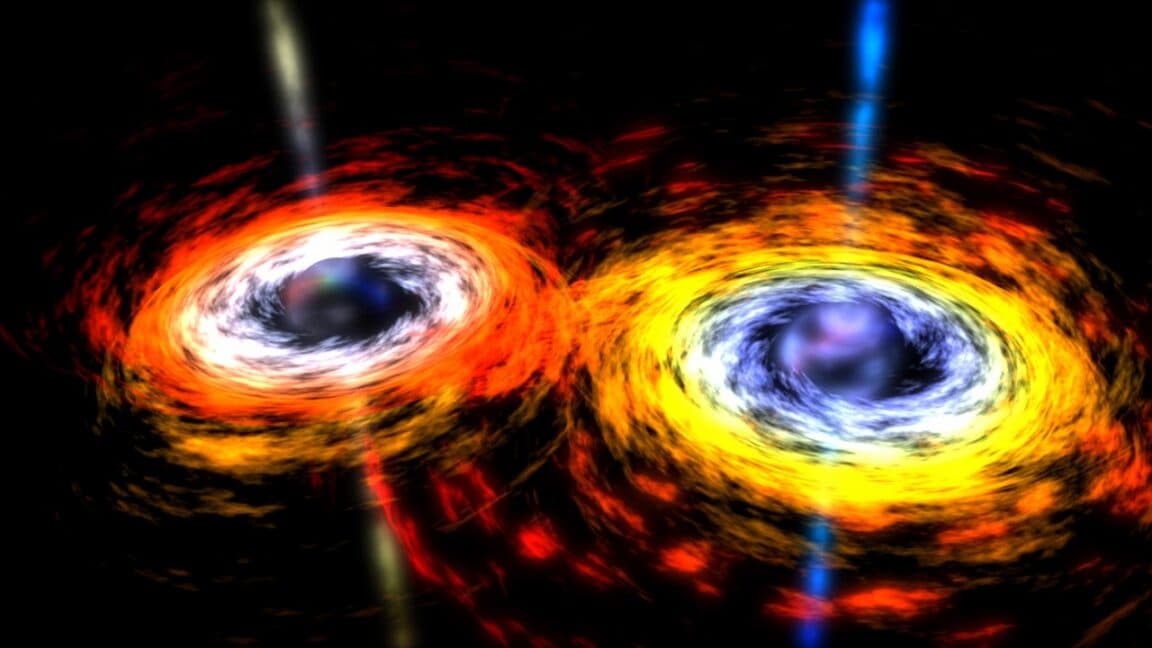
Since its first detection in 2015, LIGO has revolutionized our understanding of the cosmos by capturing ripples in spacetime generated by violent cosmic events, such as black hole mergers. These mergers emit gravitational waves that travel unimpeded across the universe, carrying information about the masses and spins of the black holes involved. By analyzing over 100 merger events recorded by LIGO and its European counterpart, Virgo, the research team identified a consistent pattern: the smaller black hole in each merger rarely exceeded 45 solar masses. This pattern held even when one of the black holes was a second-generation object—formed from the merger of two smaller black holes—which could theoretically exceed the gap.
First-Generation vs. Second-Generation Black Holes
The team categorized black holes into two generations based on their formation history. First-generation (G1) black holes are born directly from stellar collapse and are expected to fall within the mass gap if their progenitor stars were subject to pair instability. Second-generation (G2) black holes form when two smaller black holes merge, often resulting in a more massive remnant. Because these mergers occur in dense stellar environments like globular clusters, G2 black holes can grow larger than the gap’s upper limit. However, the researchers found that even when a G2 black hole was involved, the smaller black hole in the pair—almost always a G1—was constrained by the 45-solar-mass limit.
The Spin Mystery: Why More Massive Black Holes Spin Faster
Another clue emerged from analyzing the spins of the black holes involved in these mergers. The more massive black hole in each pair typically exhibited high spin rates, a phenomenon consistent with the idea that these objects formed from previous mergers. When two black holes spiral toward each other and collide, their combined angular momentum is transferred to the new, larger black hole, imparting a rapid spin. This spin signature was absent in the smaller black holes, which were more likely to have a low spin rate—further evidence that they formed directly from stellar collapse rather than a merger. Independent analyses of spin data corroborated the 45-solar-mass limit, reinforcing the team’s conclusions.
The Role of Stellar Environments: Why Some Black Holes Escape the Gap
The birthplaces of these black holes—dense stellar clusters like globular clusters—play a critical role in shaping their mass distribution. Stars in these environments are more likely to interact, leading to the formation of binary systems that eventually merge. However, the energy released during a merger can impart a powerful kick to the resulting black hole, sometimes ejecting it from the cluster entirely. This dynamic helps explain why second-generation black holes are rarer than first-generation ones. The team estimates that fewer than 1% of all mergers involve two second-generation black holes (G2-G2), making them an outlier in the broader population.
What the Future Holds: Narrowing the Gap with More Data
While the evidence for the mass gap is compelling, the researchers caution that their estimates come with significant uncertainty. The error margins on the 45-solar-mass limit are roughly ±5 solar masses, meaning the actual cutoff could lie anywhere between 40 and 50 solar masses. Fortunately, LIGO and Virgo are continuing to collect data, with upgrades to the detectors expected to improve their sensitivity. Each new merger detected could refine the mass gap’s boundaries, offering deeper insights into the physics of pair-instability supernovae. Future observations may also reveal whether the upper limit of the gap—around 130 solar masses—holds up under scrutiny or if additional mechanisms are at play.
Broader Implications: From Stellar Death to Element Formation
The confirmation of pair-instability supernovae has far-reaching implications beyond black hole formation. These explosions are thought to be cosmic factories for heavy elements like gold, platinum, and uranium. Unlike typical supernovae, which disperse material into space, pair-instability events are so energetic that they may synthesize heavier elements in quantities not seen elsewhere in the universe. Understanding where and how these explosions occur could reshape our models of galactic chemical evolution. Additionally, the mass gap data could inform simulations of galaxy formation, where the presence or absence of massive black holes influences the dynamics of star clusters and the interstellar medium.
Challenges and Open Questions
Despite the progress, several mysteries remain. The most glaring is the lack of direct observations of pair-instability supernovae themselves. While astronomers have identified candidate events—such as the 2006 supernova SN 2006gy, which flared with unusual brightness—they lack definitive proof that these explosions match theoretical models. Another puzzle is the upper end of the mass gap. The study’s authors note that only one black hole in LIGO’s data exceeds 100 solar masses, leaving the 130-solar-mass limit poorly constrained. Future detections, particularly of mergers involving extremely massive black holes, could provide the missing pieces.
The LIGO Collaboration: A Global Effort to Unlock Cosmic Secrets
The research published in Nature is the result of a collaboration between scientists from the LIGO Scientific Collaboration, Virgo Collaboration, and KAGRA, Japan’s gravitational wave observatory. Since its inception in the 1990s, LIGO has been a global endeavor, with over 1,500 scientists from more than 20 countries contributing to its success. The observatory’s two detectors—one in Livingston, Louisiana, and another in Hanford, Washington—work in tandem to capture gravitational waves with unprecedented precision. Virgo, located near Pisa, Italy, and KAGRA, buried deep in the Kamioka mine, provide additional coverage, enhancing the network’s ability to pinpoint the sources of these cosmic ripples.
What’s Next for Gravitational Wave Astronomy?
The discovery of the mass gap is just the latest in a series of breakthroughs enabled by gravitational wave astronomy. With planned upgrades to LIGO and Virgo—collectively known as Advanced LIGO+ and Advanced Virgo+—scientists expect to detect black hole mergers at even greater distances, potentially uncovering rare events that could challenge existing theories. Additionally, next-generation observatories like the Laser Interferometer Space Antenna (LISA), set to launch in the 2030s, will open new windows into the universe by detecting lower-frequency gravitational waves. These advancements could reveal the formation of supermassive black holes or even probe the earliest moments of the universe.
Frequently Asked Questions
- What is a pair-instability supernova?
- A pair-instability supernova occurs in the most massive stars, where photons in the core spontaneously convert into electron-positron pairs, destabilizing the star. This triggers a runaway fusion reaction that obliterates the star entirely, leaving no remnant black hole or neutron star behind.
- How does LIGO detect black hole mergers?
- LIGO uses laser interferometers to measure tiny distortions in spacetime caused by gravitational waves. When two black holes merge, they emit ripples in spacetime that stretch and compress space itself, which LIGO’s detectors can capture with extreme precision.
- Why is there a gap in black hole masses around 45 solar masses?
- The gap arises because stars in a specific mass range are destroyed in pair-instability supernovae, preventing black holes from forming in that range. LIGO’s data shows that black holes below 45 solar masses are common, while those above it are rare until reaching the upper gap limit near 130 solar masses.