Proteins assume complex 3D shapes even faster than does DNA, which is a simpler molecule.
- Katherine Bourzac Katherine Bourzac is a freelance journalist in San Francisco, California.
- Katherine Bourzac is a freelance journalist in San Francisco, California.
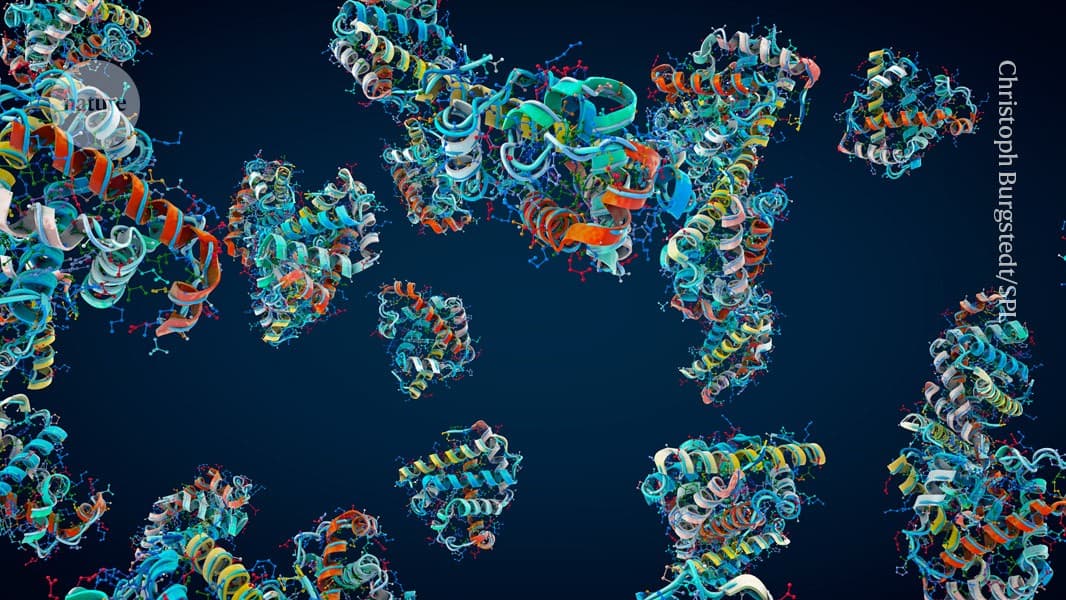
It can take less than a microsecond for proteins (artist’s impression) to fold into their 3D shapes.Credit: Christoph Burgstedt/SPL
Scientists say they have made some of the first direct measurements of how long it takes an individual, ordinary protein to fold. The results were surprising: they found no relationship between a protein’s sequence or size and how long it takes to fold into its 3D shape. And proteins seem to fold more efficiently than do other biomolecules, such as DNA — despite proteins having a more complex set of ingredients. The work was published today in Physical Review Letters1.
‘Dark proteins’ hiding in our cells could hold clues to cancer and other diseases
Proteins’ functions are closely tied to their often-complex 3D structures. Some have specialized pockets or protrusions that allow them to lock onto cell receptors to send messages, for example. But no matter how intricate its ultimate design, a protein starts out as a string of amino acids, “like a long spaghetti noodle” that can fold in any number of ways, says Hoi Sung Chung, a co-author of the paper and biophysicist at the National Institute of Diabetes and Digestive and Kidney Diseases in Bethesda, Maryland. Improperly or incompletely folded proteins can lead to dysfunction, disease or toxicity, so scientists want to understand the details of the folding process.
Identical protein molecules floating in a beaker will all reach their final 3D structure at different times, each making many unsuccessful attempts along the way. Scientists know how much time the overall process of folding, including those unsuccessful attempts, generally takes. But until now, it’s been essentially impossible to measure the duration of the act of folding itself — this sprint is called the transition-path time.
This transition period is very brief and must be studied in individual molecules. So far, scientists have glimpsed the folding process by slowing it artificially or by observing unusual proteins that fold at a slow pace.
Chung’s group captured the transition period directly by improving the time resolution of a method called single-molecule fluorescence spectroscopy. Using this technique, scientists can assess the dynamics of dye-labelled molecules by measuring their fluorescence.
The authors attached a red dye molecule to one end of a string of amino acids, and a green one to the other end. The green dye shines on its own. The red dye is activated only when it receives energy from the green dye. Before the amino-acid string folds, the fluorescence from the green dye is visible. When the string starts folding, the two dye molecules are brought closer together, allowing energy to transfer from the green molecule to the red molecule, which then begins to shine. But this light was still too faint for the scientists to detect, so they used a light-directing device patterned with nanoscale wells that amplify the signal from the dyes. This allowed them to observe the fleeting moment of folding for eight proteins.
- AI protein-prediction tool AlphaFold3 is now more open
- ‘Dark proteins’ hiding in our cells could hold clues to cancer and other diseases
- Five protein-design questions that still challenge AI
- What’s next for AlphaFold and the AI protein-folding revolution
- These ‘movies’ of proteins in action are revealing the hidden biology of cells
AI protein-prediction tool AlphaFold3 is now more open
Five protein-design questions that still challenge AI
What’s next for AlphaFold and the AI protein-folding revolution
These ‘movies’ of proteins in action are revealing the hidden biology of cells
- Why ‘quantum proteins’ could be the next big thing in biology News Feature 03 MAR 26
- Sea-urchin spines generate electrical signals in flowing water News & Views 25 FEB 26
- Whistle while you whinny: researchers identify two sounds straight from the horse’s mouth News 23 FEB 26
Why ‘quantum proteins’ could be the next big thing in biology
Sea-urchin spines generate electrical signals in flowing water
Whistle while you whinny: researchers identify two sounds straight from the horse’s mouth
- DICER cleavage fidelity is governed by 5′-end binding pockets Article 04 MAR 26
- Mechanism of co-transcriptional cap snatching by influenza polymerase Article 04 MAR 26
- Structural basis of RNA-guided transcription by a dCas12f–σE–RNAP complex Article 04 MAR 26
DICER cleavage fidelity is governed by 5′-end binding pockets
Mechanism of co-transcriptional cap snatching by influenza polymerase
Structural basis of RNA-guided transcription by a dCas12f–σE–RNAP complex
- Cavity-altered superconductivity Article 25 FEB 26
- Integrated photonics enabling ultra-wideband fibre–wireless communication Article 18 FEB 26
- Laser writing in glass for dense, fast and efficient archival data storage Article 18 FEB 26
Integrated photonics enabling ultra-wideband fibre–wireless communication
Laser writing in glass for dense, fast and efficient archival data storage