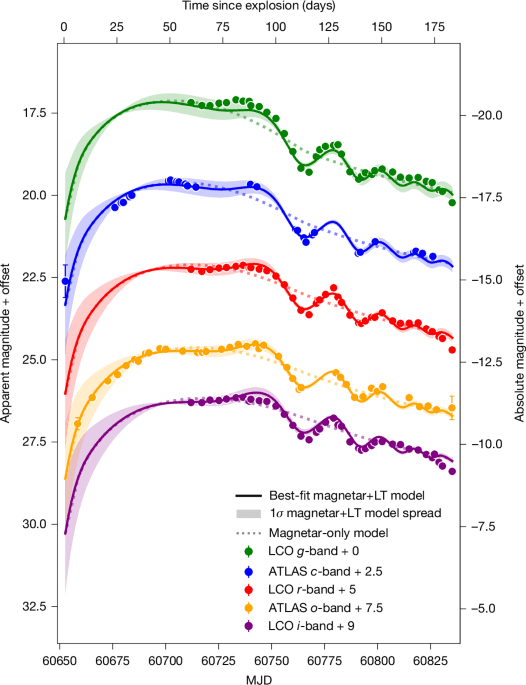
The photometric and spectroscopic datasets analysed during the present study are available in the WISeREP online database (https://www.wiserep.org/object/27312).
The code used to run parts of this analysis as well as sample walkers from MOSFiT are available on Github (https://github.com/jrfarah/24afav_analysis).
- Gal-Yam, A. in Handbook of Supernovae (eds Alsabti, A. W. & Murdin, P.) 195–237 (Springer, 2017).
- Moriya, T. J., Sorokina, E. I. & Chevalier, R. A. Superluminous supernovae. In Supernovae (eds Bykov, A. et al.) Vol. 68, 109–145 (Springer, 2019).
- Quimby, R. Superluminous supernovae. Zenodo https://doi.org/10.5281/zenodo.3478147 (2019).
- Kasen, D. & Bildsten, L. Supernova light curves powered by young magnetars. Astrophys. J. 717, 245–249 (2010).Article ADS Google Scholar
- Woosley, S. E. Bright supernovae from magnetar birth. Astrophys. J. Lett. 719, L204–L207 (2010).Article ADS Google Scholar
- Lunnan, R. et al. Hydrogen-poor superluminous supernovae from the Pan-STARRS1 Medium Deep Survey. Astrophys. J. 852, 81 (2018).Article ADS Google Scholar
- Hosseinzadeh, G. et al. Bumpy declining light curves are common in hydrogen-poor superluminous supernovae. Astrophys. J. 933, 14 (2022).Article ADS Google Scholar
- Chen, Z. H. et al. The hydrogen-poor superluminous supernovae from the Zwicky Transient Facility Phase I survey. II. Light-curve modeling and characterization of undulations. Astrophys. J. 943, 42 (2023).Article ADS Google Scholar
- Chatzopoulos, E. & Tuminello, R. A systematic study of superluminous supernova light-curve models using clustering. Astrophys. J. 874, 68 (2019).Article ADS CAS Google Scholar
- Kumar, A. et al. GOTO Transient Discovery Report for 2024-12-27. Transient Name Server Discovery Report, No. 2024-5091 (2024).
- de Wet, S., Wichern, H., Leloudas, G. & Yaron, O. ePESSTO+ Transient Classification Report for 2025-01-24. Transient Name Server Classification Report, No. 2025-337 (2025).
- Dong, X.-F., Liu, L.-D., Gao, H. & Yang, S. Magnetar flare-driven bumpy declining light curves in hydrogen-poor superluminous supernovae. Astrophys. J. 951, 61 (2023).Article ADS Google Scholar
- Zhang, B., Li, L., Dai, Z.-G. & Zhong, S.-Q. Hydrogen-poor superluminous supernovae with bumpy light curves powered by precessing magnetars. Astrophys. J. 985, 172 (2025).Article ADS Google Scholar
- Ogilvie, G. I. & Dubus, G. Precessing warped accretion discs in X-ray binaries. Mon. Not. R. Astron. Soc. 320, 485–503 (2001).Article ADS Google Scholar
- Perna, R., Duffell, P., Cantiello, M. & MacFadyen, A. I. The fate of fallback matter around newly born compact objects. Astrophys. J. 781, 119 (2014).Article ADS Google Scholar
- Lin, W., Wang, X., Wang, L. & Dai, Z. Supernova luminosity powered by magnetar–disk system. Astrophys. J. Lett. 914, L2 (2021).Article ADS Google Scholar
- Chashkina, A., Lipunova, G., Abolmasov, P. & Poutanen, J. Super-Eddington accretion discs with advection and outflows around magnetized neutron stars. Astron. Astrophys. 626, A18 (2019).Article ADS CAS Google Scholar
- Tamilan, M., Hayasaki, K. & Suzuki, T. K. Steady-state solutions for a geometrically thin accretion disk with magnetically driven winds. Prog. Theor. Exp. Phys. 2025, 023E02 (2025).Article CAS Google Scholar
- Mashhoon, B., Hehl, F. W. & Theiss, D. S. On the gravitational effects of rotating masses: the Thirring-Lense papers. Gen. Relativ. Gravit. 16, 711–750 (1984).Article ADS MathSciNet Google Scholar
- Iorio, L. General Post-Newtonian Orbital Effects: From Earth’s Satellites to the Galactic Centre (Cambridge Univ. Press, 2024).
- Iorio, L. Lense-Thirring effect at work in M87*. Phys. Rev. D 111, 044035 (2025).Article ADS MathSciNet CAS Google Scholar
- Iorio, L., Lichtenegger, H. I. M., Ruggiero, M. L. & Corda, C. Phenomenology of the Lense-Thirring effect in the solar system. Astrophys. Space Sci. 331, 351–395 (2011).Article ADS Google Scholar
- Renzetti, G. History of the attempts to measure orbital frame-dragging with artificial satellites. Cent. Eur. J. Phys. 11, 531–544 (2013). Google Scholar
- Jurua, E., Charles, P. A., Still, M. & Meintjes, P. J. The optical and X-ray light curves of Hercules X-1. Mon. Not. R. Astron. Soc. 418, 437–443 (2011).Article ADS Google Scholar
- Romanova, M. M. et al. MHD Simulations of Magnetospheric Accretion, Ejection and Plasma-field Interaction. In Proc. European Physical Journal Web of Conferences, Vol. 64, 05001 (EDP Sciences, 2014).
- Soker, N. Jets launched at magnetar birth cannot be ignored. New Astron. 47, 88–90 (2016).Article ADS Google Scholar
- Bucciantini, N., Quataert, E., Arons, J., Metzger, B. D. & Thompson, T. A. Relativistic jets and long-duration gamma-ray bursts from the birth of magnetars. Mon. Not. R. Astron. Soc. 383, L25–L29 (2008).Article ADS Google Scholar
- Liska, M. et al. Formation of precessing jets by tilted black hole discs in 3D general relativistic MHD simulations. Mon. Not. R. Astron. Soc. 474, L81–L85 (2018).Article ADS CAS Google Scholar
- Dexter, J. & Kasen, D. Supernova light curves powered by fallback accretion. Astrophys. J. 772, 30 (2013).Article ADS Google Scholar
- Nixon, C., King, A., Price, D. & Frank, J. Tearing up the disk: how black holes accrete. Astrophys. J. Lett. 757, L24 (2012).Article ADS Google Scholar
- Rybicki, G. B. & Lightman, A. P. Radiative Processes in Astrophysics (Wiley, 1986).
- Sonneborn, G. et al. X-ray Heating Of The Ejecta Of Supernova 1987A. In Proc. 219th American Astronomical Society Meeting Abstracts, 242.25 (American Astronomical Society, 2012).
- Menou, K., Perna, R. & Hernquist, L. Stability and evolution of supernova fallback disks. Astrophys. J. 559, 1032–1046 (2001).Article ADS CAS Google Scholar
- Arnett, W. D. Type I supernovae. I - Analytic solutions for the early part of the light curve. Astrophys. J. 253, 785–797 (1982).Article ADS CAS Google Scholar
- Armitage, P. J. Eccentricity of masing disks in Active Galactic Nuclei. Preprint at https://arxiv.org/abs/0802.1524 (2008).
- Lai, D. Magnetically driven warping, precession, and resonances in accretion disks. Astrophys. J. 524, 1030–1047 (1999).Article ADS Google Scholar
- Morsink, S. M. & Stella, L. Relativistic precession around rotating neutron stars: effects due to frame dragging and stellar oblateness. Astrophys. J. 513, 827–844 (1999).Article ADS Google Scholar
- Colaiuda, A., Ferrari, V., Gualtieri, L. & Pons, J. A. Relativistic models of magnetars: structure and deformations. Mon. Not. R. Astron. Soc. 385, 2080–2096 (2008).Article ADS Google Scholar
- Tremaine, S. & Davis, S. W. Dynamics of warped accretion discs. Mon. Not. R. Astron. Soc. 441, 1408–1434 (2014).Article ADS Google Scholar
- Liu, L.-D., Wang, L.-J., Wang, S.-Q. & Dai, Z.-G. A multiple ejecta-circumstellar medium interaction model and its implications for superluminous supernovae iPTF15esb and iPTF13dcc. Astrophys. J. 856, 59 (2018).Article ADS Google Scholar
- Lin, W. et al. A superluminous supernova lightened by collisions with pulsational pair-instability shells. Nat. Astron. 7, 779–789 (2023).Article ADS Google Scholar
- Kumar, H. et al. SN 2024afav: A superluminous supernova with multiple light-curve bumps and spectroscopic signatures of circumstellar interaction. Astrophys. J. Lett. 998, L3 (2026).
- West, S. L. et al. SN 2020qlb: a hydrogen-poor superluminous supernova with well-characterized light curve undulations. Astron. Astrophys. 670, A7 (2023).Article CAS Google Scholar
- Ivezić, Ž et al. LSST: from science drivers to reference design and anticipated data products. Astrophys. J. 873, 111 (2019).Article ADS Google Scholar
- Tyson, J. A. Large Synoptic Survey Telescope: Overview. In Survey and Other Telescope Technologies and Discoveries, Vol. 4836, 10–20 (SPIE, 2002).
- Villar, V. A., Nicholl, M. & Berger, E. Superluminous supernovae in LSST: rates, detection metrics, and light-curve modeling. Astrophys. J. 869, 166 (2018).Article ADS CAS Google Scholar
- Hogg, D. W., Baldry, I. K., Blanton, M. R. & Eisenstein, D. J. The K correction. Preprint at https://arxiv.org/abs/astro-ph/0210394 (2002).
- Poznanski, D., Prochaska, J. X. & Bloom, J. S. An empirical relation between sodium absorption and dust extinction. Mon. Not. R. Astron. Soc. 426, 1465–1474 (2012).Article ADS CAS Google Scholar
- Schlafly, E. F. & Finkbeiner, D. P. Measuring reddening with Sloan Digital Sky Survey stellar spectra and recalibrating SFD. Astrophys. J. 737, 103 (2011).Article ADS Google Scholar
- Guillochon, J. et al. MOSFiT: Modular Open Source Fitter for Transients. Astrophys. J. Suppl. Ser. 236, 6 (2018).Article ADS Google Scholar
- Nicholl, M., Guillochon, J. & Berger, E. The magnetar model for type I superluminous supernovae. I. Bayesian analysis of the full multicolor light-curve sample with MOSFiT. Astrophys. J. 850, 55 (2017).Article ADS Google Scholar
- Gomez, S. The Type I superluminous supernova catalogue I: light-curve properties, models, and catalogue description. Mon. Not. R. Astron. Soc. 535, 471–515 (2024).Article ADS CAS Google Scholar
- Farah, J. R. et al. Shock-cooling constraints via early-time observations of the Type IIb SN 2022hnt. Astrophys. J. 984, 60 (2025).Article ADS Google Scholar
- Virtanen, P. et al. SciPy 1.0: fundamental algorithms for scientific computing in Python. Nat. Methods 17, 261–272 (2020).Article CAS PubMed PubMed Central Google Scholar
- Lomb, N. R. Least-squares frequency analysis of unequally spaced data. Astrophys. Space Sci. 39, 447–462 (1976).Article ADS Google Scholar
- Frank, J., King, A. & Raine, D. J. Accretion Power in Astrophysics 3rd edn (Cambridge Univ. Press, 2002).
- Stone, N. & Loeb, A. Observing Lense-Thirring precession in tidal disruption flares. Phys. Rev. Lett. 108, 061302 (2012).Article ADS PubMed Google Scholar
- Fragile, P. C. & Liska, M. in New Frontiers in GRMHD Simulations (eds Bambi, C., Mizuno, Y., Shashank, S. & Yuan, F.) 361–387 (Springer, 2025).
- Brandt, N. & Podsiadlowski, P. The effects of high-velocity supernova kicks on the orbital properties and sky distributions of neutron-star binaries. Mon. Not. R. Astron. Soc. 274, 461–484 (1995).Article ADS Google Scholar
- Barnes, J. et al. A GRB and broad-lined Type Ic supernova from a single central engine. Astrophys. J. 860, 38 (2018).Article ADS Google Scholar
- Li, Y.-F. et al. The effect of anisotropic energy injection on the ejecta emission. Astrophys. J. 976, 113 (2024).Article ADS CAS Google Scholar
- Raj, A., Nixon, C. J. & Doğan, S. Disk tearing: numerical investigation of warped disk instability. Astrophys. J. 909, 81 (2021).Article ADS CAS Google Scholar
- Liska, M., Musoke, G., West, A., Krawczynski, H. & Tchekhovskoy, A. GRMHD simulations of misaligned and truncated accretion disks. Bull. Am. Astron. Soc. https://baas.aas.org/pub/2022n3i110p91/release/1 (2022).
- Musoke, G., Liska, M., Porth, O., van der Klis, M. & Ingram, A. Disc tearing leads to low and high frequency quasi-periodic oscillations in a GRMHD simulation of a thin accretion disc. Mon. Not. R. Astron. Soc. 518, 1656–1671 (2023).Article ADS Google Scholar
- Tong, H., Wang, W., Liu, X. W. & Xu, R. X. Rotational evolution of magnetars in the presence of a fallback disk. Astrophys. J. 833, 265 (2016).Article ADS Google Scholar
- Fragner, M. M. & Nelson, R. P. Evolution of warped and twisted accretion discs in close binary systems. Astron. Astrophys. 511, A77 (2010).Article ADS Google Scholar
- Shakura, N. I. & Sunyaev, R. A. Black holes in binary systems. Observational appearance. Astron. Astrophys. 24, 337–355 (1973).ADS Google Scholar
- Kendall, M. & Stuart, A. The Advanced Theory of Statistics. Vol. 2: Inference and Relationship (Hodder Arnold, 1979).
Moriya, T. J., Sorokina, E. I. & Chevalier, R. A. Superluminous supernovae. In Supernovae (eds Bykov, A. et al.) Vol. 68, 109–145 (Springer, 2019).
Quimby, R. Superluminous supernovae. Zenodo https://doi.org/10.5281/zenodo.3478147 (2019).
Kasen, D. & Bildsten, L. Supernova light curves powered by young magnetars. Astrophys. J. 717, 245–249 (2010).
Woosley, S. E. Bright supernovae from magnetar birth. Astrophys. J. Lett. 719, L204–L207 (2010).
Lunnan, R. et al. Hydrogen-poor superluminous supernovae from the Pan-STARRS1 Medium Deep Survey. Astrophys. J. 852, 81 (2018).
Hosseinzadeh, G. et al. Bumpy declining light curves are common in hydrogen-poor superluminous supernovae. Astrophys. J. 933, 14 (2022).
Chen, Z. H. et al. The hydrogen-poor superluminous supernovae from the Zwicky Transient Facility Phase I survey. II. Light-curve modeling and characterization of undulations. Astrophys. J. 943, 42 (2023).
Chatzopoulos, E. & Tuminello, R. A systematic study of superluminous supernova light-curve models using clustering. Astrophys. J. 874, 68 (2019).
Kumar, A. et al. GOTO Transient Discovery Report for 2024-12-27. Transient Name Server Discovery Report, No. 2024-5091 (2024).
de Wet, S., Wichern, H., Leloudas, G. & Yaron, O. ePESSTO+ Transient Classification Report for 2025-01-24. Transient Name Server Classification Report, No. 2025-337 (2025).
Dong, X.-F., Liu, L.-D., Gao, H. & Yang, S. Magnetar flare-driven bumpy declining light curves in hydrogen-poor superluminous supernovae. Astrophys. J. 951, 61 (2023).
Zhang, B., Li, L., Dai, Z.-G. & Zhong, S.-Q. Hydrogen-poor superluminous supernovae with bumpy light curves powered by precessing magnetars. Astrophys. J. 985, 172 (2025).
Ogilvie, G. I. & Dubus, G. Precessing warped accretion discs in X-ray binaries. Mon. Not. R. Astron. Soc. 320, 485–503 (2001).
Perna, R., Duffell, P., Cantiello, M. & MacFadyen, A. I. The fate of fallback matter around newly born compact objects. Astrophys. J. 781, 119 (2014).
Lin, W., Wang, X., Wang, L. & Dai, Z. Supernova luminosity powered by magnetar–disk system. Astrophys. J. Lett. 914, L2 (2021).
Chashkina, A., Lipunova, G., Abolmasov, P. & Poutanen, J. Super-Eddington accretion discs with advection and outflows around magnetized neutron stars. Astron. Astrophys. 626, A18 (2019).
Tamilan, M., Hayasaki, K. & Suzuki, T. K. Steady-state solutions for a geometrically thin accretion disk with magnetically driven winds. Prog. Theor. Exp. Phys. 2025, 023E02 (2025).
Mashhoon, B., Hehl, F. W. & Theiss, D. S. On the gravitational effects of rotating masses: the Thirring-Lense papers. Gen. Relativ. Gravit. 16, 711–750 (1984).
Iorio, L. General Post-Newtonian Orbital Effects: From Earth’s Satellites to the Galactic Centre (Cambridge Univ. Press, 2024).
Iorio, L. Lense-Thirring effect at work in M87*. Phys. Rev. D 111, 044035 (2025).
Article ADS MathSciNet CAS Google Scholar
Iorio, L., Lichtenegger, H. I. M., Ruggiero, M. L. & Corda, C. Phenomenology of the Lense-Thirring effect in the solar system. Astrophys. Space Sci. 331, 351–395 (2011).
Renzetti, G. History of the attempts to measure orbital frame-dragging with artificial satellites. Cent. Eur. J. Phys. 11, 531–544 (2013).
Jurua, E., Charles, P. A., Still, M. & Meintjes, P. J. The optical and X-ray light curves of Hercules X-1. Mon. Not. R. Astron. Soc. 418, 437–443 (2011).
Romanova, M. M. et al. MHD Simulations of Magnetospheric Accretion, Ejection and Plasma-field Interaction. In Proc. European Physical Journal Web of Conferences, Vol. 64, 05001 (EDP Sciences, 2014).
Soker, N. Jets launched at magnetar birth cannot be ignored. New Astron. 47, 88–90 (2016).
Bucciantini, N., Quataert, E., Arons, J., Metzger, B. D. & Thompson, T. A. Relativistic jets and long-duration gamma-ray bursts from the birth of magnetars. Mon. Not. R. Astron. Soc. 383, L25–L29 (2008).
Liska, M. et al. Formation of precessing jets by tilted black hole discs in 3D general relativistic MHD simulations. Mon. Not. R. Astron. Soc. 474, L81–L85 (2018).
Dexter, J. & Kasen, D. Supernova light curves powered by fallback accretion. Astrophys. J. 772, 30 (2013).
Nixon, C., King, A., Price, D. & Frank, J. Tearing up the disk: how black holes accrete. Astrophys. J. Lett. 757, L24 (2012).
Rybicki, G. B. & Lightman, A. P. Radiative Processes in Astrophysics (Wiley, 1986).
Sonneborn, G. et al. X-ray Heating Of The Ejecta Of Supernova 1987A. In Proc. 219th American Astronomical Society Meeting Abstracts, 242.25 (American Astronomical Society, 2012).
Menou, K., Perna, R. & Hernquist, L. Stability and evolution of supernova fallback disks. Astrophys. J. 559, 1032–1046 (2001).
Arnett, W. D. Type I supernovae. I - Analytic solutions for the early part of the light curve. Astrophys. J. 253, 785–797 (1982).
Armitage, P. J. Eccentricity of masing disks in Active Galactic Nuclei. Preprint at https://arxiv.org/abs/0802.1524 (2008).
Lai, D. Magnetically driven warping, precession, and resonances in accretion disks. Astrophys. J. 524, 1030–1047 (1999).
Morsink, S. M. & Stella, L. Relativistic precession around rotating neutron stars: effects due to frame dragging and stellar oblateness. Astrophys. J. 513, 827–844 (1999).