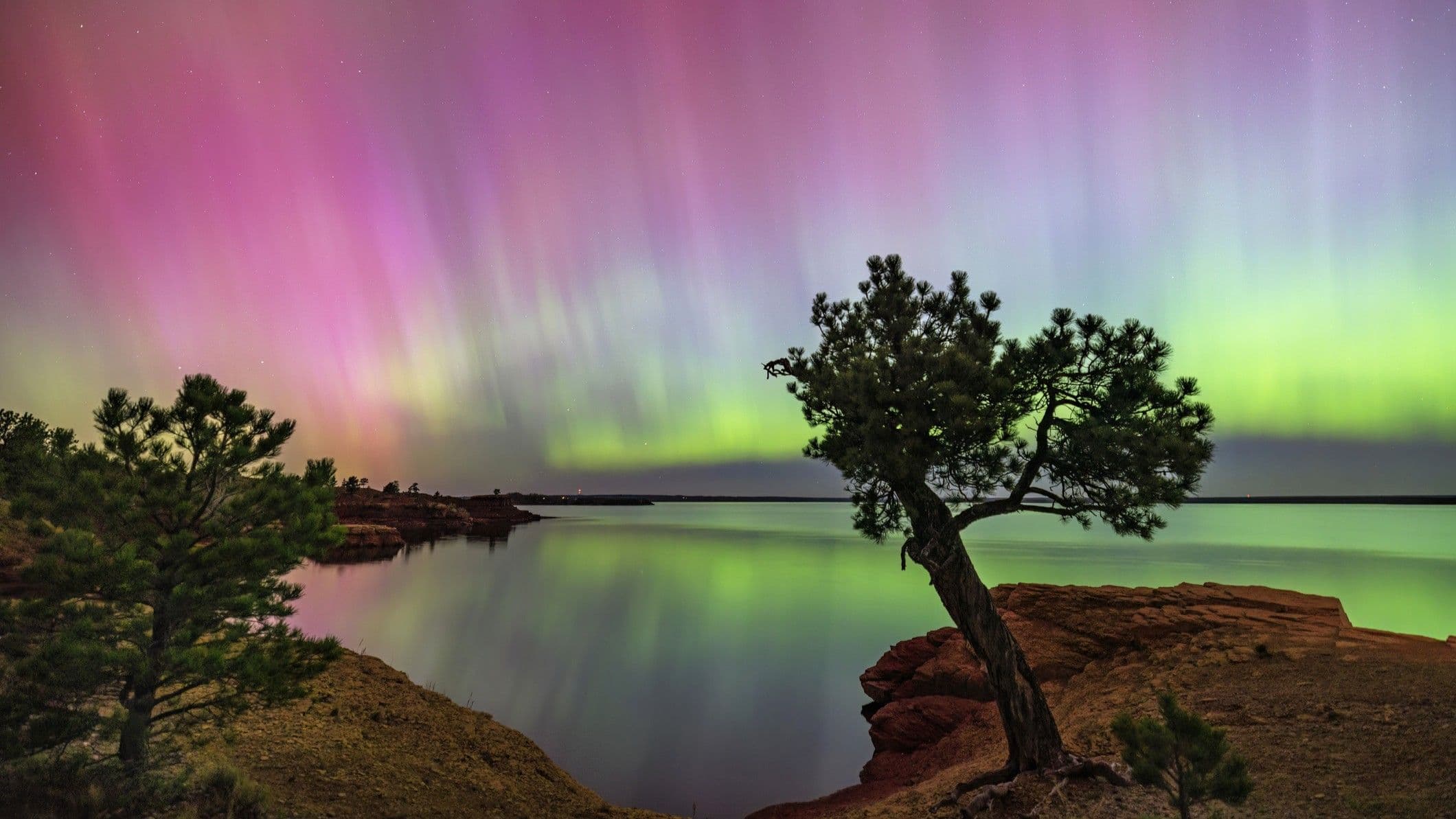
Aurora chasers across North America are bracing for a celestial spectacle this weekend as a powerful geomagnetic storm—rated G2 on NOAA’s scale—could push the northern lights as far south as Illinois, Oregon, and even New York. The storm, driven by at least four separate coronal mass ejections (CMEs) unleashed by the sun over the past 72 hours, is expected to peak late Sunday into early Monday, offering rare mid-latitude aurora sightings. Forecasters caution that while the storm’s trajectory is promising, visibility hinges on factors like cloud cover, local light pollution, and the timing of solar activity, with the best displays likely occurring in short, intense bursts.
- A G2 geomagnetic storm on March 18-19 may bring northern lights to mid-latitudes, including Illinois, New York, and Oregon.
- At least four coronal mass ejections from solar flares could prolong aurora activity through March 20-21.
- Visibility depends on cloud cover, local weather, and the storm’s magnetic field alignment.
- The spring equinox enhances solar wind interaction with Earth’s magnetic field, boosting aurora chances.
Why This Geomagnetic Storm Could Bring Rare Northern Lights to the U.S.
The National Oceanic and Atmospheric Administration’s Space Weather Prediction Center (SWPC) has issued a G2 geomagnetic storm watch for March 18-19 (UTC), translating to late evening on March 18 for North American viewers. This storm is the result of multiple CMEs—explosive bursts of plasma and magnetic field ejected from the sun during solar flares—some of which were launched as recently as March 16 during an M2.7-class flare. Unlike weaker solar events that dissipate without significant impact, these CMEs are expected to arrive in rapid succession, creating a compounding effect that could extend auroral activity through March 20-21.
How Multiple CMEs Create a Prolonged Aurora Event
Initial forecasts focused on a single CME’s potential impact, but NOAA now predicts at least four separate eruptions will strike Earth over a 48-hour window. Each CME carries charged particles that interact with Earth’s magnetosphere, compressing the magnetic field and accelerating particles toward the poles. When these particles collide with atmospheric gases like oxygen and nitrogen, they release energy in the form of light—creating the aurora borealis. The staggered arrival of multiple CMEs means the storm’s intensity could fluctuate, with periods of moderate (G2) activity interspersed with weaker (G1) phases. Some models, including those from the U.K. Met Office, suggest the main wave of CMEs may not peak until March 19 or early March 20, prolonging the event.
Geographic Reach: Where Could the Northern Lights Appear?
Under G2 conditions, the auroral oval—the ring of continuous auroral activity around the poles—shifts southward, bringing the northern lights to latitudes well beyond their typical range. NOAA’s latest forecast indicates that auroras could be visible as far south as New York, Idaho, and even Oregon, with a *possible* extension into Illinois and other midwestern states if storm conditions escalate to G3 levels. However, sightings are never guaranteed. The visibility of auroras depends heavily on three factors: the storm’s magnetic field orientation (which determines how much energy is transferred to the atmosphere), local weather conditions (clear skies are essential), and timing (auroras often intensify during short-lived substorms that may last only minutes).
Timing the Storm: When to Look Up for the Best Views
The arrival window for the CMEs is still being refined, but NOAA’s latest models suggest the first impacts could begin as early as 11 p.m. EDT on March 18, with moderate (G2) storm conditions most likely between 2 a.m. and 8 a.m. EDT on March 19. Other forecasts, including those from the U.K. Met Office, indicate the main CME could arrive later on March 19 or even early March 20, potentially extending auroral displays through the weekend. Because multiple CMEs are involved, geomagnetic activity could persist for 24-48 hours, offering multiple opportunities for sightings. For viewers in the U.S., this means checking forecasts in the late evening on March 18 and again at dawn on March 19, with a second window possible on the evening of March 19.
Why Spring Equinox Makes This Storm Extra Special
This week’s geomagnetic storm coincides with a favorable seasonal phenomenon known as the Russell-McPherron effect, first described by geophysicists Christopher Russell and Robert McPherron in 1973. Around the spring and autumn equinoxes, Earth’s tilt and its orientation in space create an alignment that allows solar wind and CMEs to interact more directly with our planet’s magnetic field. During the equinoxes—when the sun shines directly over the equator—both hemispheres experience nearly equal day and night, reducing the natural deflection of incoming charged particles. This seasonal boost in geomagnetic activity explains why March is often one of the best months for aurora hunting, with storms like this one having a higher probability of producing widespread displays.
How to Maximize Your Chances of Seeing the Aurora
Even during a strong geomagnetic storm, catching the northern lights requires preparation. Here are key steps to increase your odds of success:
1. Check Real-Time Space Weather Forecasts
NOAA’s SWPC provides hourly updates on geomagnetic storm levels, auroral oval position, and cloud cover predictions. For location-specific forecasts, apps like *My Aurora Forecast & Alerts* (iOS/Android) and *Space Weather Live* (iOS/Android) offer push notifications when conditions become favorable. These tools aggregate data from ground-based magnetometers and satellite observations to pinpoint when and where auroras are likely to appear.
2. Find Dark Skies and Clear Weather
Light pollution is the nemesis of aurora hunters. Escape urban areas and head to dark-sky preserves or rural locations with minimal artificial light. Websites like DarkSiteFinder.com can help identify optimal stargazing spots. Additionally, monitor local weather forecasts for cloud cover; even a thin layer of clouds can obscure the aurora. Clear, dark skies are non-negotiable for mid-latitude sightings—this is not the kind of event you can observe from a city street.
3. Time Your Viewing Around Peak Activity
Auroras are highly dynamic, often peaking during sudden substorms that last only minutes. These bursts occur when the solar wind’s magnetic field aligns favorably with Earth’s magnetosphere, transferring energy rapidly. For this weekend’s storm, the highest probability windows are: late evening on March 18 (around 11 p.m. EDT), early morning on March 19 (2-8 a.m. EDT), and possibly the evening of March 19. Set reminders or use apps to alert you when Kp index—a measure of geomagnetic activity—rises above 5, indicating favorable conditions.
4. Use the Right Equipment (or None at All)
While auroras are visible to the naked eye, cameras with long-exposure capabilities can capture colors and details that the human eye misses. A DSLR or mirrorless camera mounted on a tripod, set to ISO 1600-3200, f/2.8 or wider aperture, and 10-25 second exposures, works well. Smartphone cameras, especially newer models with night mode, can also photograph auroras—but results may be grainy. If you don’t have a camera, simply look north (or south in the Southern Hemisphere) and scan the horizon for faint green or purple glows. Avoid using flashlights or phones, as this can ruin your night vision.
The Science Behind the Storm: What Are CMEs and Why Do They Matter?
Coronal mass ejections are among the most powerful solar phenomena, capable of releasing billions of tons of plasma and magnetic field into space at speeds exceeding 1.5 million miles per hour. When a CME collides with Earth’s magnetosphere, it can trigger geomagnetic storms by compressing the magnetic field and accelerating charged particles toward the poles. The severity of these storms is classified using NOAA’s G-scale, which ranges from G1 (minor) to G5 (extreme). A G2 storm, like the one forecast for this weekend, can cause voltage fluctuations in power grids, disrupt high-frequency radio communications, and produce stunning auroras. The sun’s 11-year activity cycle, currently in its rising phase toward the next solar maximum (expected around 2025), has increased the frequency of such events.
Historical Precedents: When Have Northern Lights Reached Mid-Latitudes?
While this weekend’s storm is notable, it’s not unprecedented. In May 2024, a G5-class geomagnetic storm—the strongest in over two decades—dipped auroras as far south as Florida and Texas, creating a once-in-a-generation event. Other recent mid-latitude sightings include:
- October 2023: A G3 storm brought auroras to the northern U.S., including states like Minnesota and Michigan.
- April 2023: A G2 storm produced visible auroras in Wisconsin and New York.
- September 2017: A G4 storm lit up skies in the Midwest and Northeast during the tail end of Hurricane Irma’s landfall, creating a surreal backdrop for storm chasers.
These events highlight how solar activity can coincide with terrestrial phenomena to create unforgettable sky shows. However, they also underscore the unpredictability of space weather—a reminder to always stay informed via NOAA’s alerts.
How to Stay Updated on the Aurora Forecast
Space weather is a rapidly evolving field, and forecasts can change as new data arrives. For the most accurate and up-to-date information, bookmark these resources:
- **NOAA Space Weather Prediction Center (SWPC)**: Official forecasts, alerts, and real-time data on geomagnetic storms and solar flares ([swpc.noaa.gov](https://www.swpc.noaa.gov)).
- **U.K. Met Office Space Weather**: Provides detailed auroral oval maps and storm timing estimates ([metoffice.gov.uk/space-weather](https://www.metoffice.gov.uk/space-weather)).
- **Aurora Forecast Apps**: *My Aurora Forecast & Alerts* (iOS/Android) and *Space Weather Live* (iOS/Android) offer customizable alerts based on your location.
- **Aurora Hunter Communities**: Websites like SpaceWeatherLive.com and Reddit’s r/spaceweather provide crowd-sourced reports and live discussions during major events.
What’s Next for Solar Activity and Aurora Hunters?
The sun is currently approaching **Solar Cycle 25’s peak**, expected in mid-2025, which means geomagnetic storms and aurora displays are likely to become more frequent and intense over the next 12-18 months. While this weekend’s storm is moderate (G2), stronger events—potentially reaching G3 or higher—could occur as solar activity ramps up. For aurora hunters, this is an exciting time, but it also underscores the importance of preparedness. Investing in the right tools (like a good camera or aurora-tracking app) and knowing your local dark-sky spots will pay off as we enter a period of heightened solar activity.
Frequently Asked Questions About the Upcoming Geomagnetic Storm
Frequently Asked Questions
- Can I see the northern lights from a city?
- It’s highly unlikely. Light pollution from urban areas will wash out the faint auroras, even during a strong storm. For the best views, drive at least 30-50 miles away from city lights to darker skies.
- What’s the difference between a G1 and G2 geomagnetic storm?
- A G1 storm is minor and may only produce auroras near the Arctic Circle, while a G2 storm is moderate and can push auroras as far south as New York or Illinois. The G-scale measures the storm’s geomagnetic impact, with higher numbers indicating stronger effects on power grids and communications.
- Will this storm damage satellites or power grids?
- A G2 storm is unlikely to cause significant damage, but it may lead to minor voltage fluctuations in power grids and disrupt high-frequency radio communications, particularly in polar regions. Stronger storms (G4/G5) pose greater risks, but this event is not expected to reach those levels.