In a groundbreaking discovery that could redefine water security in the drought-stricken American West, scientists have uncovered a vast reservoir of freshwater hidden beneath Utah’s Great Salt Lake—one that may rival the lake’s surface area and extend up to 2.5 miles deep. Using cutting-edge airborne electromagnetic technology, researchers mapped a previously unknown freshwater deposit beneath the lake’s eastern margin, offering a potential lifeline to combat toxic dust storms, restore parched ecosystems, and alleviate chronic water shortages in the region. The findings, published in the journal *Scientific Reports* in February 2026, mark the first time such a resource has been identified beneath one of the most saline lakes in the Western Hemisphere, and could signal the presence of similar hidden reserves across arid landscapes worldwide.
Why the Great Salt Lake’s hidden freshwater could change everything for the West
The Great Salt Lake, a 1,700-square-mile saltwater lake in northern Utah, has been shrinking for decades due to a perfect storm of overconsumption, prolonged drought, and climate change. Since 1986, the lake’s water levels have plummeted by 22 feet, exposing vast stretches of its lakebed to the air. As the water recedes, the exposed sediment—a mix of clay, silt, and minerals—dries out and erodes, becoming a major source of toxic dust that blankets nearby communities. Salt Lake City, which sits directly downwind of the lake’s dry basins, has seen a surge in hazardous air pollution, including elevated levels of arsenic and other heavy metals that pose serious health risks to residents.
The newly discovered freshwater reservoir, if confirmed to span the entire lakebed, could offer a critical solution. By pumping this water to dampen the dry lakebed, authorities could suppress dust emissions and mitigate one of the most pressing environmental crises in the Intermountain West. Beyond dust control, the water could provide a new source for agricultural irrigation in Utah’s fertile valleys, where farmers are increasingly competing for dwindling Colorado River allocations. However, scientists caution that further study is needed to assess extraction feasibility, potential ecological impacts, and whether the freshwater layer extends beyond the initial survey area.
How scientists uncovered the hidden reservoir using cutting-edge technology
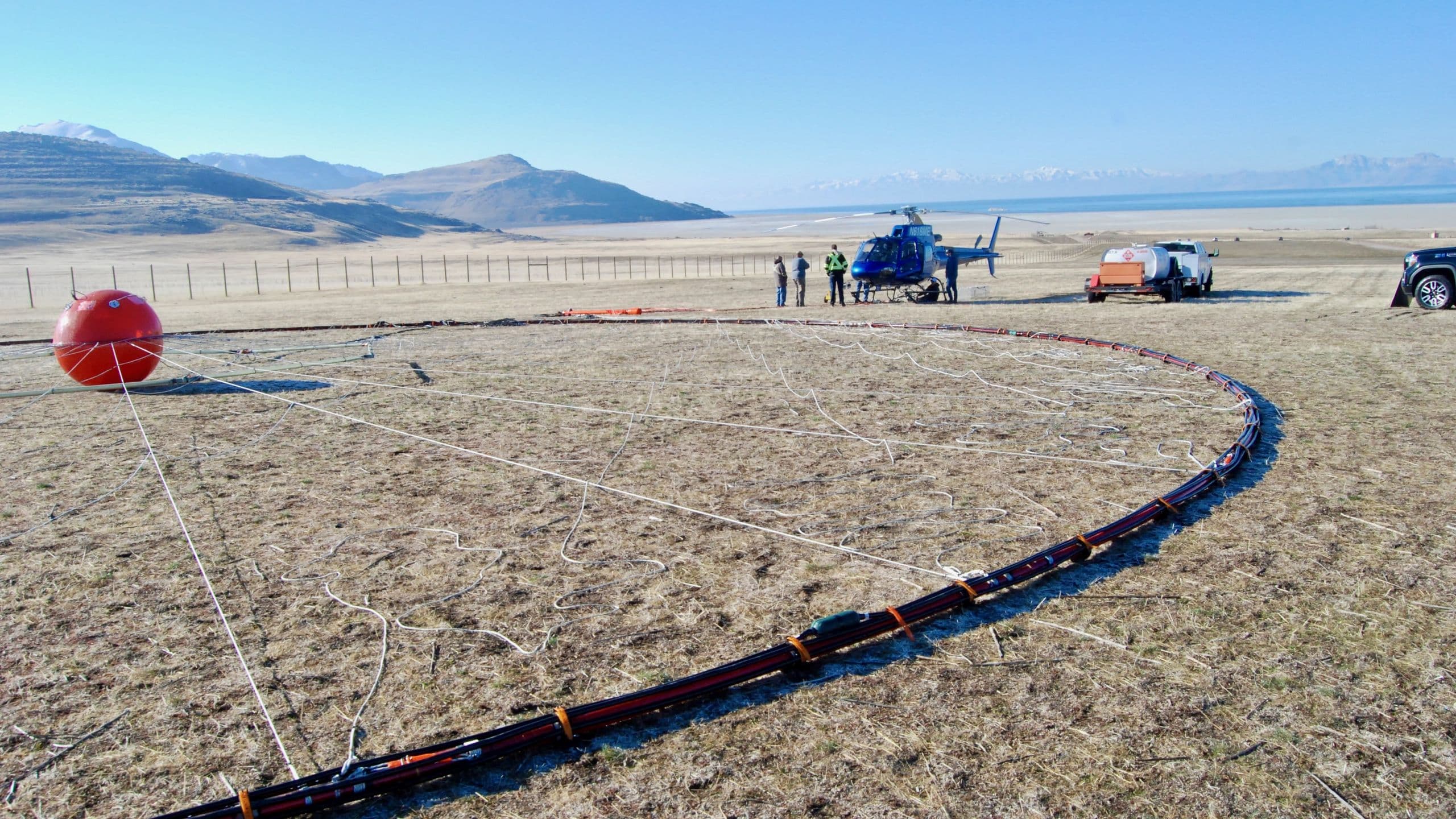
The discovery was made possible by a sophisticated airborne electromagnetic survey conducted over a 10-square-mile section of Great Salt Lake’s eastern margin. Researchers, led by geophysicist Dr. Maxim Zhdanov of the University of Utah, collaborated with Toronto-based firm Expert Geophysics to deploy a helicopter equipped with a circular electromagnetic transmitter. The device, suspended below the aircraft, sent pulses into the ground and lakebed, measuring how different materials—freshwater, saltwater, rock—conducted electricity. Saline water conducts electricity efficiently, while freshwater does not, allowing the team to map the freshwater layer’s depth and extent with remarkable precision.
From reeds to radar: The clues that led to the discovery
The first hints of freshwater beneath the Great Salt Lake emerged from an unlikely source: dense patches of phragmites, a common wetland reed that thrives in freshwater environments. For years, residents and scientists noticed these reeds sprouting from cracked, dry lakebed in Farmington Bay—a stark contrast to the lake’s otherwise barren, saline landscape. ‘Phragmites need abundant fresh water to grow,’ Zhdanov explained. ‘When we saw these mounds choked with reeds, it was a clear signal that groundwater was rising from beneath the dry lakebed.’ Samples from the mounds confirmed the presence of freshwater, but the source remained a mystery—until the airborne survey provided the answer.
Mapping the invisible: What the electromagnetic data revealed
The electromagnetic imaging revealed a continuous layer of freshwater in the sediments beneath the survey area, ranging from 330 feet (100 meters) to 2.5 miles (4 kilometers) deep. The data also showed that a layer of impermeable ‘cap’ rock likely prevents the freshwater from mixing with the lake’s highly saline water. Additionally, the survey mapped the geology beneath the lake, uncovering a ‘basement’ of watertight rocks that form the lower boundary of the reservoir. Faults in these rocks may explain why the freshwater layer’s depth varies sharply across the surveyed area.
‘The result was amazing. Of course, it was a very small fraction of the entire area of Great Salt Lake. In order to make any definitive conclusions that this water reservoir is located under the entire area, we need to expand the survey.’ — Dr. Maxim Zhdanov, lead author, University of Utah
The environmental crisis driving the search for new water sources
The Great Salt Lake is more than just a geographic landmark—it’s a critical ecosystem that supports millions of migratory birds, regulates local temperatures, and influences weather patterns. Its decline has triggered a cascade of environmental and economic consequences. The exposed lakebed, now covering roughly half the lake’s former surface area, has become a major emitter of fine particulate matter (PM2.5), which can penetrate deep into the lungs and exacerbate respiratory diseases. A 2023 study published in *Environmental Research Letters* warned that Salt Lake City could face a 30% increase in PM2.5 pollution by 2050 if the lake continues to shrink at its current rate.
The lake’s desiccation is primarily driven by three factors: excessive water diversions for agriculture, rapid urban expansion, and climate change. Utah’s population has grown by over 15% since 2010, straining already limited water supplies. Meanwhile, the region has experienced a historic megadrought, with the Colorado River—Utah’s primary water source—reaching record-low levels. The Great Salt Lake’s elevation has dropped to 4,200 feet above sea level, perilously close to the 4,191-foot threshold at which the lake could split into two smaller, hyper-saline pools, a scenario that would devastate ecosystems and accelerate dust emissions.
Could this discovery be a blueprint for finding hidden water in the West?
The Great Salt Lake discovery is not just a local anomaly—it’s a potential game-changer for water-scarce regions across the American West and beyond. Zhdanov and his team believe their airborne geophysical approach could be replicated in other arid landscapes, such as California’s Central Valley or Nevada’s dried-up Lake Tahoe, where similar freshwater reserves may lie hidden beneath saline basins. ‘The bottom line is that this project demonstrated that airborne geophysics work can be used to identify these groundwater reserves in deserts like Utah,’ Zhdanov said. If scaled up, the technology could help water managers identify untapped aquifers before they’re exploited—or lost forever—to over-extraction and climate change.
What’s next? Challenges and opportunities for Utah’s water future
While the discovery is promising, significant questions remain. The current survey covers only a fraction of the lake’s total area, and future studies will need to expand the electromagnetic mapping to confirm whether the freshwater reservoir spans the entire basin. Additionally, extracting this water for practical use—whether for dust mitigation or agriculture—would require careful planning to avoid unintended consequences, such as land subsidence or disruption of natural groundwater flows. ‘We need more studies to figure out how to access this water without causing harm,’ Zhdanov noted.
Key Takeaways
- A vast freshwater reservoir, potentially as large as the Great Salt Lake itself, has been discovered up to 2.5 miles beneath Utah’s Great Salt Lake using airborne electromagnetic surveys.
- The discovery could provide a solution to toxic dust storms plaguing Salt Lake City and other downwind communities, which are projected to worsen as the lakebed continues to dry out.
- Scientists believe the freshwater originated from snowmelt in surrounding mountains and has been trapped beneath impermeable rock layers for thousands, possibly millions, of years.
- If confirmed across the entire lakebed, the reservoir could offer a new water source for Utah’s farmers and help alleviate pressure on the Colorado River, a critical but dwindling supply for the West.
- The findings highlight the potential for airborne geophysics to uncover hidden groundwater reserves in other drought-stricken regions, offering a tool for future water security efforts.
Frequently Asked Questions
Frequently Asked Questions
- How did scientists find freshwater beneath a saltwater lake?
- Researchers used airborne electromagnetic surveys, flying a helicopter equipped with a sensor over the lake. The device sent pulses into the ground, measuring conductivity differences between freshwater and saltwater to map the hidden reservoir.
- Could this water be used to refill the Great Salt Lake?
- While the freshwater could help dampen the dry lakebed to suppress dust, refilling the lake to historic levels would require massive water imports and infrastructure, likely beyond the scope of this discovery alone.
- Are there risks to pumping water from the reservoir?
- Yes. Over-extraction could cause land subsidence, disrupt natural groundwater flows, or even allow saltwater intrusion. Scientists emphasize the need for careful study before any large-scale pumping begins.