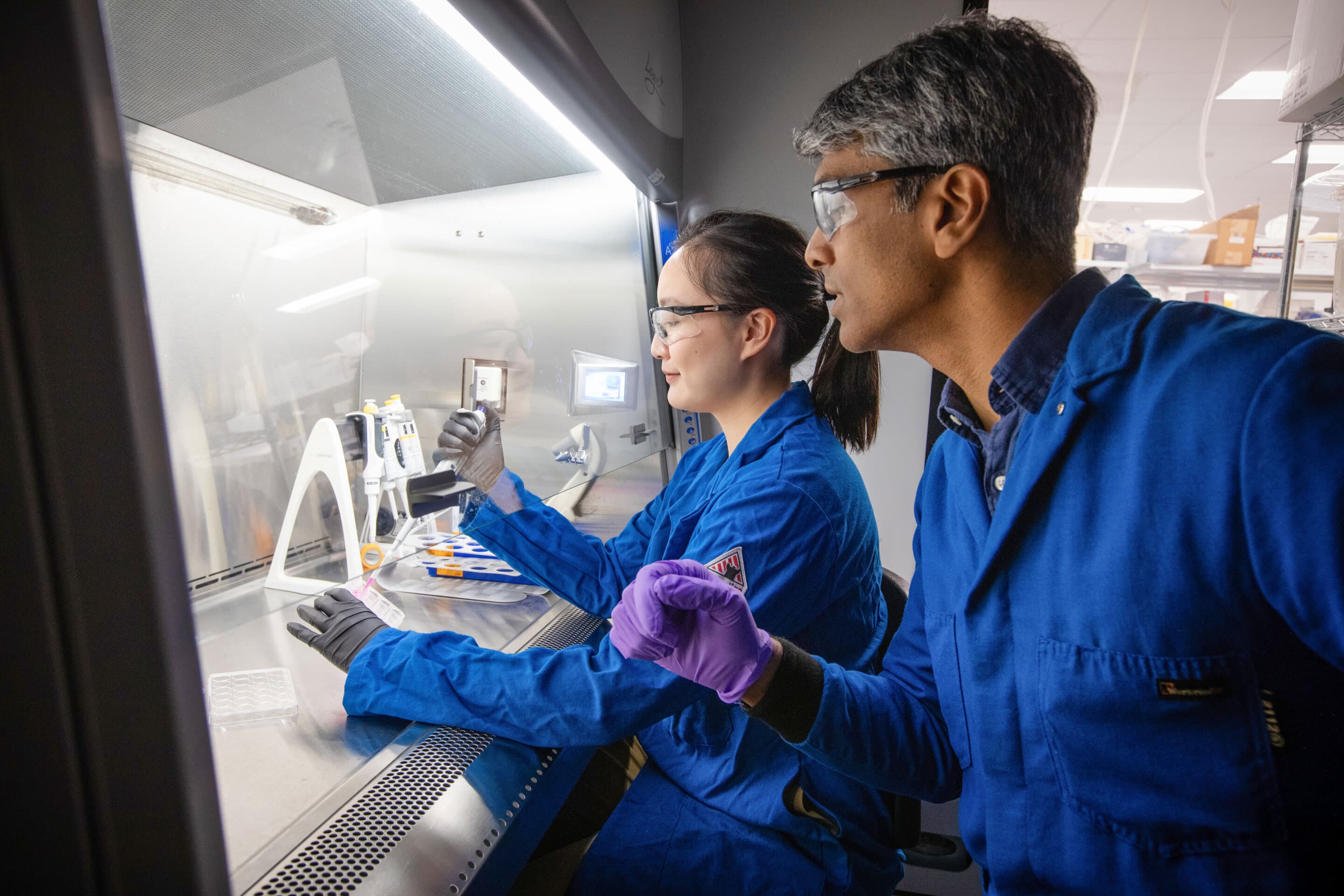
A team from University of Toronto Engineering is the first to synthesize long noncoding RNA (lncRNA) outside the cell—a new approach to drug discovery that has already yielded some promising anti-inflammatory molecules. The team was inspired by advances in the field of messenger RNA (mRNA) and protein replacement therapies. They realized that a similar approach could be used to deliver lncRNA to the body, unlocking a potential new source of drugs.
Peering into the genome's dark matter
"Only about 25% of our DNA encodes for proteins, including everything from insulin for regulating blood sugar to antibodies for immune defense," says Professor Omar F. Khan, senior author on a paper published in Science Signaling that describes the new discovery.
"Proteins are made via messenger RNA, or mRNA, which conveys the instructions for how to build proteins from our genes to our ribosomes, the part of our cells where proteins are assembled."
"But a significant amount of our DNA doesn't do that; its function is something we're still trying to understand. One thing we do know is that about 45% of our DNA produces these long strings of RNA that do not act as messengers, but which still interact with other biomolecules. We call these strings long noncoding RNA, or lncRNA."
Khan says that so far, approximately 40,000 lncRNA transcripts have been identified—a set of molecules sometimes referred to as the "dark transcriptome" because their functions are still largely unknown. He and his team were fascinated by the contrast between the large size of this chemical library and the limited amount of knowledge about it.
What research has been done on lncRNA transcripts suggests that they may be involved in gene regulation—for example, interacting with other molecules to increase or decrease expression of certain genes. This means that lncRNA could become a new method for researchers looking to treat disease.
"There's no way evolution would allow these lncRNAs to take up so much space in our genome unless they were giving us some kind of survival advantage," says Khan.
"If we can figure out what these lncRNAs do, make them in the lab, and then administer them to sick patients like any other medicine, we could modify or enhance the body's natural processes to promote healing."
Khan and his team began with a literature search through the dark transcriptome, looking for sequences that had the potential to be used in this way. For their first target, they selected lncRNA transcripts that other researchers had found to be associated with inflammation.
"Although inflammation is one of the body's natural responses to injury or infection, extreme or chronic inflammation can become a problem," says Janice Pang, a Ph.D. student in Khan's lab and lead author on the new paper.
"For example, sepsis is a potentially life-threatening condition caused by an overactive inflammation response, and chronic inflammation is associated with many conditions, from arthritis to cardiovascular disease."
"The idea was that if we could identify lncRNA sequences that regulate inflammation, we could use them to shut it down when it gets out of control."
The team identified three lncRNA sequences—GAPLINC, MIST and DRAIR—that previous research had suggested could be involved in regulating inflammation. Using a variety of techniques such as in vitro transcription synthesis, chemical modifications and high-performance liquid chromatography purification, they made the first copies of these sequences outside the cell.
From lab synthesis to living systems
They then used their extensive expertise at creating RNA delivery systems to package these lncRNA sequences into nanoparticles and inject them back into human cell cultures, as well as mice that were sick with an inflammatory disease.
"We found that each sequence reduced inflammation in a different way," says Pang.
"They did this by decreasing the production of specific cytokines, which are signaling proteins produced in the body that trigger inflammation."
The team then went one step further: they explored structural and chemical changes to each lncRNA to increase their potency. These changes allowed them to use much lower doses, which can potentially improve clinical use.
"It's a very tricky thing, because the shape of these molecules matters to their function, and you don't want to break that by changing too much," says Khan.
"But through hard work and thoughtful choices, Janice and the team were able to find modifications that actually increased their potency."
A new paradigm for drug discovery
While the team is excited about the new anti-inflammatory molecules they've created, Khan says the larger accomplishment is the opening up of a new frontier in drug discovery research.
"The traditional way of making drugs is time-consuming and costly: so many candidate molecules fail because of negative interactions with the body or a lack of performance in humans," he says.
"What's so great about these lncRNA sequences is that they've been honed by millions of years of evolution, so we know they're biocompatible with humans: they've already been de-risked, in a sense. On top of that, each lncRNA evolved to have a very narrow, specific mechanism of action. That specificity reduces the potential for side effects, and it also enables us to get the desired response with minimal doses."
"This is a completely new paradigm for drug discovery, and we think that the dark transcriptome is a great opportunity to find new treatments that will really change lives in the future."
Human and mouse long noncoding RNAs reengineered for exogenous delivery reduce LPS-induced inflammation in human macrophages and mice, Science Signaling (2026). DOI: 10.1126/scisignal.adx2924. www.science.org/doi/10.1126/scisignal.adx2924
Citation: Mining the dark transcriptome: Synthesizing the first potential drug molecules from long noncoding RNA (2026, March 10) retrieved 11 March 2026 from https://phys.org/news/2026-03-dark-transcriptome-potential-drug-molecules.html
This document is subject to copyright. Apart from any fair dealing for the purpose of private study or research, no part may be reproduced without the written permission. The content is provided for information purposes only.