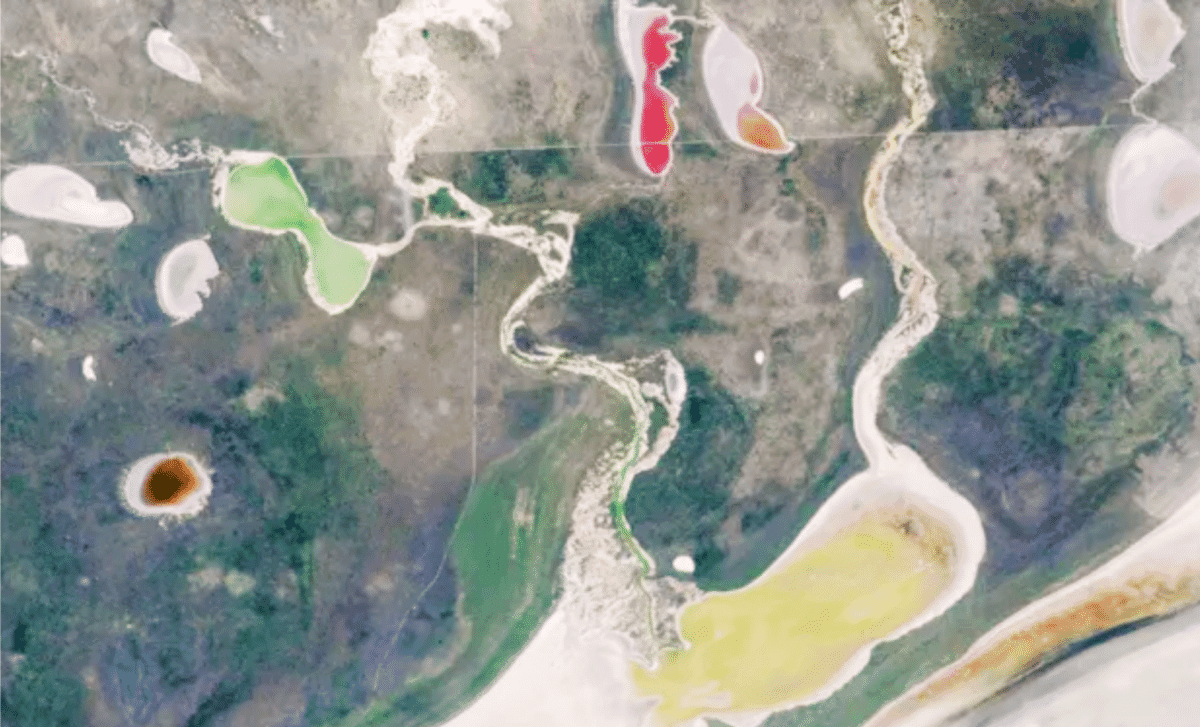
In one of the most striking natural phenomena ever documented from space, NASA’s Earth Observatory captured a fleeting yet breathtaking transformation of Namibia’s Etosha Pan in 2011. Following torrential rains that caused the Ekuma and Oshigambo rivers to overflow, the normally arid salt flat—known locally as ‘The Great White Place’—briefly became a vibrant mosaic of rainbow-colored lakes. The ephemeral bodies of water, visible from the International Space Station, were not the result of mineral deposits or sediment but rather the explosive growth of microscopic algae thriving in the shallow, mineral-rich floodwaters. For a few weeks, the stark white expanse of the Etosha Pan, spanning 1,800 square miles, pulsed with life in shades of green, red, yellow, and pink, offering scientists and the public an extraordinary glimpse into the resilience of life in one of Africa’s most extreme environments.
Key Takeaways: The Rare Rainbow Lakes of Namibia’s Etosha Pan
- NASA’s Earth Observatory captured rainbow-colored lakes in Namibia’s Etosha Pan in 2011 after rivers flooded, creating ephemeral water bodies visible from space.
- The vibrant hues resulted from algae blooms in shallow, mineral-rich water, not mineral deposits, transforming the salt flat into a kaleidoscope of colors.
- The phenomenon highlights the ecological importance of Etosha National Park, a critical habitat for wildlife and migratory birds despite the pan’s harsh conditions.
- Ephemeral lakes like these play a vital role in supporting biodiversity, including flamingos and other species, during rare flooding events.
The Science Behind the Spectacle: How Flooding Transformed a Salt Flat
The Etosha Pan, a vast salt flat in northern Namibia, is typically a desolate and dry landscape, its cracked white surface stretching endlessly under the African sun. Covering approximately 1,800 square miles, the pan is one of the most inhospitable environments on the continent, with salinity levels often exceeding those of seawater. However, every few decades, the region experiences a rare meteorological phenomenon: torrential rains in Angola’s highlands swell the Ekuma and Oshigambo rivers, causing them to breach their banks and flood the pan. In 2011, this exact scenario unfolded, drenching the salt flat in a thin layer of water that pooled in shallow depressions across the surface.
The Role of Algae in Creating Nature’s Palette
The rainbow colors observed in the newly formed lakes were not the result of minerals or sediment but rather the rapid proliferation of algae species adapted to extreme conditions. When the floodwaters receded slightly, leaving behind shallow pools of varying salinity, conditions became ideal for algae such as *Dunaliella salina*—a type of green algae known for producing carotenoids, pigments that give water a reddish hue. Other algae species, including cyanobacteria, contributed green and yellow tones. NASA scientists noted that the green lake, measuring roughly 6.5 kilometers (4 miles) in length, was particularly dense with algae, creating a vivid contrast against the white salt crust.
The algae’s ability to thrive in such an environment is a testament to extremophile biology. These microorganisms have evolved to survive in conditions that would be lethal to most life forms, using the mineral-rich water as a nutrient source. As they photosynthesize, they produce pigments that absorb and reflect light in specific wavelengths, resulting in the stunning array of colors captured in NASA’s images. When the floodwaters evaporated, the algae either died off or retreated into dormant states, leaving behind a barren landscape until the next rare flooding event.
A Brief Transformation: The Ephemeral Nature of Namibia’s Rainbow Lakes
The lakes of Etosha Pan are, by definition, ephemeral. Unlike permanent bodies of water, these fleeting oases exist only when the conditions are perfect—when floodwaters linger long enough for algae to bloom but not so long that the water becomes too saline or evaporates entirely. Historical records suggest that such flooding events occur approximately once every 20 to 30 years, though climate change and shifting weather patterns may alter this frequency. The 2011 event, for instance, followed a prolonged drought that had left the pan bone-dry for nearly a decade. When the rains finally came, they were intense enough to breach the riverbanks but not sustained enough to fill the pan permanently.
NASA’s Earth Observatory, which has been monitoring the Etosha Pan for decades, documented the phenomenon using imagery from the International Space Station (ISS). The agency’s satellite data revealed how the water levels fluctuated over several weeks, creating a dynamic and ever-changing landscape. While the images from space provided a mesmerizing overview, ground-based observations confirmed that the algae blooms were concentrated in the shallowest areas, where sunlight could penetrate most effectively. As temperatures rose and the water evaporated, the colors faded, and the pan returned to its familiar monochrome state—a stark reminder of nature’s impermanence.
Ecological Significance: Why the Etosha Pan Matters for Wildlife and Conservation
Beyond their visual spectacle, the temporary lakes of Etosha Pan play a critical role in sustaining one of Africa’s most vital wildlife reserves. Etosha National Park, which surrounds the pan, is a UNESCO-designated conservation area and one of the continent’s premier safari destinations. Despite the pan’s harsh conditions, the park supports an astonishing diversity of species, including elephants, lions, giraffes, and zebras. The presence of water—even ephemeral—transforms the landscape into a hub of activity, attracting herbivores and predators alike. According to LiveScience, the pan also serves as a critical breeding ground for flamingos, which flock to the region during flooding events to feed on algae and small crustaceans.
A Lifeline for Migratory Birds and Endangered Species
The temporary lakes are particularly vital for migratory birds, including tens of thousands of flamingos that descend upon the pan during wet periods. These birds rely on the shallow waters to filter-feed on algae and brine shrimp, which thrive in the saline environment. The Etosha Pan’s ability to support such large populations of flamingos has made it a key stopover site along the African-Eurasian flyway, a migratory route spanning continents. Conservationists note that the pan’s periodic flooding helps maintain the delicate balance of the ecosystem, ensuring that food sources are replenished and habitats are renewed.
The return of water to the pan also benefits larger mammals, which travel long distances to quench their thirst. Elephants, in particular, are known to dig for water in the salt crust during dry periods, but flooding events provide them with easily accessible sources. Predators such as lions and hyenas follow the herbivores, creating a temporary but intense burst of life in the otherwise arid landscape. For conservationists, these events underscore the importance of protecting not only the permanent habitats within Etosha National Park but also the transient ecosystems that emerge after rare flooding.
Challenges and Threats to the Etosha Pan’s Fragile Ecosystem
Despite its ecological significance, the Etosha Pan faces growing threats from climate change and human activity. Rising temperatures and shifting rainfall patterns could reduce the frequency of flooding events, potentially disrupting the algae blooms and the food chains they support. Additionally, mineral extraction and tourism pressures pose risks to the pan’s delicate balance. Namibia’s government has designated Etosha National Park as a protected area, but conservationists warn that ongoing monitoring and adaptive management strategies are essential to preserve this unique phenomenon for future generations.
The Broader Implications: What Namibia’s Rainbow Lakes Teach Us About Resilience and Adaptation
The story of Etosha Pan’s rainbow lakes is more than just a captivating visual wonder; it is a case study in resilience and adaptation. The algae that paint the pan in vibrant hues are extremophiles—organisms that thrive in conditions that would be lethal to most life forms. Their ability to flourish in saline, nutrient-poor water highlights the tenacity of life on Earth and offers insights into the potential for life on other planets. Astrobiologists, for instance, study similar ecosystems as analogs for conditions that might exist on Mars or Europa, where water is scarce but microbial life could theoretically persist.
From a conservation perspective, the Etosha Pan serves as a reminder of the importance of protecting transient ecosystems. These ephemeral landscapes, which exist only under specific conditions, are often overlooked in favor of permanent habitats. Yet, they play a disproportionate role in supporting biodiversity. The rainbow lakes of Etosha Pan demonstrate how a brief flooding event can transform a barren wasteland into a vibrant ecosystem, underscoring the need for flexible and forward-thinking conservation strategies.
How NASA’s Earth Observatory Captured This Rare Phenomenon
NASA’s Earth Observatory has been a pioneer in documenting global environmental phenomena from space, using a combination of satellites, the International Space Station (ISS), and advanced imaging technology. In the case of the Etosha Pan’s rainbow lakes, the agency relied on the Moderate Resolution Imaging Spectroradiometer (MODIS) aboard the Terra and Aqua satellites, as well as high-resolution cameras operated by astronauts on the ISS. These tools allowed scientists to monitor the flooding event in real-time, capturing the transformation of the pan from a dry salt flat to a kaleidoscope of colors.
The images were processed to highlight the algae blooms, using color-enhancement techniques to distinguish between different species and their pigments. NASA’s data also revealed how the lakes evolved over time, with some areas drying out faster than others due to variations in salinity and water depth. This level of detail provides valuable insights for researchers studying the impacts of climate change on aquatic ecosystems and the role of water in shaping landscapes.
Frequently Asked Questions About Namibia’s Rainbow Lakes
Frequently Asked Questions
- How often do the rainbow lakes in Etosha Pan appear?
- Rainbow lakes in Etosha Pan are rare and typically form only after significant flooding events, which occur approximately once every 20 to 30 years. The 2011 event was one of the most well-documented, following intense rains in Angola that swelled the Ekuma and Oshigambo rivers.
- What causes the vibrant colors in the lakes?
- The colors are caused by algae blooms, particularly species like *Dunaliella salina*, which produce pigments such as carotenoids. These algae thrive in the shallow, mineral-rich floodwaters, creating hues of green, red, yellow, and pink.
- Why is the Etosha Pan important for wildlife?
- Etosha National Park is a critical habitat for diverse species, including elephants, lions, and flamingos. The temporary lakes provide water and food sources during flooding events, supporting migratory birds and sustaining the park’s delicate ecosystem.