At NASA's Glenn Research Center in Cleveland, Ohio, a specialized team of visualization experts is revolutionizing how scientists and engineers understand complex aerospace systems through advanced three-dimensional graphics and immersive digital environments. The Graphics and Visualization Lab (GVIS) creates a comprehensive portfolio of scientific visualizations and interactive simulations designed to support NASA's ambitious missions, ongoing projects, and emerging technological innovations across the agency. These sophisticated visual tools serve as critical instruments that enable researchers, engineers, and scientists to develop innovative solutions while simultaneously bringing theoretical concepts and experimental designs to tangible life, bridging the gap between abstract engineering challenges and practical, implementable answers.
How Scientific Visualizations Transform Complex Aerospace Systems Into Understandable Models
The fundamental mission of GVIS centers on creating scientific visualizations that decode extraordinarily complex scientific systems—phenomena and processes that remain fundamentally impossible to observe with the human eye alone. These advanced visualizations represent both massive-scale systems such as aircraft engines and propellant storage tanks, as well as microscopic-level processes, simultaneously adding invaluable supplementary information that illuminates precisely how these intricate systems function under real-world operational conditions. By displaying information across both large and microscopic scales, scientific visualizations provide researchers with powerful, comprehensive insight into the inner workings of sophisticated mechanical systems, enabling them to identify inefficiencies, optimize performance parameters, and accelerate the development timeline from concept to deployment.
The capability to visualize systems at multiple scales simultaneously represents a transformative advancement in aerospace engineering research. Rather than relying solely on theoretical calculations or physical prototypes—both time-consuming and expensive approaches—engineers can now leverage digital visualization to understand system behavior comprehensively. This technological shift has profound implications for the aerospace industry, potentially reducing development cycles, minimizing costly manufacturing errors, and enabling engineers to explore design variations that would be prohibitively expensive to test physically.
Zero Boil-Off Tank Technology: Visualizing Cryogenic Propellant Storage for Long-Duration Missions
One exemplary application of GVIS visualization capabilities involves the Zero Boil-Off Tank (ZBOT), an advanced long-term propellant storage system developed by NASA to address one of spaceflight's most persistent technical challenges. Spacecraft fuels consist of volatile cryogenic liquid propellants—substances that must be maintained at extraordinarily low temperatures to remain in liquid form—and these propellants face continuous threats from environmental heat leaks that inevitably penetrate the spacecraft's insulation systems during extended missions. The ZBOT project represents a critical technological initiative designed to overcome these constraints, enabling NASA to conduct long-duration deep-space exploration missions that would be impossible with conventional propellant storage methods.
GVIS has created detailed visualizations of the Zero Boil-Off Tank that showcase the complex thermal and fluid dynamics occurring within the storage vessel during operation. These visualizations represent numerous experimental iterations and testing scenarios conducted to determine optimal cryogenic propellant storage methodologies. By rendering the inner workings of propellants inside the tank in three-dimensional, interactive format, GVIS visualizations bring these experiments to life, allowing researchers to observe and understand thermal stratification, boil-off reduction mechanisms, and heat transfer mitigation strategies that would be invisible during actual laboratory testing. This visualization approach dramatically accelerates the research process by enabling teams to identify promising design modifications and thermal management strategies before committing resources to expensive physical prototypes.
Turbomachinery Visualizations and Engine Design: Reducing Development Time and Manufacturing Costs
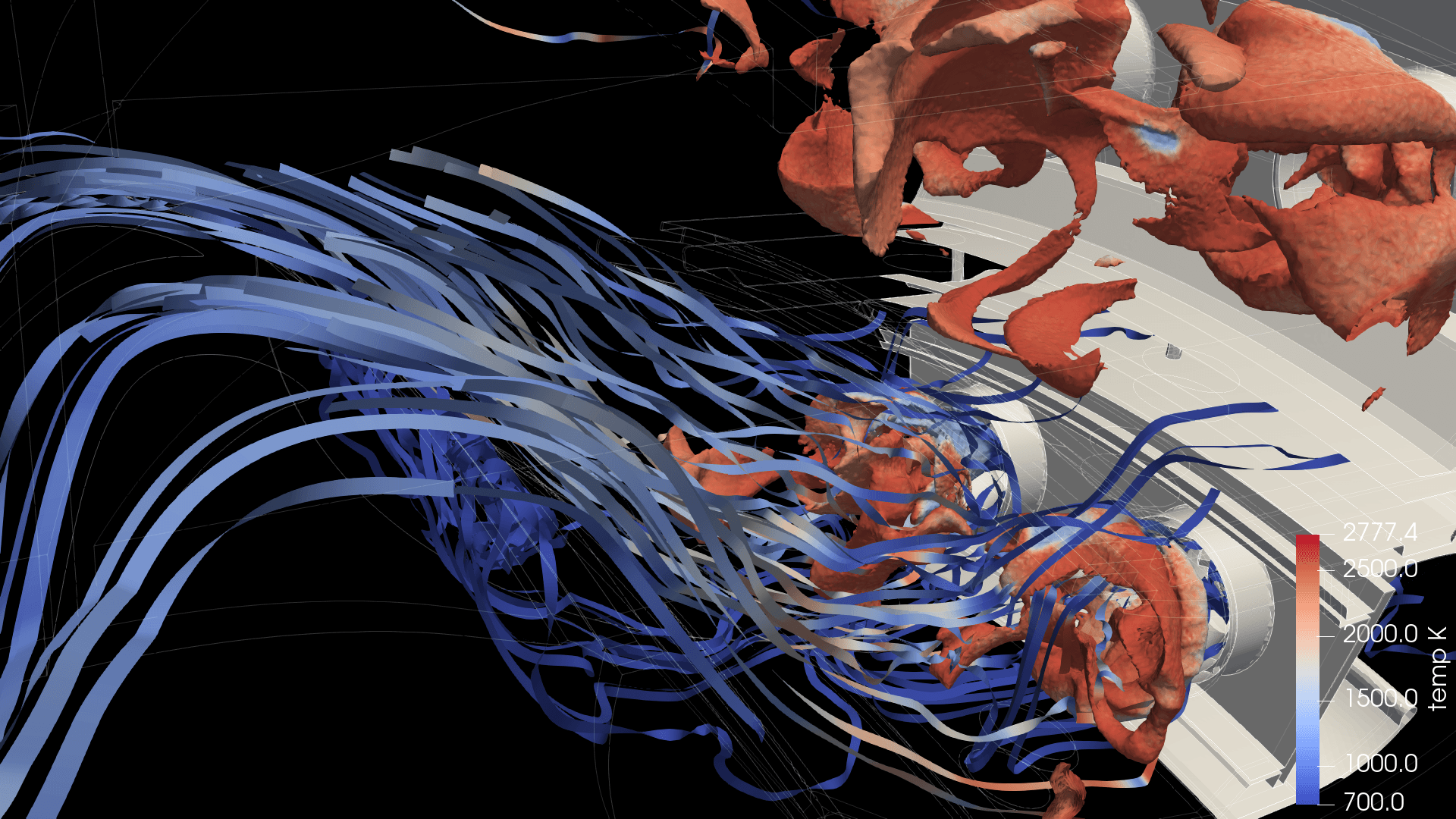
Beyond cryogenic storage systems, GVIS specializes in creating advanced turbomachinery visualizations that provide visual representations of energy transfer processes occurring within aircraft engines and propulsion systems. These three-dimensional renderings of complex rotating machinery have proven to be vital tools in the aerospace industry's ongoing effort to reduce both the time and expense required to test and manufacture next-generation aircraft engines. Traditional approaches to engine development involve building and testing expensive physical prototypes, a process that consumes substantial financial resources and extends project timelines significantly.
Turbomachinery visualizations created by GVIS enable engineers to virtually test design modifications, observe fluid flow patterns around rotating components, and identify potential mechanical stress points before physical manufacturing begins. This virtual testing capability translates directly into reduced development timelines, lower overall project costs, and more efficient allocation of research and development budgets. For a field where a single engine prototype can cost millions of dollars and require months or years to manufacture and test, the ability to conduct preliminary design validation through visualization represents a substantial competitive and economic advantage.
Electric Propulsion Innovation: The High-Efficiency Megawatt Motor and Future Aircraft Technology
As the aerospace industry increasingly focuses on electrified propulsion systems to reduce environmental impact and improve operational efficiency, GVIS has created detailed visualizations of the High-Efficiency Megawatt Motor (HEMM), a 1.4 megawatt electric machine currently under development at NASA's Glenn Research Center. The HEMM project represents a critical component of NASA's broader initiative to advance electric and hybrid-electric propulsion technologies that could fundamentally transform future aircraft design and operational capabilities. This advanced electric motor is specifically engineered to improve efficiency in next-generation aircraft equipped with electrified propulsion systems, contributing to NASA's sustainability goals while simultaneously advancing aerospace technology capabilities.
GVIS visualizations of the HEMM motor, including detailed magnetic flux demonstrations, illustrate the complex electromagnetic interactions occurring within the machine during operation. These visualizations help engineers understand how magnetic fields interact with electrical current to produce mechanical motion, and identify opportunities for improving efficiency and reducing heat generation. As aircraft manufacturers and NASA explore the feasibility of electric and hybrid-electric propulsion for both commercial and research aircraft, these visualization tools become increasingly essential for validating theoretical designs and optimizing motor performance characteristics.
The GRUVE Lab: Immersive Virtual Reality Environment for Advanced Scientific Exploration
Many of the scientific visualizations created by GVIS are specifically designed for implementation within the Glenn Reconfigurable User-Interface and Virtual Reality Exploration Lab, commonly known as GRUVE Lab. This specialized facility houses the CAVE—a fully immersive, three-dimensional virtual environment that represents the cutting edge of visualization technology. The CAVE acronym stands for Cave Automatic Virtual Environment, a technology that creates a completely immersive experience by projecting three-dimensional imagery onto multiple surrounding walls, effectively surrounding the user with a virtual world.
When users enter the CAVE environment at GRUVE Lab, they wear tracking active-shutter glasses that continuously monitor their head position and orientation. This sophisticated tracking system ensures that three-dimensional models and simulations remain perfectly proportional and properly aligned with the user's perspective, creating a genuinely immersive experience that feels spatially accurate and intuitive. This personalized, interactive experience allows users to develop substantially greater understanding of complex scientific systems and facilitates more effective implementation of these systems in real-world applications. Researchers can manipulate virtual models, observe systems from multiple angles simultaneously, and conduct virtual experiments that would be impossible or prohibitively expensive to perform physically.
Why Scientific Visualization Matters: Educational Impact and Accessibility of Complex Concepts
Beyond their practical applications in engineering design and system optimization, scientific visualizations created by GVIS serve as indispensable educational tools that democratize access to complex scientific concepts. Visual representations of scientific principles are inherently easier to comprehend and share compared to traditional text-based or mathematical descriptions. These visualizations effectively eliminate scientific jargon that often obscures understanding, serving as powerful supplements to traditional classroom lessons and technical presentations. Importantly, scientific visualizations can be readily modified and customized for different audiences, ranging from elementary school students learning fundamental physics principles to advanced graduate researchers working on cutting-edge aerospace challenges.
The barrier between abstract scientific concepts and genuine comprehension is substantially reduced through the artistry and technical precision of scientific visualization. When students and professionals can observe systems functioning in three-dimensional space, understanding becomes more intuitive and memorable. This visual literacy approach has proven particularly effective in STEM education, where the ability to visualize molecular structures, fluid flow patterns, or electromagnetic fields dramatically improves student comprehension and retention. By making complex aerospace systems visible and interactive, GVIS visualizations inspire the next generation of scientists and engineers while simultaneously providing experienced professionals with powerful tools for innovation and optimization.
- GVIS at NASA Glenn Research Center creates immersive 3D visualizations and simulations that help scientists and engineers develop innovative aerospace solutions across multiple scales, from massive engines to microscopic processes
- The Zero Boil-Off Tank (ZBOT) visualization demonstrates how advanced graphics help researchers understand cryogenic propellant storage challenges critical for long-duration space missions
- Turbomachinery and High-Efficiency Megawatt Motor (HEMM) visualizations reduce aircraft engine development time and manufacturing costs by enabling virtual testing before expensive physical prototypes
- The GRUVE Lab's CAVE immersive virtual reality environment uses tracking glasses to create fully immersive 3D experiences that dramatically improve scientific comprehension and system implementation
- Scientific visualizations serve dual purposes as powerful engineering tools and transformative educational resources that make complex aerospace concepts accessible to diverse audiences
Contacting GVIS: Accessing NASA's Scientific Visualization Expertise
Organizations and researchers interested in leveraging GVIS expertise for their own scientific visualization projects can contact the GVIS Team directly via email at GRC-DL-GVIS@mail.nasa.gov. Whether seeking consultation on visualization strategy, requesting creation of custom scientific visualizations, or exploring partnership opportunities with NASA Glenn Research Center, the GVIS team welcomes inquiries from researchers, educators, and industry partners interested in advancing visualization technology for aerospace and scientific applications.
Frequently Asked Questions
- What is the Graphics and Visualization Lab (GVIS) at NASA Glenn Research Center?
- GVIS is a specialized laboratory at NASA Glenn Research Center in Cleveland that creates advanced three-dimensional visualizations and immersive simulations to support NASA's missions, projects, and technological innovations. The lab develops visual tools that help scientists and engineers understand complex aerospace systems that are impossible to observe directly, ranging from massive engines to microscopic-level processes.
- How do scientific visualizations improve aircraft engine development?
- Scientific visualizations enable engineers to conduct virtual testing of engine designs before building expensive physical prototypes, dramatically reducing development time and manufacturing costs. Turbomachinery visualizations show energy transfer, fluid flow patterns, and stress points, allowing researchers to optimize designs and identify improvements efficiently without the expense and time required for physical prototyping.
- What is the CAVE technology used in the GRUVE Lab?
- The CAVE (Cave Automatic Virtual Environment) is a fully immersive three-dimensional virtual environment where users wear tracking active-shutter glasses that monitor head position and orientation. This technology creates a spatially accurate, interactive experience that allows researchers to manipulate virtual models and conduct experiments that would be impossible or prohibitively expensive to perform physically.