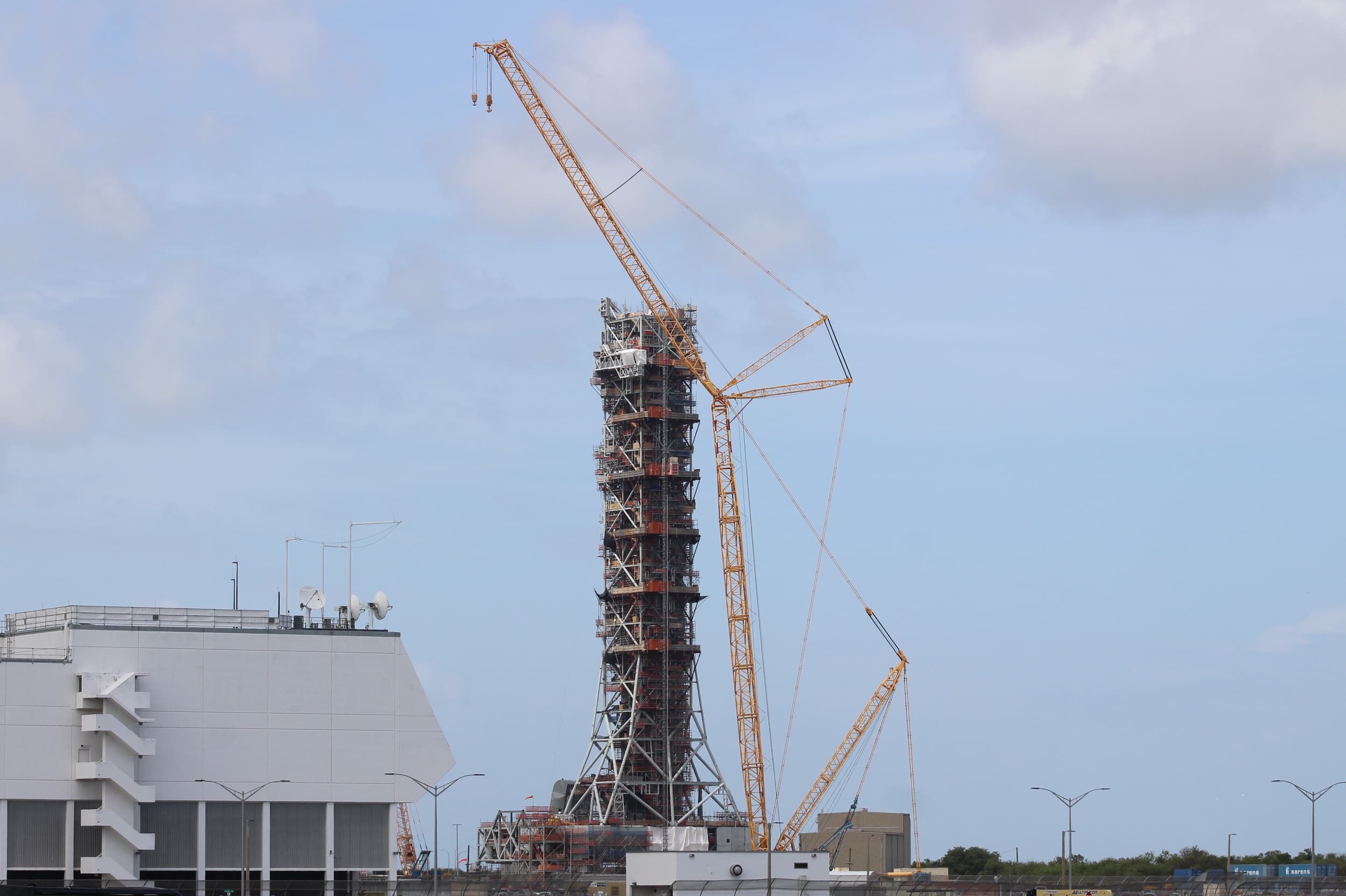
Washington — NASA has abruptly halted construction on Mobile Launcher 2 (ML-2), a $383 million launch platform originally intended for the Space Launch System’s (SLS) Block 1B configuration, which the agency has since abandoned. The decision, revealed during a March 29 briefing by Shawn Quinn, manager of NASA’s Exploration Ground Systems program, marks a significant strategic shift as the agency reallocates critical hardware from ML-2 to support ongoing Artemis missions. With the SLS Block 1B’s cancellation in late February, NASA is now focusing on standardizing future SLS launches around a "near Block 1" configuration, a move aimed at increasing flight rates and reducing logistical complexity. The pivot comes amid years of cost overruns and schedule delays for ML-2, which ballooned from an initial $383 million contract to an estimated $2.5 billion, with completion potentially delayed until 2029.
Why NASA Canceled SLS Block 1B and What It Means for Artemis Missions
NASA’s February 27 announcement that it would no longer pursue the SLS Block 1B rocket marked a pivotal moment in the agency’s Artemis program, which aims to return humans to the Moon. The Block 1B variant was designed to carry the larger Exploration Upper Stage (EUS), enabling heavier payloads and longer-duration missions. However, NASA officials cited rising costs, developmental delays, and the need for a more streamlined, flight-ready architecture as key drivers behind the decision. The agency has instead opted to standardize future SLS launches around a "near Block 1" configuration, which will rely on a modified Centaur upper stage—replacing the aging Interim Cryogenic Propulsion Stage (ICPS), of which only one unit remains in NASA’s inventory.
The End of an Era: How the Block 1B Cancellation Reshapes Lunar Plans
The cancellation of the Block 1B is not just a technical adjustment but a strategic realignment of NASA’s Moon-to-Mars ambitions. The EUS was slated to debut on Artemis 4, facilitating missions to the lunar Gateway and deeper lunar surface exploration. Without it, NASA will rely on the Block 1 configuration for at least the next several Artemis missions, delaying or scaling back some of the agency’s most ambitious lunar objectives. "We’re looking at a near-term flight rate that prioritizes reliability and sustainability," said Lori Glaze, NASA’s acting associate administrator for exploration systems development, during an April 2 briefing. "The Block 1 configuration, while less powerful, allows us to maintain momentum on Artemis while we evaluate long-term needs."
Replacing ICPS: The Role of the Centaur Upper Stage
NASA’s decision to replace the ICPS with a Centaur-derived upper stage for future SLS missions reflects a broader trend in the agency’s push for cost efficiency and reusability. The Centaur, a workhorse upper stage used on United Launch Alliance’s Atlas V rocket, offers a proven track record in spaceflight. While it lacks the payload capacity of the EUS, it provides a more immediate solution to keep Artemis missions on schedule. "The Centaur upper stage will allow us to extend the SLS’s operational lifespan without waiting for new, untested hardware," explained Shawn Quinn. The modification also aligns with NASA’s goal of leveraging existing commercial technologies to reduce development risks and accelerate timelines.
The Costly Collapse of Mobile Launcher 2: How a $383M Project Ballooned to $2.5B
The saga of Mobile Launcher 2 is a cautionary tale of government contracting gone awry. In 2019, NASA awarded Bechtel—a global engineering and construction giant—a cost-plus contract worth $383 million to design and build ML-2, with an original completion date set for March 2023. Cost-plus contracts, which reimburse the contractor for expenses plus a fee, are intended to mitigate risk but often lead to budget overruns when project scopes expand or timelines slip. By 2024, NASA’s Office of Inspector General projected ML-2’s total cost could reach $2.5 billion, with delivery potentially delayed until 2029—nearly six years behind schedule. The project’s struggles were compounded by Bechtel’s apparent underbidding, a miscalculation that left the company struggling to meet performance expectations. "Because Bechtel underbid on a cost-plus contract in order to, what appears, to get it," then-NASA Administrator Bill Nelson remarked at a May 2022 Senate hearing, "they couldn’t perform. And NASA is stuck."
A History of Delays and Design Challenges
ML-2 was designed to accommodate the SLS Block 1B’s larger dimensions, requiring a taller launch tower and repositioned umbilical arms to service the Exploration Upper Stage and Orion spacecraft. The platform’s complexity was exacerbated by the need for cryogenic propellant lines and high-pressure systems capable of handling the SLS’s massive fuel load. However, the design phase revealed unforeseen engineering hurdles, including structural reinforcements needed to withstand the acoustic and thermal stresses of an SLS launch. Bechtel’s struggles were further compounded by supply chain disruptions and workforce shortages, common challenges in large-scale aerospace projects. By 2023, independent reviews flagged the project as "at high risk of further cost growth and schedule slippage," prompting NASA to reassess its priorities.
How NASA Is Repurposing ML-2 Hardware for Artemis Missions
With ML-2’s future in limbo, NASA is salvaging what it can from the project to support ongoing Artemis missions. The agency has issued a stop-work order, halting further construction and redirecting teams to remove and store critical components slated for use on Mobile Launcher 1 (ML-1), the platform currently supporting SLS Block 1 launches. Key hardware, including umbilical arms for the core stage and Orion spacecraft, are being preserved as spares. These arms, identical in design to those on ML-1, contain components with long lead times—such as cryogenic flex lines—that would be costly or impossible to replace quickly. "We pivoted the team to begin removing some of the hardware that is common on Mobile Launcher 1 that we can use as critical spares," Quinn explained. "We can put them to good use in future Artemis missions supporting Mobile Launcher 1."
The Strategic Value of Umbilical Arms and Cryogenic Lines
The umbilical arms are a linchpin of the SLS launch system, delivering propellant, power, and communications to the rocket during pre-launch preparations. On ML-2, these arms were designed to interface with the Block 1B’s larger upper stage, but their core components—including cryogenic flex lines—are compatible with the Block 1 configuration. By salvaging these arms, NASA avoids the need to manufacture new ones, which could take years and millions of dollars. "The umbilical arms have parts on them that take a very long time to make," Quinn noted. "We’re going to take the arms off and we’re going to put them into storage and properly care for them so they can be used if we need to have parts for Mobile Launcher 1."
Lessons from Artemis 1 and 2: Improving Mobile Launcher 1 for Future Missions
The successful launch of Artemis 2 on April 1 marked a milestone for NASA’s Artemis program, but it also underscored the challenges facing the agency’s ground systems. The Artemis 1 launch in November 2022 caused unexpected damage to Mobile Launcher 1, particularly to its elevators, tubing, and blast doors. "We had a fair amount of repairs to do to tubing, to the elevators and to other equipment on the mobile launcher," Quinn said. Investigations revealed that the launcher’s water deluge system, designed to mitigate plume damage from the solid rocket boosters, failed due to a broken gaseous nitrogen line, leading to corrosion in hundreds of meters of tubing. In response, NASA implemented several upgrades, including reinforced blast doors and improved deluge system redundancy.
Hardening the Platform for Higher Flight Rates
To prevent similar damage in future launches, NASA has undertaken a series of structural and procedural upgrades to Mobile Launcher 1. These include installing stronger blast doors to protect elevators and critical systems, enhancing the water deluge system to ensure proper coverage, and refining models to predict plume-induced stress. "We learned from Artemis 1 and we redid our models for the kind of plume damage that we might get as the rocket leaves the mobile launcher," Quinn explained. Initial assessments of Artemis 2 suggest these changes were effective, with Lori Glaze noting that damage was "largely cosmetic" compared to the more severe impacts sustained during Artemis 1. The improvements are critical as NASA aims to increase its Artemis launch cadence, with Artemis 3 targeting a crewed lunar landing in 2026 and subsequent missions planned at roughly annual intervals.
The Broader Implications for NASA’s Moon-to-Mars Program
NASA’s pivot away from the SLS Block 1B and ML-2 reflects deeper challenges in the agency’s lunar exploration strategy. The Artemis program, which aims to establish a sustainable human presence on the Moon by the end of the decade, relies heavily on the SLS and Orion spacecraft as its backbone. However, the program has faced criticism for its high costs, repeated delays, and the emergence of commercial alternatives like SpaceX’s Starship and Blue Origin’s Blue Moon lander. The cancellation of Block 1B and the repurposing of ML-2 hardware signal NASA’s willingness to adapt, but they also raise questions about the long-term viability of the SLS program. "We’re in a transition period," Glaze said. "The near-term focus is on getting Artemis 3 to the Moon safely and on time, but we’re also looking at how to evolve our architecture for the 2030s and beyond."
Key Takeaways: What This Means for NASA, Artemis, and the Future of SLS
- NASA has halted work on Mobile Launcher 2, a $383M platform originally intended for the canceled SLS Block 1B rocket, due to cost overruns that ballooned to an estimated $2.5B.
- The agency is repurposing critical hardware from ML-2, including umbilical arms and cryogenic lines, to support ongoing Artemis missions using the SLS Block 1 configuration.
- NASA’s decision to standardize on a "near Block 1" SLS variant, paired with a Centaur-derived upper stage, aims to increase launch reliability and flight rates amid Artemis program pressures.
- Lessons learned from Artemis 1’s launcher damage have led to upgrades on Mobile Launcher 1, including reinforced blast doors and improved water deluge systems, which performed well during Artemis 2.
- The cancellation of Block 1B and ML-2’s halt reflect broader strategic challenges in NASA’s Moon-to-Mars program, highlighting the need for cost efficiency and adaptability in the face of commercial space competition.
What’s Next for NASA’s Artemis Program?
With Artemis 2 successfully launched and Artemis 3—the first crewed lunar landing mission—scheduled for 2026, NASA is under pressure to deliver on its promises. The agency’s shift away from Block 1B and ML-2 suggests a more pragmatic approach, prioritizing mission readiness over developmental ambitions. Future plans include refining the Centaur upper stage integration, continuing upgrades to Mobile Launcher 1, and evaluating the long-term role of SLS in the Artemis architecture. "Our goal is to fly safely and reliably," Glaze emphasized. "We’re not rushing, but we’re not slowing down either. The Moon is within reach, and we’re committed to getting there."
Frequently Asked Questions
- Why did NASA cancel the SLS Block 1B rocket?
- NASA canceled the SLS Block 1B due to rising costs, developmental delays, and a need to standardize on a more flight-ready configuration. The agency pivoted to a "near Block 1" version with a Centaur upper stage to increase launch reliability and maintain Artemis mission schedules.
- How much did Mobile Launcher 2 cost, and why did it overrun?
- Mobile Launcher 2 was initially contracted for $383 million in 2019, but costs ballooned to an estimated $2.5 billion due to design complexities, supply chain issues, and Bechtel’s underbidding on a cost-plus contract. The project faced repeated delays, with completion potentially pushed to 2029.
- What components from ML-2 will NASA reuse for Artemis missions?
- NASA is salvaging umbilical arms and cryogenic flex lines from ML-2, as these components are compatible with Mobile Launcher 1. The hardware, which has long lead times to manufacture, will be stored as spares to support future Artemis launches.