- NASA’s Juno spacecraft recorded lightning on Jupiter up to 100 times more powerful than Earth’s.
- Despite ongoing scientific value, Juno’s future is uncertain due to budget constraints.
- NASA faces tough choices between sustaining legacy missions and launching new explorations.
Since arriving at Jupiter in 2016, NASA’s Juno spacecraft has revolutionized our understanding of the gas giant’s turbulent atmosphere. Recently, researchers analyzing data collected during the mission’s extended phase confirmed that Jupiter experiences lightning flashes at least 100 times more intense than those seen on Earth—an extraordinary finding detailed in a study published March 20, 2024, in AGU Advances. Yet even as scientists uncover new mysteries beneath Jupiter’s swirling clouds, the very future of this trailblazing mission hangs in the balance. Financial pressures and shifting priorities within NASA threaten to terminate operations for one of humanity’s few active probes beyond the asteroid belt.
Why Jupiter Lightning Research Matters
Scientific Insights from Microwave Detection
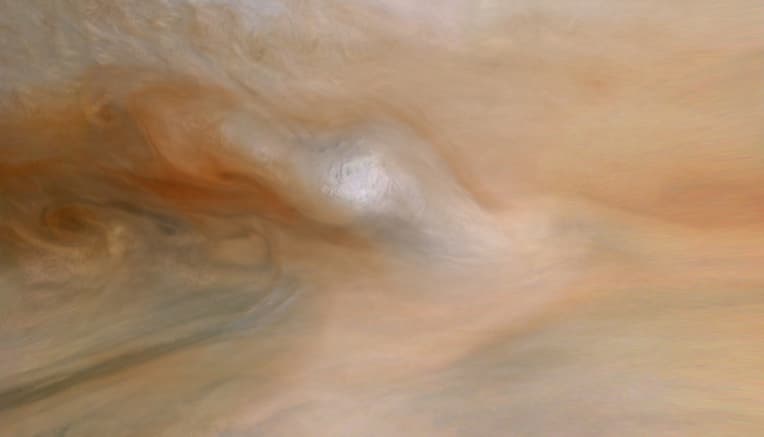
Unlike visual telescopes obscured by thick layers of Jovian cloud cover, Juno's Microwave Radiometer (MWR) enables direct observation of atmospheric activity occurring deep below the surface. During periods of reduced storm activity in 2021 and 2022, the spacecraft identified 613 distinct microwave pulses attributed to lightning. Power levels ranged from Earth-like intensities to discharges exceeding terrestrial norms by at least two orders of magnitude—a stark contrast that underscores fundamental differences in planetary meteorology. While confirmation remains elusive regarding whether some Jovian bolts reach energies a million-fold stronger than anything experienced on Earth, these readings provide critical clues into how charged particles behave across vastly different worlds.
Comparative Atmospheric Dynamics
Although both planets employ ice crystal interactions to initiate electrical discharge, environmental conditions vary dramatically between Earth and Jupiter. Terrestrial thunderclouds consist primarily of water vapor suspended in nitrogen-dominated surroundings where buoyant moisture readily ascends. In contrast, Jupiter’s dense hydrogen-rich atmosphere causes moist air parcels to sink rather than rise—requiring significantly greater thermal input before convection initiates. This substantial energy barrier contributes directly to the formation of larger, longer-lasting storm systems capable of generating exceptionally violent lightning events. Scientists like UC Berkeley researcher Michael Wong note that further investigation is required to determine whether compositional differences or vertical scale disparities account entirely for observed phenomena.
"Could the key difference be hydrogen versus nitrogen atmospheres, or could it be that the storms are taller on Jupiter and so there’s greater distances involved?" – Michael Wong, University of California, Berkeley
Budget Crunch Forces Difficult NASA Decisions
Agency Must Choose Between Old and New Missions
As part of an internal reevaluation process initiated under former President Donald Trump's fiscal year 2026 proposal—which sought severe reductions to NASA’s science budget—officials requested termination plans from teams managing over a dozen robotic missions currently operating throughout the solar system. Though congressional action prevented implementation of most proposed cuts, current appropriations remain approximately $220 million short of previous allocations for NASA’s planetary sciences division. Under pressure to maintain forward momentum on next-generation endeavors such as the Europa Clipper orbiter and Dragonfly rotorcraft bound for Titan, agency leadership now confronts unprecedented decisions involving operational sustainability versus expansion potential.
"We can’t quite afford to support everything that we have done in the past," – Louise Prockter, Director, NASA Planetary Science Division
Cost Versus Scientific Return Debate
Maintaining older spacecraft incurs annual costs approaching ten percent—or roughly $260 million—of the total planetary science budget. Extended operations, though scientifically rewarding, increasingly compete against newly approved ventures like OSIRIS-APEX continuing its journey toward a second asteroid encounter in 2029. According to Prockter, redirecting these funds could enable initiation of roughly two additional low-cost Discovery class missions within the next decade. Examples include resource-limited projects designed to address narrowly defined objectives such as asteroid sample retrieval or comet nucleus characterization. However, terminating productive assets like Juno risks foregoing unexpected breakthrough discoveries that emerge unpredictably from sustained observations of complex celestial bodies.
Historical Context of Long-Lived Space Probes
Legacy Missions That Transformed Our Understanding
Juno joins an elite cadre of veteran explorers whose prolonged service reshaped scientific paradigms well beyond original design parameters. Notable predecessors include Voyager 1 and 2, which first detected lightning in Jupiter's atmosphere during flybys beginning in 1979, and Cassini-Huygens, whose two-decade odyssey around Saturn yielded transformative findings about icy moons including Enceladus and Titan. Like Juno today, many of these flagships operated years beyond initial projections thanks to onboard redundancy and conservative fuel usage patterns. Even recently revived platforms like the Kepler space telescope continued contributing exoplanet detections until final shutdown in 2018. Their collective contributions validate arguments favoring extended mission longevity amid growing fiscal uncertainty.
Balancing Heritage Assets Against Future Goals
Beyond mere numbers, the dilemma reflects a philosophical shift within NASA strategy—from consolidating hard-won knowledge acquired incrementally through enduring surveillance to embracing rapid-cycle exploration aimed at answering unresolved core questions. Administrator Jared Isaacman has publicly advocated accelerating scientific output via streamlined acquisition models and maximized efficiency gains across all functional domains. Yet critics argue that premature closure of proven assets undermines institutional memory, wastes prior investments, and reduces flexibility necessary for adaptive responses to unanticipated developments. As policymakers navigate these tensions, Juno stands symbolically poised between yesterday's achievements and tomorrow's aspirations.
Impact of Potential Juno Termination
Loss of Unique Observational Capabilities
Should NASA decide to deactivate Juno, no other spacecraft would replace its singular vantage point monitoring Jupiter’s polar regions, magnetosphere dynamics, auroral behavior, and persistent cyclonic formations—including the iconic Great Red Spot estimated to have existed for nearly two centuries. Unlike Earth-based observatories constrained by distance and seasonal availability, Juno provides continuous real-time telemetry enabling correlation between electromagnetic fluctuations and geophysical responses occurring simultaneously at varying atmospheric depths. Such integrated views prove invaluable for modeling comparative planetary evolution processes applicable broadly throughout galactic exoplanetary systems.
Implications for Upcoming Missions
Prematurely ending Juno raises broader concerns about continuity gaps potentially undermining coordinated investigations planned alongside upcoming ventures like ESA’s Juice mission scheduled to enter Jovian orbit in July 2024. Without baseline datasets provided by Juno’s specialized instruments, synergistic collaborations essential for multi-agency cross-validation become logistically challenging and scientifically limiting. Moreover, absence of concurrent in situ measurements complicates interpretation of remote sensing data gathered exclusively from afar, reducing overall fidelity of resulting analyses used to refine theoretical constructs governing planetary magnetohydrodynamics.
Frequently Asked Questions
- How does Jupiter produce such strong lightning?
- Jupiter's immense size and unique atmospheric composition contribute to extremely tall, energetic storms. Moist convection behaves differently in its hydrogen-rich environment, requiring more energy to form but producing stronger updrafts and electrical discharges compared to Earth.
- What are NASA’s criteria for extending planetary missions?
- NASA evaluates several factors including remaining fuel reserves, hardware health status, scientific productivity rankings, cost effectiveness relative to newer alternatives, and compatibility with strategic roadmap goals prioritizing fresh discoveries over continued operation of existing assets.
- Will cutting old missions increase funding for new ones?
- Redirecting resources previously allocated to extended missions could theoretically fund development of two Discovery-class probes annually. However, actual implementation depends heavily upon congressional approval cycles and fluctuating economic climates impacting federal discretionary spending authority.