NASA Administrator Jared Isaacman unveiled sweeping changes to the Artemis program, aimed at restoring momentum, reducing technical risk, and establishing a sustainable path to lunar exploration. Citing persistent delays, technical setbacks, and an unsustainable three-year gap between SLS launches, Isaacman described the prior architecture as “not a path to success.”
Industry partners have largely endorsed the streamlined approach, though aligning the extensive SLS supply chain and workforce to the new plan will present implementation challenges.
The revised plan standardizes hardware configurations, adds a critical integrated systems test flight, increases launch cadence to roughly one SLS mission every 10 months, and maintains the target for the first crewed lunar landing in 2028—potentially with two landings that year. Artemis II remains the immediate priority: the first crewed Orion flight will loop around the Moon, with launch now targeted for April 2026. The SLS upper stage (ICPS) was rolled back to the Vehicle Assembly Building (VAB) after a helium leak—caused by a dislodged seal in the quick-disconnect system—was identified during preparations.
Artemis II stack back in the VAB for repairs, via Max Evans, NSF/L2
Repairs required special access platforms in High Bay 3, with rollout to Launch Pad 39B currently projected around March 19, 2026. It was during this repair period that Isaacman announced the comprehensive replan.
The most significant change affects Artemis III. Originally planned as the first crewed lunar landing in 2027, it has been reconfigured as an all-up systems test in low Earth orbit.
Orion will rendezvous and dock with one or both commercial Human Landing Systems—SpaceX’s Starship HLS and/or Blue Origin’s Blue Moon MK2—validating in-space operations, life support, propulsion, docking interfaces, and Axiom Space’s lunar EVA suits.
Explicitly modeled on Apollo 9, the mission eliminates the high-risk direct jump to surface operations without prior integrated testing.
Just like Apollo 9, Artemis III will test next-generation hardware and integrated operations in 2027 before Artemis IV lands on the lunar surface in 2028. By flying Moon rockets at an annual cadence, we develop the muscle memory, knowledge, and confidence required to land… https://t.co/iRkQJhvsyK — NASA Administrator Jared Isaacman (@NASAAdmin) March 3, 2026
By flying Moon rockets at an annual cadence, we develop the muscle memory, knowledge, and confidence required to land… https://t.co/iRkQJhvsyK
— NASA Administrator Jared Isaacman (@NASAAdmin) March 3, 2026
Artemis IV will then deliver the first crewed lunar landing in early 2028, with Artemis V following later that year for a second touchdown and initial outpost development. NASA intends to sustain at least one crewed landing per year thereafter, building toward an enduring lunar presence.
Although some media mistranslated this as a delay, it’s actually part of a drive to speed up the Artemis objectives.
To achieve this faster tempo, the agency is standardizing future SLS flights on a “near Block 1” configuration, canceling the planned Exploration Upper Stage (EUS) and associated Block 1B upgrades. Production lines will focus on repeatable, high-rate manufacturing to rebuild workforce “muscle memory.”
Isaacman framed the changes as a return to fundamentals: “Standardizing vehicle configuration, increasing flight rate, and progressing through objectives in a logical, phased approach, is how we achieved the near-impossible in 1969, and it is how we will do it again.”
President Trump gave the world the Artemis Program, and NASA and our partners have the plan to deliver. We will standardize architecture where possible, add missions and accelerate flight rate, execute in an evolutionary way, and safely return American astronauts to the Moon,… pic.twitter.com/Qjm6BD5Ipi — NASA Administrator Jared Isaacman (@NASAAdmin) February 27, 2026
— NASA Administrator Jared Isaacman (@NASAAdmin) February 27, 2026
He emphasized urgency in the face of “credible competition from our greatest geopolitical adversary.” At the same time, Associate Administrator Amit Kshatriya described the plan as providing “a more stable foundation, [and] more realistic path.”
Industry partners, including Boeing, SpaceX, Blue Origin, and ULA, along with bipartisan congressional support, have endorsed the approach and the additional funding secured for SLS production.
The overhaul adds one mission, reduces technical risk, and establishes a sustainable cadence capable of supporting long-term lunar infrastructure rather than isolated “flags and footprints” achievements.
Questions remain, however, regarding some implementation details and how all objectives will ultimately be met. NSF spoke to numerous workers involved with the vehicle for additional background.
ICPS to Centaur V: The New Upper Stage Path
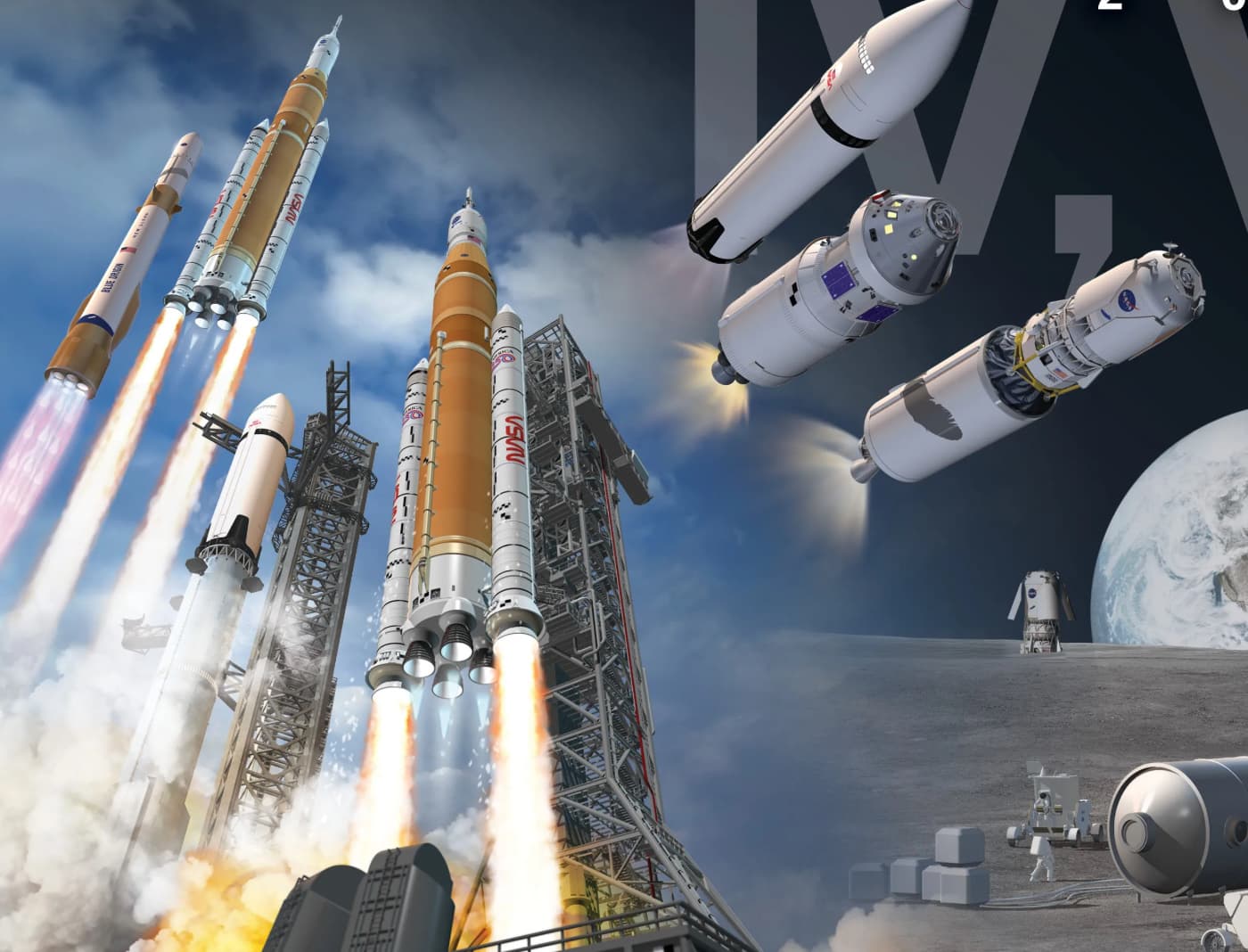
While Centaur V was not explicitly named in the announcement, sources and even NASA-released graphics strongly indicate it as the likely replacement for the ICPS starting after Artemis III.
On Friday, it was confirmed via a NASA contract award.
The ICPS—a single-engine (RL10) cryogenic upper stage derived from the Delta IV second stage—successfully supported Artemis I and is slated for Artemis II and the reconfigured Artemis III. Its Delta IV heritage limits high-rate production, contributing to extended launch gaps.
The original plan called for transitioning to the more powerful, four-engine EUS with Artemis IV to enable heavier payloads and Block 1B capability.
EUS development, however, encountered significant delays and cost overruns, making it incompatible with the push for standardized, rapid flights. One “update” famously presented nothing more than a render of some of the hardware via a TV screen on the factory floor at Michoud.
NASA has canceled EUS and Block 1B/2 upgrades entirely, opting for a standardized upper stage to support ~10-month intervals and annual landings from 2028. The agency describes this as a “near Block 1” setup with a new second stage.
Centaur V—ULA’s modern dual-RL10 LH2/LOX upper stage for Vulcan Centaur—offers proven reliability, ongoing production, human-rating heritage, and propellant compatibility.
Thought you guys might enjoy seeing a trio of Centaur Vs in the final assembly stands. There are 5 stations. 4 supported 25/yr with a 5th for surge pic.twitter.com/NUb5wIk0kF — Tory Bruno (@torybruno) August 7, 2024
— Tory Bruno (@torybruno) August 7, 2024
Its larger capacity could deliver comparable or better translunar performance without major SLS redesigns, aligning with the “back to basics” focus on repeatable hardware.
ML-1 to ML-2 conversion, via L2 documentation
The shift from SLS Block 1 (ICPS) to Block 1B (EUS) previously necessitated Mobile Launcher 2 (ML-2) due to height and interface differences that would have severely impacted ML-1 refurbishment schedules.
ML-2, built by Bechtel, reached approximately 90% completion (final stacking in 2025, standing ~377 feet tall) at a cost exceeding $1 billion.
ML-2 by Max Evans on March 6, 2026.
NASA has since stated it is “no longer planning to use… Mobile Launcher 2.” With EUS and Block 1B canceled, ML-2 is surplus to requirements for Artemis.
ML-1 will support all future missions, with relatively minor modifications to umbilical arms and interfaces expected to accommodate the new upper stage—changes far less extensive than those required for EUS.
Sources note that NASA has actually studied Centaur V (and similar options) as potential SLS upper stages since at least 2021, which would ease the transition outlined in the replan.
It was also noted that the “umbilical playground” known as the Launch Equipment Test Facility (LETF) at KSC, which was recently mothballed, is expected to resume testing to validate any ML-1 umbilical adjustments, and some work on ML-2’s umbilical systems reportedly continues.