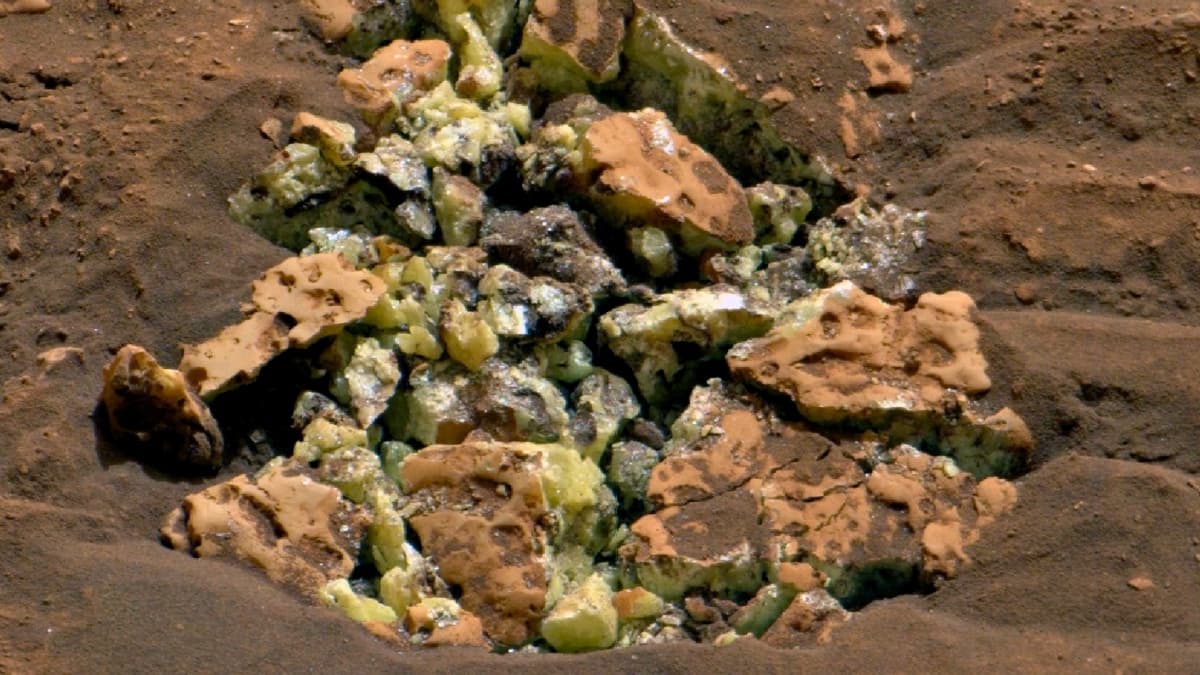
In a serendipitous discovery, NASA's Curiosity rover cracked open an unassuming rock on Mars in May 2024, revealing bright yellow crystals of pure sulfur—a first for the Red Planet. The find, made in the Gediz Vallis Channel, has left scientists puzzled about how this rare, elemental form of sulfur formed under Martian conditions. The discovery suggests that pure sulfur may be more abundant in certain regions of Mars than previously believed, offering new clues about the planet's geological history and potential habitability.
- NASA's Curiosity rover discovered pure sulfur on Mars, a first for the planet, in May 2024.
- The sulfur was found in the Gediz Vallis Channel, an ancient Martian waterway rich in geological history.
- Scientists are investigating how pure sulfur formed under Martian conditions, which could reshape understanding of the planet's past.
- The discovery suggests elemental sulfur may be more widespread in certain regions of Mars than previously thought.
- Curiosity's instruments identified the sulfur, but the rover's path played a crucial role in the accidental discovery.
How Curiosity Accidentally Uncovered Pure Sulfur on Mars
While exploring the Gediz Vallis Channel—a region once shaped by flowing water billions of years ago—the Curiosity rover rolled over a fragile rock, inadvertently cracking it open. Inside, scientists found bright yellow crystals of pure sulfur, also known as brimstone. Unlike sulfates, which are common on Mars and form when sulfur combines with other minerals in water, pure sulfur only forms under very specific conditions.
Why This Discovery Challenges Current Understanding
Sulfates have long been detected on Mars, providing insights into the planet's water history and climate evolution. However, pure sulfur is far rarer and requires unique geological processes to form. The discovery raises questions about whether similar deposits exist elsewhere on Mars and what conditions allowed for their formation.
Finding a field of stones made of pure sulfur is like finding an oasis in the desert. It shouldn't be there, so now we have to explain it. Discovering strange and unexpected things is what makes planetary exploration so exciting.
The Significance of Sulfur for Mars Exploration
Sulfur is a critical element for life as we know it, playing a role in the formation of essential amino acids. While the discovery does not confirm the presence of life on Mars, it adds to growing evidence of past habitable conditions, including water, chemistry, and organic molecules. The Gediz Vallis Channel, once a riverbed, may hold further clues about Mars' potential to support life in its distant past.
How This Discovery Could Reshape Mars Science
The presence of pure sulfur suggests that Mars' geological history may be more complex than previously understood. Scientists will now analyze the region in greater detail, possibly using advanced modeling to reconstruct how sulfur deposits formed. The discovery also highlights the importance of serendipity in space exploration, as Curiosity's accidental encounter with the rock led to this breakthrough.
What’s Next for Curiosity and Mars Exploration
Curiosity will continue its mission in the Gediz Vallis Channel, analyzing more rocks and soil to determine if pure sulfur is more widespread. Meanwhile, NASA's Perseverance rover, which landed on Mars in February 2021, is also making groundbreaking discoveries, including potential meteorites and signs of ancient water activity. Both rovers are part of NASA's broader effort to understand Mars' past habitability and prepare for future human exploration.
Frequently Asked Questions
Frequently Asked Questions
- Why is the discovery of pure sulfur on Mars significant?
- Pure sulfur is rare on Mars and forms under specific conditions, suggesting unknown geological processes. Its presence could provide new insights into Mars' past environment and potential habitability.
- How did Curiosity accidentally find sulfur?
- While exploring the Gediz Vallis Channel, the rover rolled over a fragile rock, cracking it open and revealing bright yellow sulfur crystals inside.
- What does this discovery mean for the search for life on Mars?
- While not direct evidence of life, the discovery adds to growing evidence of past habitable conditions, including water, chemistry, and essential elements like sulfur.