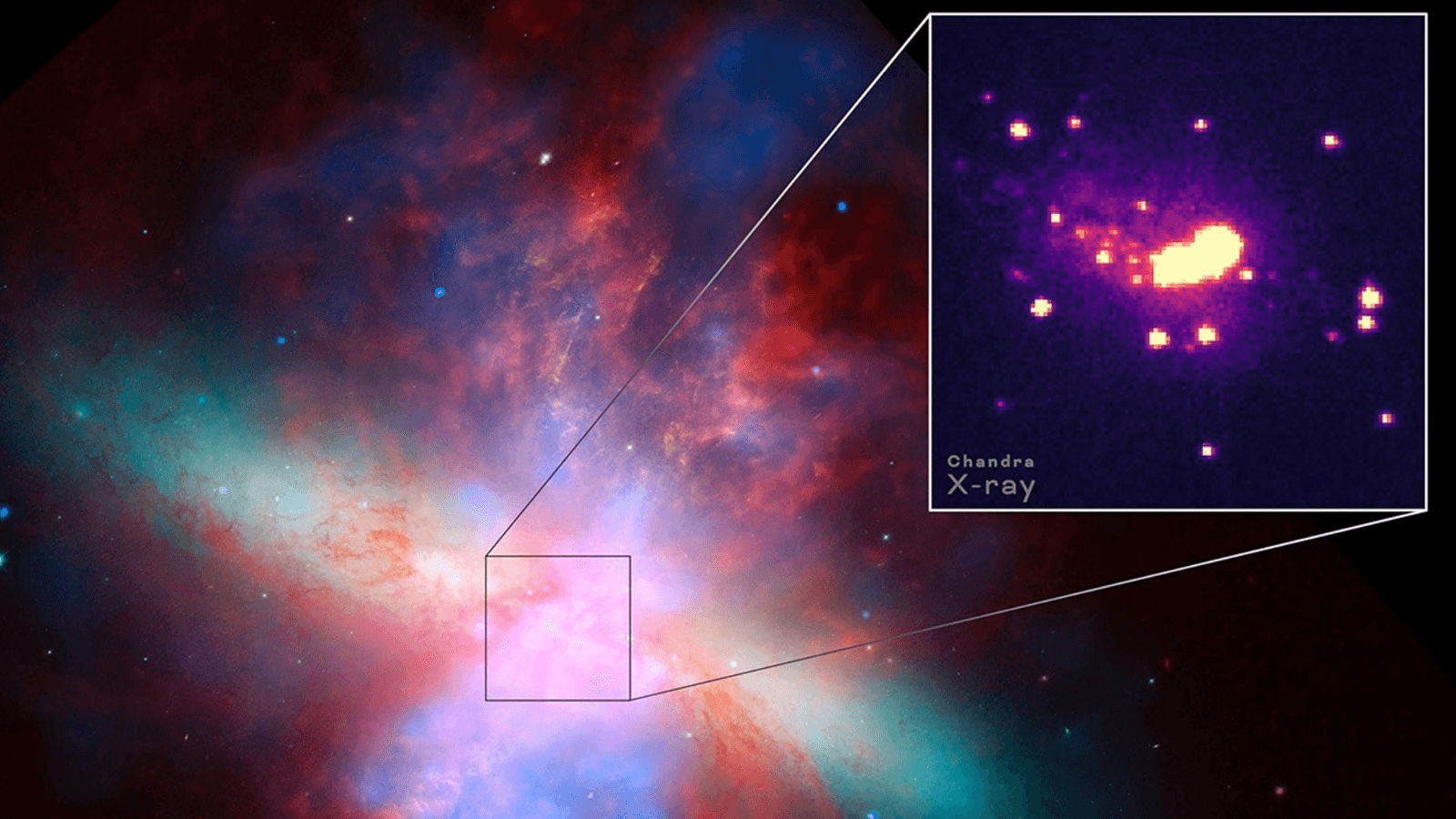
NASA’s cutting-edge X-ray Imaging and Spectroscopy Mission (XRISM) has uncovered one of the most violent phenomena in the universe: supersonic winds tearing through the heart of a distant star-forming galaxy at speeds exceeding 2 million miles per hour. The discovery, centered on the aptly named Cigar Galaxy—officially cataloged as Messier 82 (M82)—not only challenges long-held astrophysical models but also offers unprecedented insight into the mechanisms that govern galactic evolution. Using its advanced Resolve instrument, XRISM detected these hyper-velocity winds emanating from M82’s core, where temperatures soar to 45 million degrees Fahrenheit, driving material outward in a cosmic hurricane that ejects the equivalent of seven solar masses of gas every year.
Why M82’s Galactic Winds Matter: A Cosmic Puzzle Unfolds
Starburst galaxies like M82 are among the most prolific stellar nurseries in the universe, birthing new stars at rates hundreds of times greater than our Milky Way. These regions are also known for their extreme outflows—massive streams of gas and dust that can extend tens of thousands of light-years into space. But until now, astronomers lacked the tools to measure the true speed and scale of these winds. The XRISM mission, launched in September 2023, has changed that. By analyzing X-ray emissions from superheated iron in M82’s core, the spacecraft confirmed winds traveling at 2 million mph, far exceeding earlier predictions. This finding forces scientists to rethink how energy from star formation and supernovae shapes the interstellar medium and even influences the fate of entire galaxies.
The Role of Cosmic Rays and Supernova Shockwaves
The traditional explanation for galactic winds in starburst galaxies involves shockwaves from intense star formation and supernova explosions near the galactic center. These violent events heat surrounding gas to millions of degrees, creating high-pressure zones that drive material outward. However, XRISM’s data suggests this process may be even more dynamic than previously believed. Erin Boettcher, a researcher at the University of Maryland and NASA’s Goddard Space Flight Center, noted in a statement that while the classic model holds merit, the observed wind speeds—faster than many simulations predicted—indicate additional forces at play.
One such force could be cosmic rays, high-energy particles accelerated by supernova remnants and other violent astrophysical events. These particles may provide the extra pressure needed to propel gas out of the galaxy entirely. ‘We believe cosmic rays are a major contributor to the pressure driving these outflows,’ Boettcher explained. ‘Understanding their role is crucial because they don’t just push gas—they also shape the galaxy’s magnetic fields and influence future star formation.’
XRISM’s Breakthrough: Measuring the Unmeasurable
Launched as a joint mission between NASA and the Japan Aerospace Exploration Agency (JAXA), XRISM is designed to observe the universe in X-rays, a part of the electromagnetic spectrum blocked by Earth’s atmosphere. Its Resolve instrument—a microcalorimeter spectrometer—can detect the faintest X-ray emissions, allowing scientists to measure the Doppler shifts in light from superheated gas in M82’s core. By focusing on iron atoms heated to 25 million degrees Celsius, the team determined wind speeds of over 3.2 million kilometers per hour. ‘Prior to XRISM, we didn’t have the ability to measure velocities needed to test [the shockwave model],’ Boettcher said. ‘Now we see gas moving even faster than some models predict, more than enough to drive the wind all the way to the edge of the galaxy.’
The Mystery of the Missing Mass: Where Does All the Gas Go?
While the discovery of these hyper-velocity winds is groundbreaking, it also presents a conundrum. XRISM’s data shows that M82’s core expels seven solar masses of gas annually—a rate that, if sustained, should theoretically power the galaxy’s larger, cooler outflows. Yet the observations reveal that far more material is being ejected than expected. ‘If the wind blows steadily at the speed we’ve measured, then we think it can power the larger, cooler wind by driving out four solar masses of gas a year,’ said Edmund Hodges-Kluck, a member of the XRISM team. ‘But XRISM tells us much more gas is moving outward. Where do the three extra solar masses go? Do they escape out of the galaxy as hot gas some other way? We don’t know.’
Theories and Unanswered Questions
One possibility is that some of the expelled gas is heated to such extreme temperatures that it becomes invisible to XRISM’s instruments, only detectable at other wavelengths. Another theory suggests that magnetic fields within the galaxy could be channeling the gas into different paths, allowing it to escape more efficiently. Alternatively, the additional mass might be reaccreted by the galaxy in a feedback loop, influencing future star formation. Skylar Grayson of Arizona State University, another team member, emphasized the need for further study: ‘Some of our early models of starburst galaxies were developed in the 1980s, and we’re finally able to test them in ways that weren’t possible before XRISM. It provides opportunities to figure out why the model might not be capturing everything that’s going on in the real universe.’
M82: A Galaxy Under the Microscope
Located approximately 12 million light-years from Earth in the constellation Ursa Major, M82 is a dwarf galaxy with a diameter of about 37,000 light-years—roughly one-third the size of the Milky Way. Despite its modest dimensions, M82 is one of the closest and most studied starburst galaxies, making it an ideal laboratory for astronomers. Its elongated, cigar-like shape is the result of a gravitational interaction with its larger neighbor, M81, which triggered a burst of star formation roughly 100 million years ago. This event, known as a tidal interaction, compressed interstellar gas, igniting a wave of stellar births that continues today.
Observations Across the Spectrum
M82’s dramatic outflows have been observed by an array of space telescopes, including the Hubble Space Telescope, the James Webb Space Telescope (JWST), the Chandra X-ray Observatory, and the Spitzer Space Telescope. Each instrument provides a different perspective: Hubble captures visible-light images of the galaxy’s turbulent gas clouds, while JWST’s infrared sensors reveal the warm dust heated by newborn stars. Chandra’s X-ray data highlights the superheated gas in the galaxy’s core, and Spitzer’s observations trace the cooler, more extended outflows. XRISM’s contribution is unique in its ability to measure the velocities of these winds with unparalleled precision.
The Broader Implications for Galactic Evolution
Understanding galactic winds is crucial for astronomers studying the lifecycle of galaxies. These outflows can regulate star formation by removing gas—the raw material for new stars—from a galaxy. In extreme cases, they may even strip entire galaxies of their star-forming potential, transforming them into ‘red and dead’ elliptical galaxies. The winds observed in M82 are a prime example of this process in action. By studying how these winds operate, researchers hope to better understand why some galaxies evolve into sprawling spirals like the Milky Way, while others become compact, gas-poor ellipticals.
What’s Next for XRISM and Starburst Research?
The XRISM team plans to continue monitoring M82 and other starburst galaxies to unravel the remaining mysteries of galactic winds. Future observations may involve combining XRISM data with radio and optical telescope readings to create a more comprehensive picture of these outflows. Additionally, the mission’s findings will inform the development of next-generation astrophysical models, potentially leading to new insights into the role of cosmic rays and magnetic fields in galactic dynamics. ‘This is just the beginning,’ Hodges-Kluck noted. ‘XRISM is giving us a new window into the high-energy universe, and we’re only scratching the surface of what it can reveal.’
- NASA’s XRISM mission measured winds of 2 million mph in the starburst galaxy M82, the fastest ever recorded in such a galaxy.
- The winds eject seven solar masses of gas annually, but the fate of three extra solar masses remains unknown, challenging existing models.
- Cosmic rays may play a significant role in driving these outflows, alongside shockwaves from supernovae.
- M82’s extreme star formation was triggered by a gravitational interaction with its neighbor M81, making it a key case study in galactic evolution.
- XRISM’s Resolve instrument uses X-ray spectroscopy to measure gas velocities and temperatures with unprecedented precision.
Frequently Asked Questions
Frequently Asked Questions
- What is the Cigar Galaxy, and why is it important?
- The Cigar Galaxy, or M82, is a nearby starburst galaxy located 12 million light-years away in Ursa Major. It is undergoing a period of intense star formation, triggered by a gravitational interaction with its neighbor M81, and its outflows of gas and dust are among the most studied in astronomy.
- How does XRISM measure wind speeds in galaxies?
- XRISM’s Resolve instrument detects X-ray emissions from superheated iron atoms in the galaxy’s core. By analyzing the Doppler shift in these X-rays, scientists can calculate the speed of the gas and determine wind velocities.
- What are cosmic rays, and how do they affect galactic winds?
- Cosmic rays are high-energy particles, often accelerated by supernovae, that permeate galaxies. They can exert pressure on interstellar gas, helping to drive outflows and influence the galaxy’s magnetic fields.