The cosmos may be expanding more slowly in our local neighborhood than astronomers had long believed, according to two groundbreaking studies that could help resolve one of cosmology’s most perplexing mysteries—the so-called ‘Hubble tension.’ Using an innovative technique to analyze the movements of galaxies within nearby groups, researchers have calculated a Hubble constant of approximately 64 kilometers per second per megaparsec (km/s/Mpc), a value that falls between previous measurements derived from local supernovae and the cosmic microwave background (CMB), the afterglow of the Big Bang. This convergence suggests that the discrepancy may stem not from missing physics, but from how scientists measure the universe’s expansion, potentially reducing the need to invoke exotic new forces or particles.
- The local universe may expand at ~64 km/s/Mpc, slower than the 73 km/s/Mpc suggested by local supernovae measurements.
- The Hubble tension arises from conflicting expansion rate values derived from different observational methods.
- New analysis of Centaurus A and M81 galaxy groups indicates less dark matter may be required to explain galactic dynamics.
- Findings align more closely with CMB-based predictions from the standard cosmological model (Lambda CDM).
- Upcoming data from the 4MOST telescope could expand this method’s reach to more distant galaxy groups.
What Is the Hubble Constant and Why Does It Matter?
The Hubble constant, denoted H₀, is the universe’s expansion rate, named after astronomer Edwin Hubble, who in the 1920s discovered that galaxies are moving away from each other at speeds proportional to their distance. This foundational insight revealed that the cosmos is not static but dynamically expanding—a discovery that reshaped modern cosmology. Today, H₀ is measured in kilometers per second per megaparsec (km/s/Mpc), where 1 megaparsec equals 3.26 million light-years. For example, a Hubble constant of 70 km/s/Mpc implies that a galaxy 1 megaparsec away recedes at 70 km/s, while one 10 megaparsecs away moves at 700 km/s. Accurately determining H₀ is critical because it helps scientists estimate the universe’s age, predict its ultimate fate, and test the validity of the standard cosmological model, known as Lambda Cold Dark Matter (ΛCDM).
The Two Competing Methods That Created the Hubble Tension
The current dispute over the Hubble constant stems from two primary measurement techniques, each offering starkly different results. The first method relies on ‘standard candles’—Type Ia supernovae, which explode with a predictable brightness. By observing these supernovae in nearby galaxies and measuring their redshift (the stretching of light due to cosmic expansion), astronomers calculate a local H₀ value of approximately 73 km/s/Mpc. The second method uses the cosmic microwave background (CMB), the relic radiation from the Big Bang, observed by missions like the European Space Agency’s Planck satellite. By analyzing temperature fluctuations in the CMB, cosmologists extrapolate H₀ to about 68 km/s/Mpc using the ΛCDM model. The 5 km/s/Mpc gap, though seemingly small, represents a statistically significant discrepancy that has persisted even as measurement precision has improved. This ‘Hubble tension’ suggests either an unknown systematic error in one of the methods or the need for new physics beyond the standard model.
How Astronomers Used Galaxy Groups to Reassess Expansion
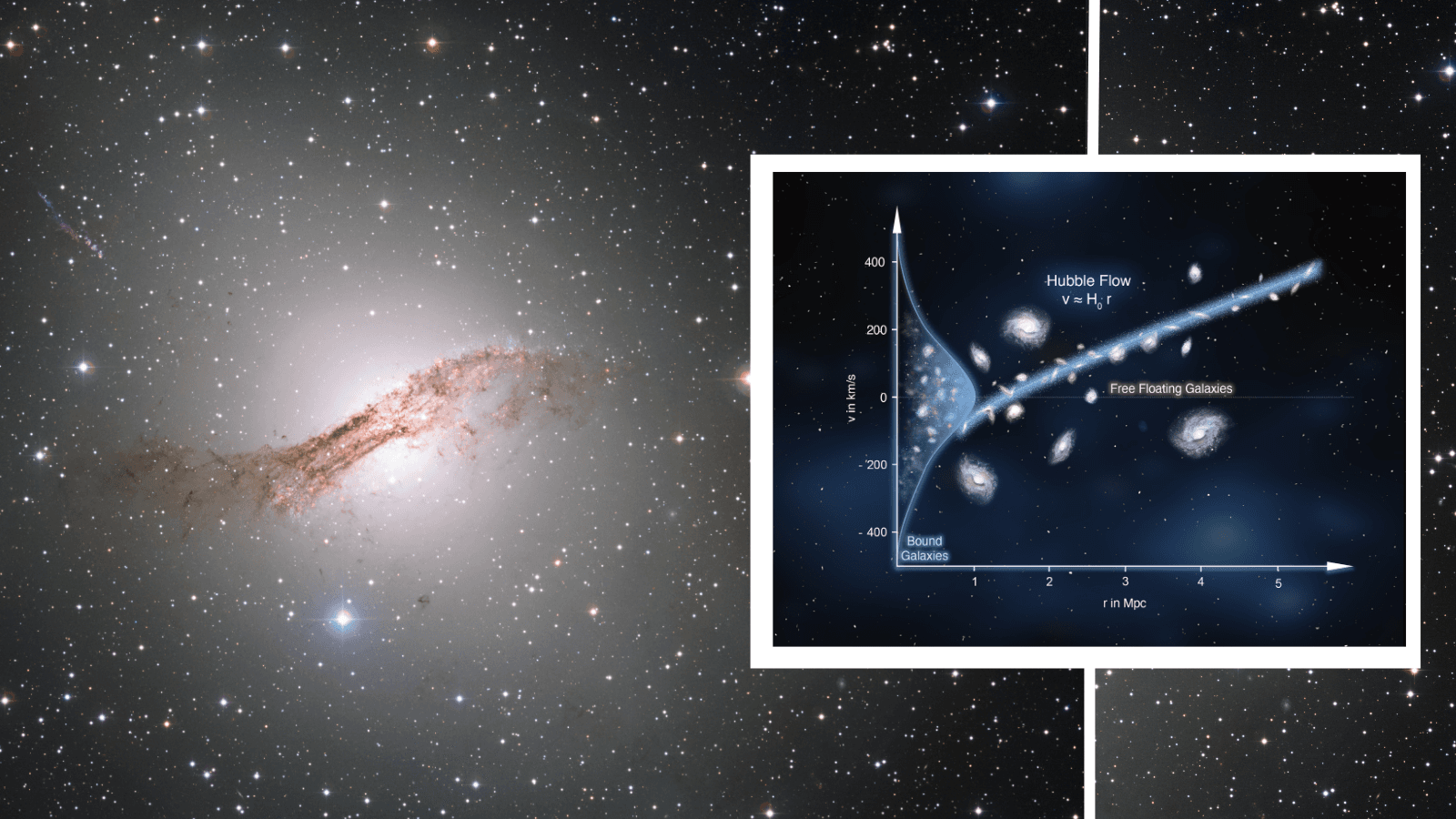
Instead of relying on supernovae or the CMB, two independent research teams turned to the motions of galaxies within nearby groups to estimate the Hubble constant. These galaxy groups are caught in a cosmic tug-of-war: their member galaxies are gravitationally bound to one another, yet simultaneously pulled apart by the universe’s expansion. By analyzing this delicate balance, scientists can infer the expansion rate. The teams focused on two prominent galaxy groups: the Centaurus A group, the closest major galactic assembly beyond our Local Group (which includes the Milky Way), and the M81 group, a collection of galaxies about 12 million light-years from Earth.
Revealing the Centaurus A Group’s Hidden Structure
One of the studies, published in *Astronomy & Astrophysics*, examined the Centaurus A group, long thought to be dominated by the massive elliptical galaxy Centaurus A itself. However, the researchers discovered that Centaurus A and the nearby spiral galaxy M83 actually form a binary system, challenging prior assumptions about the group’s mass distribution. ‘We found that the dominant galaxies in these groups don’t require vast dark matter halos to explain their dynamics,’ said one of the lead authors, Dr. Marcel Pawlowski of the Leibniz Institute for Astrophysics Potsdam. ‘The motions of the smaller galaxies can be largely attributed to the gravitational influence of the brightest members.’ This revelation suggests that dark matter’s role in shaping galaxy groups may be less critical than previously believed.
The M81 Group’s Mysterious Tilt and Cosmic Alignment
The second study, also published in *Astronomy & Astrophysics*, analyzed the M81 group, which includes the famous interacting galaxies M81 and M82. The team found that the inner region of the group, spanning roughly 1 million light-years, is tilted by about 34 degrees relative to its outer structure, which extends up to 10 million light-years. This misalignment is part of a larger, sheet-like structure of matter that connects the M81 group to the Centaurus A group. ‘The alignment we observed suggests these groups are part of a larger, dynamically coherent cosmic web,’ explained Dr. Helmut Jerjen of the Australian National University, a co-author on the paper. ‘This structure could influence how we model the distribution of mass in the local universe.’
Why the New Hubble Constant Measurement Matters
The most striking implication of these findings is their potential to alleviate the Hubble tension. By arriving at a Hubble constant of approximately 64 km/s/Mpc—closer to the CMB-derived value than to local supernova measurements—the studies offer a compromise that could reduce the need for exotic explanations. Previously, some cosmologists speculated that the tension might require revisions to the ΛCDM model, such as the introduction of new particles (e.g., sterile neutrinos) or modifications to dark energy. However, the new galaxy-group method suggests that the discrepancy may instead stem from systematic uncertainties in how we measure H₀. ‘This is not a definitive resolution, but it’s a significant step toward understanding where the discrepancies come from,’ said Dr. Adam Riess, a Nobel laureate and Johns Hopkins University astronomer who was not involved in the studies. ‘It’s possible we’ve been overestimating the role of dark matter in local dynamics.’
Implications for Dark Matter and Galaxy Formation
The findings also challenge long-held assumptions about dark matter’s role in galaxy dynamics. The ΛCDM model posits that galaxies are embedded in massive, invisible dark matter halos that exert gravitational influence over their surroundings. However, the new analysis suggests that the brightest galaxies within these groups may account for most of the observed motions, reducing the need for extensive dark matter. ‘If dark matter halos aren’t as dominant as we thought, it could reshape our understanding of galaxy formation and evolution,’ said Dr. Pawlowski. This aligns with emerging evidence from dwarf galaxies and ultra-diffuse galaxies, which often exhibit gravitational dynamics that are difficult to reconcile with massive dark matter halos.
The Road Ahead: Expanding the Method to the Wider Universe
While the new technique shows promise, it is currently limited to two nearby galaxy groups. To validate these results, astronomers must apply the method to a broader sample of galactic assemblies across the local universe. The next major opportunity will come with the fourth data release from the 4-meter Multi-Object Spectroscopic Telescope (4MOST), a survey instrument in Chile that will provide high-resolution spectra for millions of galaxies. ‘With 4MOST, we’ll be able to study galaxy groups out to much greater distances, testing whether our local measurements hold up on cosmic scales,’ said Dr. Jerjen. ‘If the pattern persists, it could be a game-changer for cosmology.’ Other upcoming observatories, such as the Vera C. Rubin Observatory and the Nancy Grace Roman Space Telescope, may also contribute by mapping the motions of galaxies with unprecedented precision.
Broader Context: The Hubble Tension in Cosmology
The Hubble tension is more than just a numerical discrepancy—it’s a fundamental challenge to our understanding of the universe. Since the early 2000s, when the first precise CMB measurements suggested a lower H₀ value, astronomers have debated whether the issue lies in observational errors, theoretical assumptions, or a genuine gap in our knowledge. Some researchers have proposed that the tension could indicate the need for ‘early dark energy,’ a hypothetical force that briefly accelerated the universe’s expansion shortly after the Big Bang. Others have suggested that local measurements might be skewed by the Milky Way’s motion through the cosmic web, a phenomenon known as the ‘bulk flow.’ The new galaxy-group studies add a fresh perspective by focusing on the gravitational dynamics of galactic neighborhoods, rather than relying on distant supernovae or the primordial universe.
What’s Next for Cosmological Models?
The convergence of the new H₀ measurement with CMB-based predictions does not yet close the case on the Hubble tension. However, it does provide a compelling alternative to invoking new physics. Future work will likely involve cross-verifying the galaxy-group method with other emerging techniques, such as using gravitational waves from neutron star mergers (a field known as ‘standard sirens’) or analyzing the distribution of baryonic matter in galaxy clusters. ‘The beauty of this approach is that it doesn’t require us to throw out the ΛCDM model,’ said Dr. Riess. ‘Instead, it encourages us to refine our measurements and better understand the local universe’s structure.’ As more data becomes available, cosmologists may finally resolve whether the Hubble tension is a crisis or merely a calibration challenge.
Conclusion: A Step Closer to Cosmic Clarity
The discovery that the local universe may expand more slowly than previously thought represents a significant advancement in our quest to understand cosmic expansion. By leveraging the motions of galaxies within nearby groups, astronomers have uncovered a potential pathway to reconcile conflicting measurements of the Hubble constant without resorting to untested theoretical innovations. While the Hubble tension is not yet resolved, these findings offer a glimmer of hope that the discrepancies may stem from observational biases rather than fundamental flaws in our cosmological framework. As observational tools like 4MOST and future space telescopes come online, the scientific community will have the opportunity to test these results on a grander scale. For now, the studies underscore the importance of approaching cosmic mysteries with both creativity and rigor, reminding us that even in an era of precision cosmology, the universe still holds surprises.
Frequently Asked Questions
- What is the Hubble tension and why is it important?
- The Hubble tension refers to the 5 km/s/Mpc discrepancy between the universe’s expansion rate measured locally (using supernovae) and the rate inferred from the cosmic microwave background. It matters because resolving it could confirm or challenge our standard model of cosmology, ΛCDM.
- How did the new studies measure the universe’s expansion rate?
- The teams analyzed the motions of galaxies within the Centaurus A and M81 groups, which are bound by gravity but pulled apart by cosmic expansion. By studying this balance, they calculated a Hubble constant of ~64 km/s/Mpc.
- Does this finding mean dark matter is less important in galaxies?
- Not necessarily, but it suggests that the brightest galaxies in these groups may account for most of the observed gravitational dynamics, potentially reducing the need for vast dark matter halos in these specific cases.