
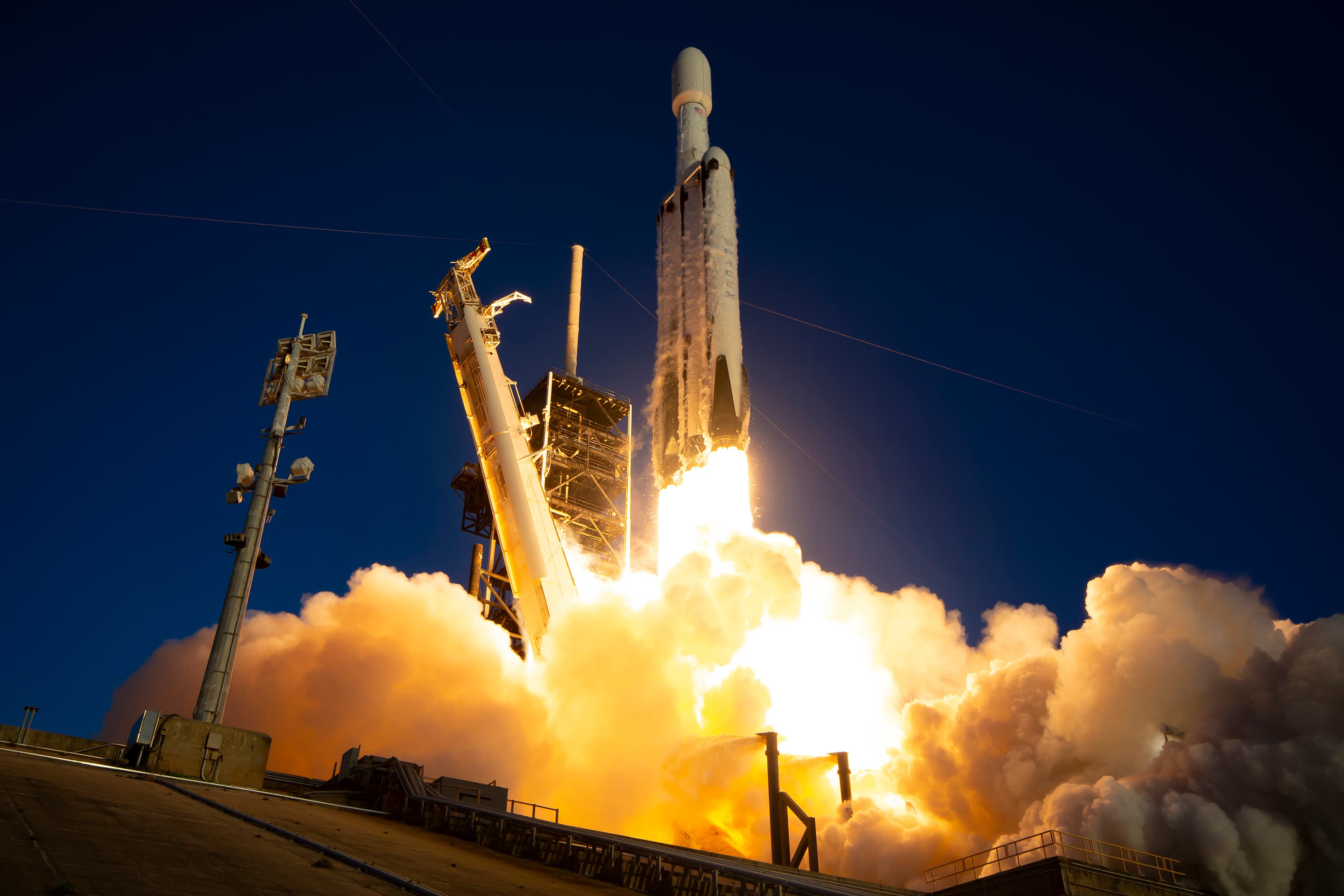
NASA’s $4.3 billion Nancy Grace Roman Space Telescope is now on its way into deep space, beginning a five-year mission designed to transform how scientists survey the Universe. Equipped with a 300-megapixel camera and a refurbished spy telescope mirror, Roman will scan vast areas of the sky at a speed far beyond Hubble. The observatory could uncover billions of galaxies, tens of thousands of planets and thousands of supernovae while helping scientists investigate two of the Universe’s biggest mysteries: dark energy and dark matter.
Roman Heads for Deep Space
A SpaceX Falcon Heavy launched Roman at 7:25 a.m. EDT Sunday from Launch Complex 39A at NASA’s Kennedy Space Center in Florida. The rocket’s 27 main engines delivered the roughly 20,000-pound observatory toward the Sun-Earth L2 Lagrange point, nearly 1.5 million kilometers from Earth. Roman is expected to reach its operational orbit in about three months. Ground teams will activate and calibrate the spacecraft during the journey. NASA expects the first science images to be ready by the end of the year. “This is a big spacecraft,” said Denton Gibson, NASA’s launch director for the Roman mission. “We needed all 5 million pounds of thrust on that Falcon Heavy, which performed flawlessly.”
A Spy Telescope Became NASA’s Next Great Observatory
Roman has an unusual origin story. Its 7.9-foot, or 2.4-meter, primary mirror began life as part of a telescope built for the National Reconnaissance Office, the U.S. government’s spy satellite agency. NASA received two surplus NRO telescopes in 2012 after a surveillance satellite program was canceled. Scientists eventually selected one for what became the Roman mission. The donated hardware forced NASA to redesign the observatory around it. Engineers also modified the mirror to accommodate the telescope's new operating environment. “It certainly wasn’t just plug and play,” said Julie McEnery, senior project scientist for Roman at NASA’s Goddard Space Flight Center. The payoff is a telescope with a mirror roughly the same diameter as Hubble's, but with a dramatically wider field of view.
Roman Will Survey the Sky at Extraordinary Speed
Roman is designed to cover 12 percent of the sky during its mission. Hubble, by comparison, has observed about 0.1 percent during its 36 years in orbit. The difference comes down largely to Roman’s Wide Field Instrument, a near-infrared camera capable of capturing an area larger than the full Moon. NASA expects the observatory to discover tens of thousands of new planets, billions of galaxies, thousands of supernovae and tens of billions of stars. Nicky Fox, head of NASA’s Science Mission Directorate, said Roman's speed will allow scientists to conduct surveys that would take Hubble vastly longer. “What Roman can do in a month would take Hubble a century,” Fox said. The scale of the imagery will be enormous. Julie McEnery said more than half a million 4K televisions would be needed to display a single image from Roman's largest survey.
Dark Energy and Dark Matter Are Prime Targets
Roman's broad surveys are designed to help scientists understand the forces and structures shaping the Universe. Dark energy is believed to account for about 70 percent of the cosmos and is associated with the accelerating expansion of the Universe. Dark matter makes up a little more than a quarter, while ordinary matter makes up the remainder. Neither dark energy nor dark matter has been directly observed. Roman could provide enough data to test whether the current Standard Model of the Universe accurately describes reality. Roman’s surveys will also map enormous structures, including clusters of galaxies and the filaments of matter and dark matter that form the cosmic web. “Roman isn’t just doing Hubble and Webb science faster,” Fox said. “It’s doing fundamentally different science that could not be done by either observatory.”
The Telescope Will Hunt for Distant Planets
Roman is not focused only on galaxies. Its coronagraph will block the intense light from stars, allowing astronomers to directly image planets orbiting them. The instrument is designed to detect planets that can be as much as 100 million times fainter than their host stars. NASA says Roman’s coronagraph is expected to be 100 to 1,000 times more sensitive than previous coronagraphs on Hubble and Webb. Scientists will use the technology to study the sizes, atmospheres and structures of exoplanets. The work could also help shape future missions aimed at directly imaging rocky planets in habitable zones. Roman will search for additional planets using the transit method, detecting the small changes in starlight that occur when a planet passes in front of its star.
Roman Will Generate 20 Petabytes of Data
The telescope's scientific reach comes with an enormous data challenge. Roman is expected to transmit about 1.4 terabytes of data to Earth during a single day of observations. Across its planned five-year primary mission, NASA expects the observatory to generate about 20 petabytes, or 20,000 terabytes. Hubble has produced a little more than 400 terabytes since its launch in 1990. Roman's data will therefore require a different approach. Scientists have developed a cloud-based platform where researchers can access and analyze the observations instead of relying solely on personal computers. “No single person is going to be able to look at all of the stars and all the galaxies and all the unusual things that we’re going to see with Roman,” said Jeremy Perkins, an integration and test scientist at NASA Goddard.
A New Kind of Cosmic Survey
Roman will also perform observations that Hubble and Webb cannot easily replicate. During one survey, it will cover an area equivalent to 3,455 full Moons in about three weeks. It will then repeatedly observe a smaller portion of that region over five-and-a-half days. That rapid, repeated coverage could allow scientists to create 3D views of activity across the Milky Way and distant galaxies. “We will do fundamentally different science,” said Jackie Townsend, NASA’s project manager for the Roman mission. “In some subset of our observations, we’re going to be making 3D movies of what is going on in the Milky Way galaxy and in distant galaxies.” Roman is intended to work alongside Hubble and the James Webb Space Telescope rather than replace them. Its wider view will give scientists a different way to study the same Universe.
What Comes Next
Roman now faces roughly three months of travel before reaching its operational position around L2. During that time, NASA teams will activate and calibrate its instruments. Once observations begin, the telescope will start building an enormous map of the cosmos, with the first science images expected by the end of the year. The mission's biggest discoveries may not be objects scientists already expect to find. With a survey this large, Roman could reveal patterns or phenomena that were simply impossible to see with narrower telescopes. As Townsend put it, scientists may discover that they understood the Universe differently once Roman's dataset becomes available.
FAQ
What is NASA’s Nancy Grace Roman Space Telescope?
The Nancy Grace Roman Space Telescope is a NASA astrophysics observatory designed to survey large areas of the Universe and investigate dark energy, dark matter, galaxies, stars and exoplanets.
When did the Roman Space Telescope launch?
Roman launched Sunday at 7:25 a.m. EDT from NASA’s Kennedy Space Center in Florida aboard a SpaceX Falcon Heavy rocket.
How is Roman different from Hubble?
Roman has a field of view about 100 times wider than Hubble’s and is designed to survey the sky much faster. NASA expects some Roman observations to be conducted at a speed about 1,000 times faster than Hubble.
What will the Roman Space Telescope discover?
NASA expects Roman to discover tens of thousands of planets, billions of galaxies, thousands of supernovae and tens of billions of stars during its mission.
How much data will Roman produce?
Roman is expected to generate about 20 petabytes, or 20,000 terabytes, of data during its planned five-year prime mission.


