The first mission of Northrop Grumman's big new cargo spacecraft is nearly over.
The NG-23 Cygnus XL launched atop a SpaceX Falcon 9 rocket on Sept. 14, carrying about 11,000 pounds (4,990 kilograms) of scientific gear and other supplies toward the ISS.
That big cargo load explains the new freighter's name: Earlier versions of Cygnus hauled about 8,500 pounds (3,856 kg) to the orbiting lab.
Cygnus XL had a bit of a hiccup on its debut mission, suffering an engine glitch on its way to the station. The spacecraft — named the S.S. William "Willie" McCool, after one of the seven astronauts who died in the 2003 space shuttle Columbia accident — overcame the problem, however, arriving at the ISS on Sept. 18, a day later than originally planned.
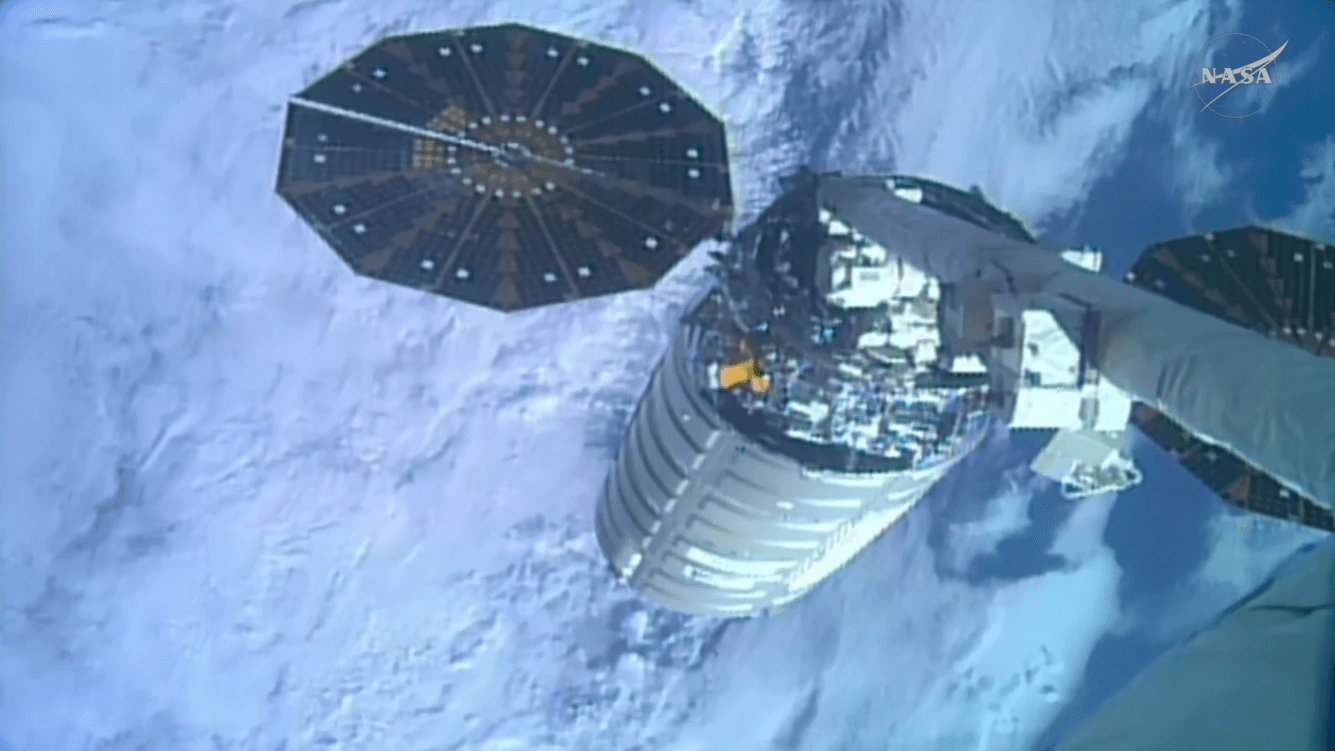
The orbiting outpost's Canadarm2 grappled Cygnus XL that day, berthing it to the Unity module. The big robotic arm was put to work again Thursday as well, removing S.S. William "Willie" McCool from Unity and then releasing it 260 miles above the South Atlantic Ocean. The release was followed by a six-minute thruster burn by Cygnus, backing away from the ISS and its approximately 650-foot (200 meters) safety perimeter "keep-out sphere."
Breaking space news, the latest updates on rocket launches, skywatching events and more!
"From all of us here in Houston and our partners at Northrop Grumman and our robotics team in Montreal, we want to thank you for your assistance with the departure today," mission controllers said to French astronaut Sophie Adenot, operator of the Canadarm2 this morning, adding, "missions like this don't happen without the dedication and teamwork of so many people across NASA and our partners."
Cygnus is one of four robotic cargo spacecraft that service the ISS these days, along with SpaceX's Dragon capsule, Russia's Progress vehicle and the Japan Aerospace Exploration Agency's (JAXA) HTV-X. Dragon is reusable, but the other three burn up in Earth's atmosphere when their missions are over.
HTV-X — a more advanced version of the Japanese HTV freighter — just wrapped up its first-ever visit to the orbiting lab, departing on March 6 after a four-month stay. That cargo craft will remain in orbit as a free flyer for the next three months or so, hosting a suite of JAXA science experiments.
Michael Wall is a Senior Space Writer with Space.com and joined the team in 2010. He primarily covers exoplanets, spaceflight and military space, but has been known to dabble in the space art beat. His book about the search for alien life, "Out There," was published on Nov. 13, 2018. Before becoming a science writer, Michael worked as a herpetologist and wildlife biologist. He has a Ph.D. in evolutionary biology from the University of Sydney, Australia, a bachelor's degree from the University of Arizona, and a graduate certificate in science writing from the University of California, Santa Cruz. To find out what his latest project is, you can follow Michael on Twitter.
You must confirm your public display name before commenting
Please logout and then login again, you will then be prompted to enter your display name.