- Jiaqi Lei1 na1,
- Kai Yang1 na1,
- Wanyue Cao2,3,4 na1,
- Shaolong Qi1,
- Xianlong Du1,
- Hongjian Li5,
- Yangfan Wang1,
- Jinqun Gan1,
- Yunxuan Feng1,
- Yongcan Li1,
- Wenjie Zhang1,
- Xin Lin ORCID: orcid.org/0000-0003-0956-36545,
- Xinhui Su6,
- Qi Zhang ORCID: orcid.org/0000-0002-6096-06902,3,4,
- Tingbo Liang ORCID: orcid.org/0000-0003-0143-33532,3,4 &
- Guocan Yu ORCID: orcid.org/0000-0003-1157-41841,5
Nature (2026)Cite this article
- Biomedical engineering
- DNA and RNA
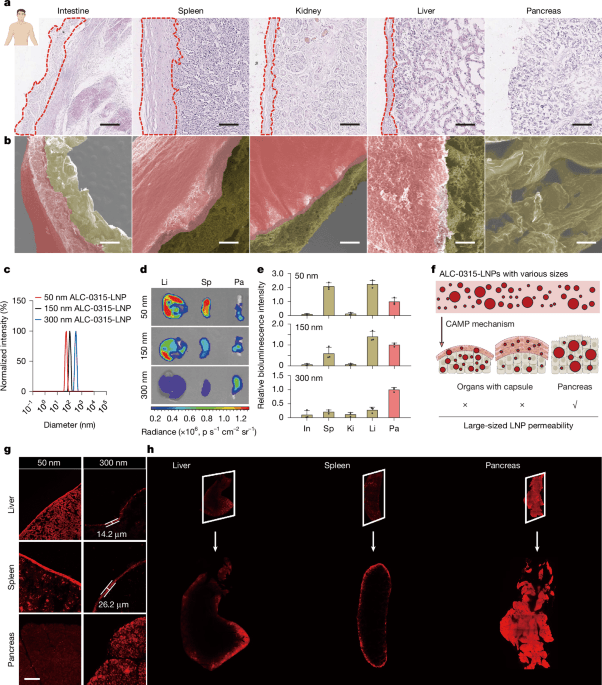
Achieving pancreatic-targeted delivery marks a breakthrough in treating pancreatic diseases, yet precise delivery remains challenging1. Here we identify an explicit and universal principle for pancreatic-selective delivery and propose a pancreatic-targeted lipid nanoparticle (AH-LNP) for mRNA delivery. AH-LNP exhibits size enlargement after assembly with proteins, facilitating capsule-filter-mediated pancreas-selective accumulation and receptor-mediated endocytosis, thereby boosting the pancreatic-targeted ability. Benefiting from this, AH-LNP enables precise and efficient genome editing in the pancreas through the delivery of Cas9 mRNA and single guide RNA (sgRNA), exhibiting promising potential in the treatment of autoimmune pancreatic diseases. Furthermore, pancreatic-targeted delivery of mRNA encoding therapeutic cytokines through AH-LNP demonstrates superior antitumour efficacy when combined with a cancer vaccine or chimeric antigen receptor T cell therapy in multiple pancreatic cancer models. The safety and pancreatic mRNA delivery of AH-LNP were verified in multiple animal models, including non-human primates, demonstrating great promise for clinical translation. Our findings highlight the transformative potential of this pancreatic-targeted mechanism and the derived LNP platform, opening avenues for developing precision therapeutics against diverse pancreatic diseases.
This is a preview of subscription content, access via your institution
Access Nature and 54 other Nature Portfolio journals
Get Nature+, our best-value online-access subscription
Receive 51 print issues and online access
- Purchase on SpringerLink
- Instant access to the full article PDF.
Prices may be subject to local taxes which are calculated during checkout
- Learn about institutional subscriptions
- Read our FAQs
- Contact customer support