Strange things happen to materials when you peel them down, layer by layer, from thick chunks all the way to sheets just an atom thick. Reporting in the journal Nature Materials, a team led by physicists at The University of Texas at Austin has experimentally demonstrated a sequence of exotic magnetic phases in an ultrathin material that fully realizes, for the first time, a theoretical model of two-dimensional magnetism first proposed in the 1970s. The researchers say the advance might inspire new ultracompact technologies.
The sequence of exotic magnetic phases involves two key transitions that occur as certain materials cool down towards absolute zero. Both transitions have been observed experimentally on their own before, but never together in a complete sequence.
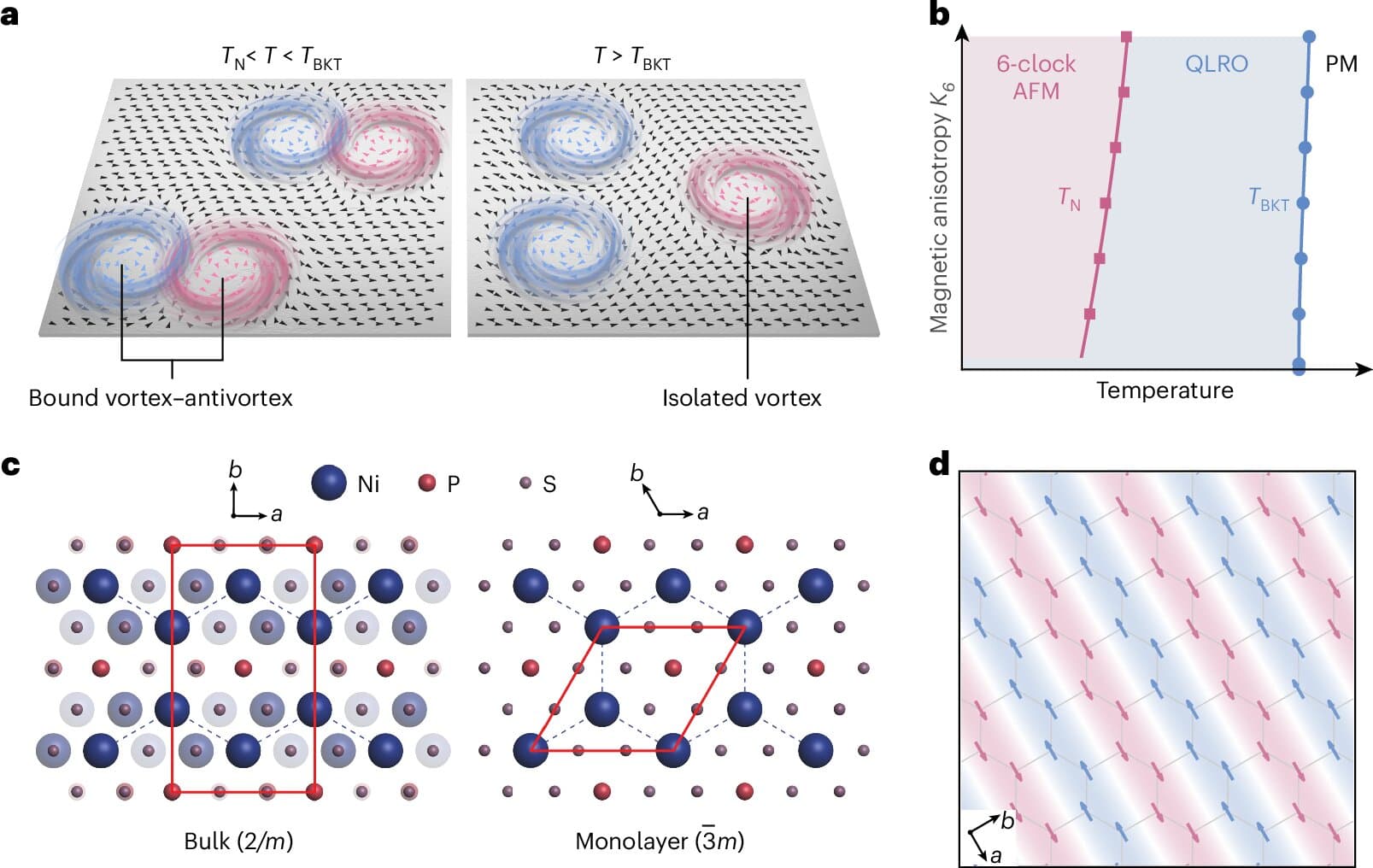
When the researchers cooled an atomically thin sheet of nickel phosphorus trisulfide (NiPS3) to temperatures between -150 and -130° C, the material entered the first special magnetic phase, called a Berezinskii–Kosterlitz–Thouless (BKT) phase. In this regime, the magnetic orientations associated with individual atoms in the material—known as magnetic moments—form swirling patterns called vortices. Pairs of these vortices wind in opposite directions, one clockwise and the other counterclockwise, and remain tightly bound together.
The BKT phase is named after Vadim Berezinskii and Nobel Prize winners J. Michael Kosterlitz and David Thouless, who were awarded the 2016 Nobel Prize in Physics for their theoretical description of this type of phase transition.
"The BKT phase is particularly intriguing because these vortices are predicted to be exceptionally robust and confined to just a few nanometers laterally while occupying only a single atomic layer in thickness," said Edoardo Baldini, assistant professor of physics at UT and leader of the research. "Because of their stability and extremely small size, these vortices offer a new route to controlling magnetism at the nanoscale and provide insight into universal topological physics in two-dimensional systems."
Upon further cooling, the material transitioned into a second distinct magnetic phase, called a six-state clock ordered phase, in which magnetic moments adopt one of six symmetry-related orientations. The observation of both the BKT regime and the low-temperature ordered state establishes the experimental realization of the two-dimensional six-state clock model—a paradigmatic theoretical framework proposed in the 1970s.
"At this stage, our work demonstrates the full sequence of phases expected for the two-dimensional six-state clock model and establishes the conditions under which nanoscale magnetic vortices naturally emerge in a purely two-dimensional magnet," Baldini said.
Future work on the BKT phase will be aimed at finding the right combination of material properties to stabilize similar magnetic phases at higher and higher temperatures, perhaps even all the way up to room temperature. This initial observation sets an important foundation for these efforts.
Beyond NiPS3, the findings indicate that a broad class of two-dimensional magnetic materials may host previously unexplored phases, opening new directions for both fundamental physics and nanoscale device concepts.
Frank Y. Gao et al, Six-state clock physics in an atomically thin antiferromagnet, Nature Materials (2026). DOI: 10.1038/s41563-026-02516-7
Citation: Physicists discover long-predicted 'clock magnetism' in an atomically thin crystal (2026, March 2) retrieved 4 March 2026 from https://phys.org/news/2026-03-physicists-clock-magnetism-atomically-thin.html
This document is subject to copyright. Apart from any fair dealing for the purpose of private study or research, no part may be reproduced without the written permission. The content is provided for information purposes only.