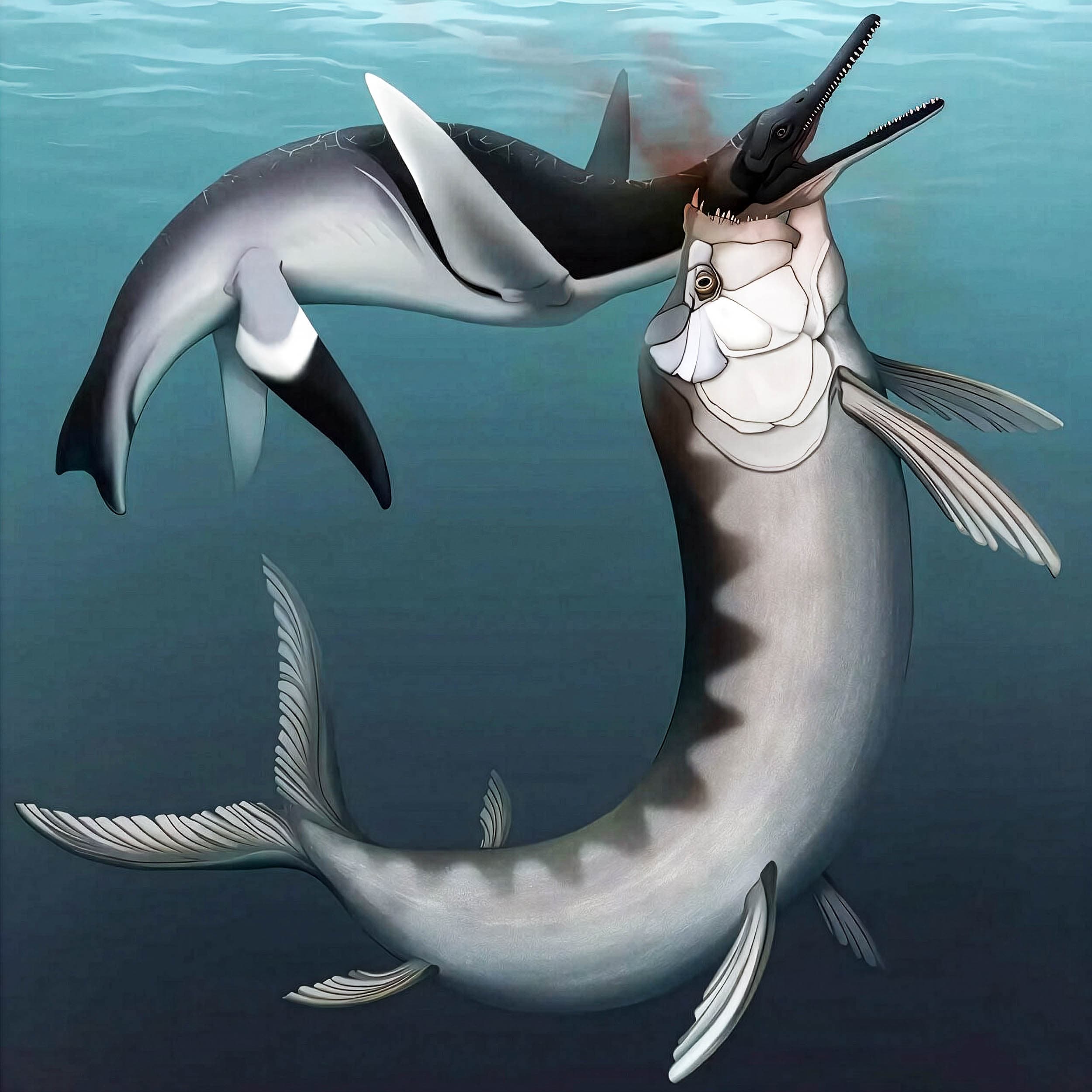
In a prehistoric drama that would make modern nature documentaries pale in comparison, researchers have uncovered direct fossil evidence of a violent clash between two of the ocean’s most fearsome predators—one that ended in a fatal feast. A 13-foot-long marine reptile known as a Polycotylus plesiosaur, preserved in Alabama’s Mooreville Chalk formation, carries a crushed tooth from a giant predatory fish called Xiphactinus lodged deep within a neck vertebra. The discovery, published in the journal *Cretaceous Research*, offers scientists a rare glimpse into the brutal feeding behaviors and competitive dynamics of apex predators that ruled Cretaceous seas roughly 80 million years ago. Unlike typical predator-prey relationships, this fossil suggests that the roles of hunter and victim were not always so neatly defined—and that ancient marine ecosystems were far more chaotic than previously thought.
- A 13-foot Polycotylus plesiosaur fossil from Alabama’s Mooreville Chalk contains a crushed Xiphactinus tooth embedded in its neck vertebra, proving a fatal attack occurred.
- Researchers used CT scanning and 3D modeling to identify the tooth as belonging to Xiphactinus, a massive predatory fish that typically swallowed prey whole.
- The bite targeted the plesiosaur’s neck, a vulnerable area that could sever its airway and major blood vessels, leading to rapid death and quick sinking into anoxic waters.
- This fossil challenges the notion of neatly categorized predator-prey relationships in the Cretaceous, revealing a violent ecosystem where competition and chance led to deadly encounters.
- The Mooreville Chalk formation has yielded multiple bite marks from sharks, marine reptiles, and large fish, suggesting a complex food web where scavenging and predation often overlapped.
How the Cretaceous Marine Food Web Was Far More Violent Than Previously Believed
For decades, paleontologists have pieced together ancient ecosystems by categorizing species into clear roles: herbivores, carnivores, scavengers, and apex predators. The Cretaceous oceans, teeming with life from ammonites to mosasaurs, were no exception. Yet this newly analyzed fossil from Alabama’s Mooreville Chalk—dating back to the Late Cretaceous period, approximately 80 million years ago—challenges that tidy framework. The Mooreville Chalk, a marine deposit stretching across parts of Alabama and Mississippi, has long been a treasure trove of marine reptile fossils, including plesiosaurs, mosasaurs, and the occasional land animal washed offshore. But this particular specimen, a Polycotylus plesiosaur, stands out not just for its size—13 feet long—but for the gruesome evidence preserved within its bones.
Polycotylus plesiosaurs were not the largest marine reptiles of their time—that title belonged to the 50-foot-long Elasmosaurus—but they were formidable hunters in their own right. With elongated necks, streamlined bodies, and powerful flippers, they were built for agility and speed in pursuit of fish, squid, and other prey. Xiphactinus, on the other hand, was a bony fish that could grow up to 18 feet long, with a mouth lined with sharp, conical teeth designed to impale slippery prey. Traditionally, Xiphactinus has been depicted as a gulper, swallowing entire fish—sometimes even those too large for its body—based on fossils like the famous "Fish-within-a-Fish" specimen at the Sternberg Museum in Kansas, where a smaller fish is preserved mid-swallow inside a Xiphactinus’s ribcage. Yet the Alabama plesiosaur fossil tells a different story: one of direct conflict, where two top predators crossed paths in a deadly encounter.
The Mooreville Chalk: Alabama’s Window into a Lost Ocean Ecosystem
The Mooreville Chalk Formation is one of the most significant fossil beds in North America for understanding the Late Cretaceous period. Stretching over 300 miles across central Alabama, this geological layer consists of fine-grained marine sediment deposited when much of the southeastern U.S. was submerged beneath a shallow inland sea known as the Western Interior Seaway. During the Cretaceous, this seaway connected the Arctic Ocean to the Gulf of Mexico, creating a vast, nutrient-rich environment that teemed with life. The Mooreville Chalk has yielded an astonishing array of fossils, including the remains of ammonites, sharks, marine reptiles, and even the occasional dinosaur bone washed offshore from nearby landmasses.
What makes the Mooreville Chalk particularly valuable to paleontologists is its preservation conditions. Rapid burial in fine sediment, coupled with low oxygen levels in deeper waters, slowed decomposition and scavenger activity. This allowed even delicate structures like skin impressions and stomach contents to survive for millions of years. The formation has already produced evidence of shark bites on mosasaur bones, bite marks from other marine reptiles, and even the remains of land animals that drifted into the sea and were scavenged by predators. Against this backdrop, the Polycotylus plesiosaur fossil—with its embedded Xiphactinus tooth—adds another layer to the story of a violent, competitive ecosystem where survival often depended on speed, strength, and sheer luck.
Decoding the Fatal Bite: How a Single Tooth Rewrote Ancient Predator Behaviors
The key to this discovery lies in a single, broken tooth embedded in the neck vertebra of the Polycotylus plesiosaur. Stephanie Drumheller, a paleontologist at the University of Tennessee, Knoxville (UT Knoxville), first noticed the anomaly while examining the fossil. Unlike typical predator-prey interactions, where bite marks might be superficial or healed, this injury showed no signs of healing—indicating the attack occurred at or near the time of death. The tooth was lodged deep within the vertebra, broken at both ends, which made identification challenging. Traditional methods of fossil preparation, which involve carefully removing rock to expose bones, risked destroying the fragile evidence. So Drumheller and her team turned to computed tomography (CT) scanning, a non-invasive technique that allows researchers to peer inside fossils without damaging them.
The CT scan revealed the tooth’s hidden structure: a large, conical shape with a hollow center, slightly curved to match the curvature of a Xiphactinus jaw. UT Knoxville undergraduates Miles Mayhall and Emma Stalker took the analysis further, digitally separating the tooth from the surrounding bone and constructing a 3D model. This model not only confirmed the tooth’s origin but also exposed damage at its base and tip, which explained why it appeared so confusing in its embedded state. F. Robin O’Keefe, a professor of biological sciences at Marshall University and co-author of the study, linked the injury to the plesiosaur’s exposed neck anatomy. "Plesiosaurs are famous for their long necks, but those necks come at a price," O’Keefe explained. "A blow there could tear the airway and major vessels, leaving the animal little chance to survive."
“This fossil is a good reminder that nature is rarely that cut and dry,” said Drumheller. “We often assume predator-prey relationships follow predictable patterns, but this find shows that ancient ecosystems were far more complex—and violent—than we imagined.”
Three Possible Scenarios: Was This a Hunt, a Fight, or a Post-Mortem Bite?
While the fossil provides undeniable proof of a violent encounter, the exact circumstances of the attack remain open to interpretation. Researchers have outlined three primary scenarios that could explain the embedded tooth, each with different implications for our understanding of Cretaceous marine life.
1. A Direct Hunting Attempt Gone Wrong
In this scenario, Xiphactinus targeted the Polycotylus plesiosaur as prey, aiming for a vulnerable spot—the neck. Plesiosaurs, with their long necks, were agile hunters, but their necks also presented a significant weakness. A bite to the neck could sever the trachea or major blood vessels, leading to rapid exsanguination or suffocation. However, this theory conflicts with what we know about Xiphactinus’s typical feeding behavior. The fish was primarily a gulper, swallowing smaller prey whole, and its teeth were not well-suited for slicing or tearing flesh. The size discrepancy between the two animals—Xiphactinus was likely larger than the 13-foot plesiosaur—also raises questions about whether the fish would have seen the plesiosaur as potential food.
2. A Violent Clash Between Apex Predators
Another possibility is that the bite occurred during a direct confrontation between the two predators. Competition for resources in the Cretaceous seas was fierce, and encounters between top predators were not uncommon. A Xiphactinus might have attacked a plesiosaur in a territorial dispute, during mating season, or simply out of aggression. The neck wound suggests a high-risk, high-reward strategy—one that could have ended the plesiosaur’s life instantly. This scenario aligns with other fossil evidence from the Mooreville Chalk, which shows bite marks from multiple predators, including sharks and mosasaurs, on marine reptile bones. It also supports the idea that ancient marine ecosystems were not as neatly divided as once thought, with predators sometimes turning on one another.
3. A Post-Mortem Bite from a Scavenger
The third possibility is that the bite occurred after the plesiosaur’s death, when its carcass sank to the seafloor and was scavenged by a passing Xiphactinus. This would explain why the tooth was embedded in the neck—a location rich in soft tissue that scavengers often target. The lack of healing in the bone supports this idea, as does the fact that the plesiosaur’s carcass sank quickly into anoxic waters, preserving it nearly intact. However, this scenario still points to a violent ecosystem where scavengers played a significant role in the food web. It also raises questions about how often predator-prey conflicts in the Cretaceous ended with one animal becoming another’s meal, even if the original attack was not the cause of death.
Why the Neck Was a Fatal Weakness for Cretaceous Marine Reptiles
The plesiosaur’s neck was both a marvel of evolution and a critical vulnerability. Stretching up to 20 feet in some species, the neck allowed plesiosaurs to strike at prey with precision, but it also exposed vital systems to attack. A bite to the neck could sever the trachea, jugular vein, or carotid artery, leading to rapid death. For a predator like Xiphactinus, targeting the neck would have been a high-stakes gamble—one that could yield a quick kill but also risk injury from the plesiosaur’s powerful flippers or teeth. Yet the Alabama fossil shows that such risks were sometimes taken, whether out of hunger, competition, or sheer aggression.
This vulnerability was not unique to plesiosaurs. Mosasaurs, another group of marine reptiles that dominated the Cretaceous seas, also had long necks and were frequently found with bite marks on their vertebrae. The Mooreville Chalk has yielded mosasaur fossils with shark bite marks on their ribs and flippers, suggesting that even the ocean’s top hunters were not immune to attack. These findings underscore the idea that the Cretaceous seas were a battleground, where survival often depended on avoiding predators as much as catching prey.
A Rare Glimpse into Cretaceous Predator-Prey Dynamics
Fossils that capture direct evidence of predator-prey interactions are exceptionally rare. Most ancient food web reconstructions rely on indirect evidence, such as stomach contents, tooth marks on bones, or coprolites (fossilized feces). The Alabama plesiosaur fossil, however, provides a direct snapshot of a violent encounter between two apex predators. This makes it a critical piece of evidence for understanding how Cretaceous marine ecosystems functioned. It also challenges long-held assumptions about predator behavior, suggesting that ancient hunters were far more opportunistic—and unpredictable—than previously believed.
The discovery also highlights the importance of advanced imaging techniques like CT scanning in paleontology. Without non-invasive methods to examine fossils, the embedded tooth might have been overlooked or destroyed during preparation. Techniques like 3D modeling are increasingly becoming essential tools for paleontologists, allowing them to extract new information from old specimens. As Drumheller noted, "This fossil is a good reminder that nature is rarely that cut and dry. We often assume predator-prey relationships follow predictable patterns, but this find shows that ancient ecosystems were far more complex—and violent—than we imagined."
What’s Next? More Fossils Could Reveal a Pattern of Violence
The Polycotylus plesiosaur fossil raises as many questions as it answers. Was this a rare, isolated incident, or part of a larger pattern of violent encounters in Cretaceous seas? Researchers hope that further examination of Mooreville Chalk fossils—and other Late Cretaceous marine deposits—could reveal more evidence of predator-on-predator attacks. Already, the formation has yielded multiple bite marks from sharks, mosasaurs, and other large fish, suggesting that competition and scavenging were common in this ecosystem.
One promising avenue of research is the study of other plesiosaur fossils from the Mooreville Chalk. If additional specimens show similar bite marks or embedded teeth, it could indicate that attacks on large marine reptiles were not uncommon. Similarly, examining Xiphactinus fossils for signs of injury or healed wounds could reveal whether these fish were frequently involved in violent encounters. As technology advances, paleontologists may uncover even more direct evidence of the brutal realities of life in the Cretaceous oceans.
The Broader Implications: Rethinking Ancient Ecosystems
Beyond its immediate scientific significance, the Alabama plesiosaur fossil serves as a reminder of the complexity and unpredictability of ancient ecosystems. For too long, paleontologists have relied on simplistic models of predator-prey relationships, assuming that each species had a defined role. Yet discoveries like this one—along with others from the Mooreville Chalk and similar formations—paint a far more nuanced picture. In reality, ancient marine ecosystems were dynamic, competitive, and often violent places where survival depended on adaptability, luck, and sheer ferocity.
This fossil also underscores the importance of preserving and re-examining old museum collections. Many of the specimens in institutions like the Sternberg Museum or UT Knoxville’s collections have been studied for decades, yet new technologies and techniques can uncover hidden details that were previously overlooked. As Drumheller and her team demonstrated, even a single fossil can rewrite our understanding of the past.
Conclusion: A Gruesome Reminder of Nature’s Brutality
The story of the Polycotylus plesiosaur and its Xiphactinus assailant is more than just a fascinating fossil discovery—it’s a window into a lost world where the rules of survival were written in blood and teeth. For 80 million years, the bones of these ancient predators lay buried in Alabama’s chalk, waiting for a new generation of scientists to uncover their secrets. Thanks to advanced imaging, careful analysis, and a bit of luck, we now have a direct glimpse into the violent, competitive world of Cretaceous marine life. As researchers continue to explore the Mooreville Chalk and other fossil-rich deposits, who knows what other gruesome tales of ancient predation they might uncover? One thing is certain: nature, in the Cretaceous as in the present, was rarely as cut and dry as we might like to believe.
Frequently Asked Questions
- How did researchers identify the tooth as belonging to Xiphactinus?
- Using computed tomography (CT) scanning and 3D modeling, researchers at the University of Tennessee, Knoxville, digitally extracted the embedded tooth from the plesiosaur’s vertebra. The tooth’s conical shape, large hollow center, and slight curvature matched known Xiphactinus dental characteristics, confirming its origin.
- Could the bite have occurred after the plesiosaur died?
- Yes, researchers considered this possibility. The lack of healing in the bone suggests the bite occurred near the time of death, and the plesiosaur’s rapid descent into anoxic waters could have preserved the carcass before scavengers dispersed the bones. However, the exact timing remains uncertain.
- Why is the Mooreville Chalk significant for paleontology?
- The Mooreville Chalk Formation in Alabama is one of North America’s most important Late Cretaceous fossil beds. Its fine-grained marine sediments preserved delicate structures and even stomach contents, providing insights into a diverse ecosystem that included sharks, marine reptiles, and land animals washed offshore.