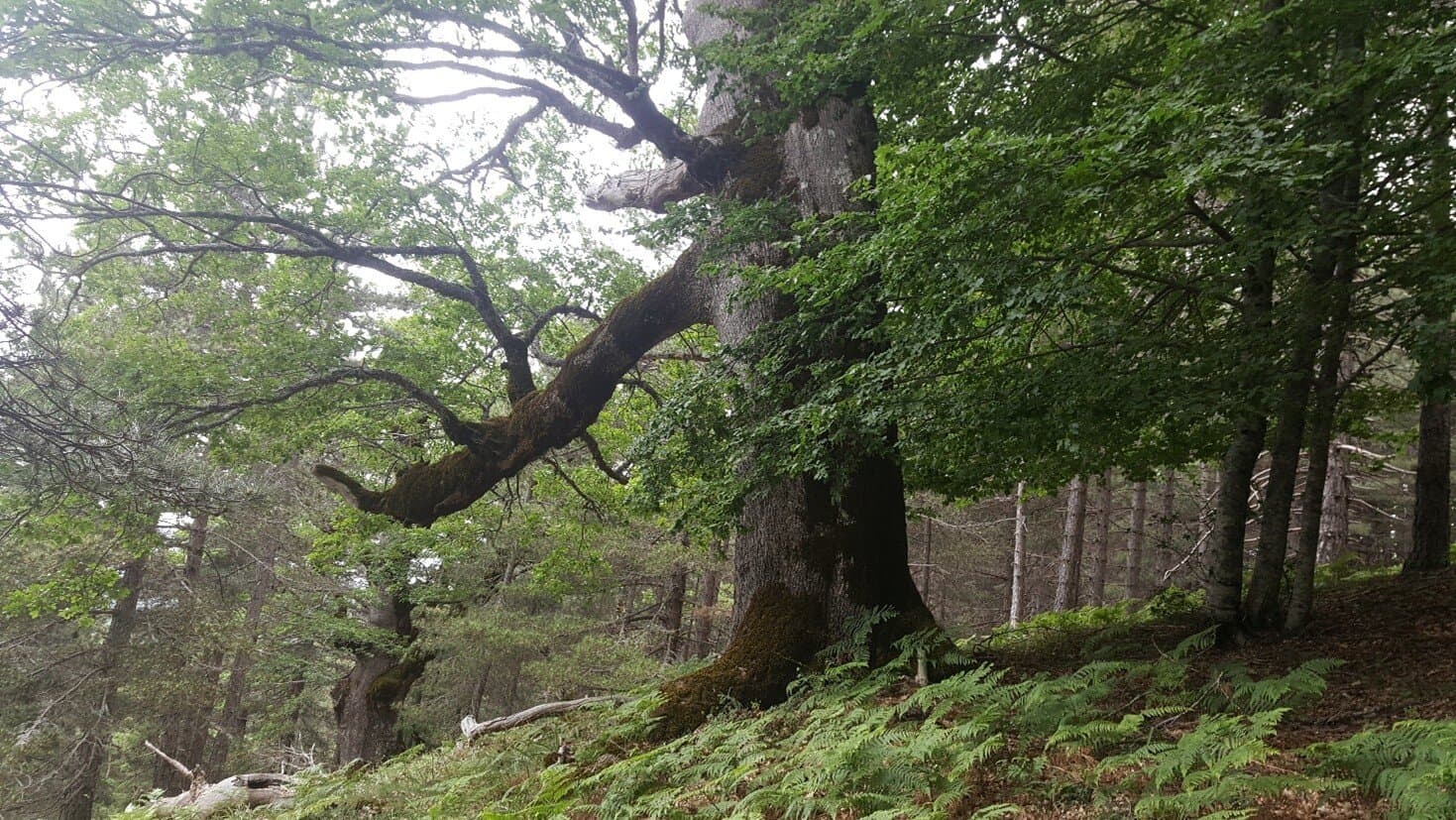
For decades, scientists have relied on tree rings to estimate how long trees can live. But new research suggests that this widely used method may have been underestimating the lifespan of many flowering trees—sometimes by centuries. A new international study published in Radiocarbon shows that radiocarbon dating can dramatically extend the known maximum age of broadleaved trees, revealing that many species live far longer than previously thought.
Tree-ring analysis (dendrochronology) provides precise tree ages and annual records of growth, but it has limitations. Many old trees develop hollow trunks, decay at the core, or grow in ways that make ring boundaries difficult to identify. In tropical forests, most species do not form clear annual rings at all. Radiocarbon dating, by contrast, can be applied to small fragments of inner wood—even in partially decayed stems—and works regardless of ring visibility.
By reviewing 42 angiosperm (flowering tree) species dated using radiocarbon methods worldwide, the researchers found that 20 species exceeded 500 years, and five surpassed 1,000 years.
"Our results show that tree-ring analysis often captures only part of the potential longevity of broadleaf species," said Dr. Jordan Palli, lead author of the study. "When we apply radiocarbon dating to the innermost wood, we frequently discover that trees are hundreds of years older than expected."
"Radiocarbon dating is a very well-established dating method ensuring high degrees of accuracy and precision, especially when state-of-the-art accelerator mass spectrometers are used," points out Prof. Lucio Calcagnile, Director of the Center for Applied Physics, Dating and Diagnostics (CEDAD) of the University of Salento.
The study indicates that maximum lifespans of 400–500 years are not exceptional among many broadleaved species, but rather relatively common.
"Tree-ring maximum ages are often less than half of those obtained through radiocarbon dating," Palli explained. "This gap becomes larger as potential longevity increases."
"The interest in analyzing old trees also stems from their role as fundamental proxy records for a wide variety of phenomena, including climate fluctuations and solar activity," emphasizes Prof. Gianluca Quarta, full professor of Applied Physics at the University of Salento.
From Mediterranean oaks to Amazon giants
The research highlights striking examples across continents. The African baobab (Adansonia digitata) has reached nearly 2,600 years. In temperate Europe, sessile oak (Quercus petraea) has been dated to approximately 933 years, making it the oldest scientifically dated flowering tree in temperate environments.
In Mediterranean forests, holm oaks (Quercus ilex) have reached more than 700 years, while in the Amazon, Cariniana micrantha has surpassed 1,400 years. Interestingly, some of the oldest trees were not found in closed old-growth forests, but in open, rocky landscapes historically shaped by grazing and even traditional pruning practices.
Ancient trees are ecological keystones. They support biodiversity, store carbon, stabilize ecosystems and serve as natural climate archives. Accurately determining their age is essential for conservation planning and forest management.
"Old trees are functional and structural hubs of biodiversity and resilience," said Prof. Gianluca Piovesan, coordinator of the study. "By missing the true age, we miss the true depth of the tree's contribution to its ecosystem functioning."
Radiocarbon dating is not without challenges—particularly reduced resolution for recent centuries due to fluctuations in atmospheric carbon—but statistical approaches such as wiggle-matching can reduce uncertainty.
For tropical forests, where annual rings are often absent, radiocarbon dating may be the only reliable method to determine tree age. Radiocarbon dating on tropical trees shows surprisingly old ages of small understory trees, while some larger tropical trees are relatively young.
"More radiocarbon dating of tropical trees will help us to gain a better understanding of the lifespan of tropical trees, and the incredible diversity of life history strategies that exist in tropical forests," according to Prof. Roel Brienen, professor of Forest Ecology and Global Change at the University of Leeds (UK).
The authors argue that radiocarbon dating remains heavily underutilized in forest ecology and conservation. They call for expanded efforts to locate and protect old and ancient trees worldwide in cultural and natural landscapes for a sustainable future.
"Precise age information gives us a historical benchmark," Piovesan said. "It helps policymakers set informed targets for forest restoration, old-growth protection and sustainable management."
In a changing world, understanding how long trees can live may reshape how we value—and safeguard—the oldest living witnesses of Earth's ecological history.
Jordan Palli et al, Radiocarbon dating opens up new frontiers in the study of tree longevity: Insights from angiosperm trees, Radiocarbon (2026). DOI: 10.1017/rdc.2026.10196
Citation: Radiocarbon dating rewrites angiosperm trees' lifespan records worldwide (2026, March 3) retrieved 5 March 2026 from https://phys.org/news/2026-03-radiocarbon-dating-rewrites-angiosperm-trees.html
This document is subject to copyright. Apart from any fair dealing for the purpose of private study or research, no part may be reproduced without the written permission. The content is provided for information purposes only.