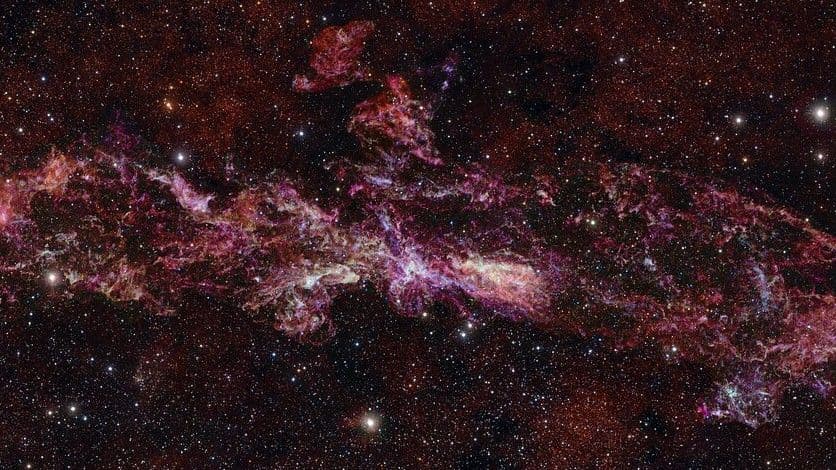
Scientists using the ALMA telescope have created the most-detailed-ever map of the Milky Way's chaotic center. The observations could open a window to the ancient universe as it appeared shortly after the Big Bang.
When you purchase through links on our site, we may earn an affiliate commission. Here’s how it works.
Unlock instant access to exclusive member features.
By submitting your information you agree to the Terms & Conditions and Privacy Policy and are aged 16 or over. You are now subscribed
Once a week Life's Little Mysteries Feed your curiosity with an exclusive mystery every week, solved with science and delivered direct to your inbox before it's seen anywhere else.
Get full access to premium articles, exclusive features and a growing list of member rewards.
Scientists have unveiled the largest, most-detailed-ever map of the chaotic gas clouds at our galaxy's center. The resulting image could take years to analyze but promises to help unravel the mysteries of how the earliest stars lived and died right after the Big Bang.
The new observations, taken with the Atacama Large Millimeter/submillimeter Array (ALMA) radio telescope in Chile, cover 650 light-years' worth of structures surrounding the Milky Way's central black hole, deep within the constellation Sagittarius. This region is known as the Central Molecular Zone (CMZ) for its many clouds of dense molecular gas and is thought to closely mirror the compact and chaotic conditions of the earliest galaxies in the universe.
The full image covers a parcel of the sky about as wide as three full moons — the largest image ALMA has ever produced since starting operations in 2013. This ultra-detailed view includes everything from gargantuan clouds of supersonic gas to individual stars whipping around the galactic center and is already turning up some "rare and enigmatic" structures that defy explanation.
- James Webb telescope reveals sharpest-ever look at the edge of a supermassive black hole
- Astronomers discover a gigantic, wobbling black hole jet that 'changes the way we think about the galaxy'
- James Webb telescope spies a monstrous molecular cloud shrouded in mystery — Space photo of the week
By studying the movement, velocity and chemical composition of the gas within the CMZ, scientists hope to better understand the extreme conditions that spurred the evolution of the Milky Way, as well as the ancient galaxies that filled the infant universe.
"It's a place of extremes, invisible to our eyes, but now revealed in extraordinary detail," Ashley Barnes, an astronomer at the European Southern Observatory (ESO) and a member of the team behind the new observations, said in a statement. And with even more powerful telescopes under construction in the region, "in many ways, this is just the beginning," Barnes added.
Roiling around the supermassive black hole Sagittarius A*, the CMZ is a sprawling collection of colliding clouds, supersonic gas highways, and hyperactive stars that grow fast and die young. The region contains most of the dense gas in our galaxy — about 80%, according to the Harvard and Smithsonian Center for Astrophysics — and is the hottest, densest and most turbulent neighborhood in the Milky Way.
The turbulent flow of molecular gas supercharges star formation in parts of the CMZ while leaving other areas perplexingly empty. Scientists hope to understand how the large-scale processes that push matter through the CMZ govern the evolution of small-scale objects, like individual stars and gas clouds.
Get the world’s most fascinating discoveries delivered straight to your inbox.
Enter ACES — the ALMA CMZ Exploration Survey, which brings together more than 160 scientists from 70 institutions around the world to study the mysterious CMZ. In a series of five papers accepted for publication in the journal Monthly Notices of the Royal Astronomical Society, the ACES team shared the survey's preliminary findings and how they could advance our understanding of the galactic center over the coming years.
The team noted that, by studying the various wavelengths of light emitted by gas in the CMZ, the survey identified more than 70 types of molecules tumbling through the galactic center. These include both simple molecules, such as silicon monoxide, and more complex organic ones, like ethanol and methanol, the researchers said.
By zooming in on specific regions of the image, the team could also see how specific processes — such as the eruption of shock waves released during massive gas cloud collisions — affected the heat, motion and chemical composition of different areas in the CMZ. All of this will eventually help scientists build a 3D map of the CMZ, revealing how different substructures are interconnected and how the large-scale flow of matter leads to star formation and destruction.
- James Webb telescope reveals sharpest-ever look at the edge of a supermassive black hole
- Astronomers discover a gigantic, wobbling black hole jet that 'changes the way we think about the galaxy'
- James Webb telescope spies a monstrous molecular cloud shrouded in mystery — Space photo of the week
"The CMZ hosts some of the most massive stars known in our galaxy, many of which live fast and die young, ending their lives in powerful supernova explosions, and even hypernovae," ACES team leader Steven Longmore, a professor of astrophysics at Liverpool John Moores University, said in the statement.
The preliminary findings also describe some unusual discoveries. One anomaly the team briefly noted is a structure called the Millimeter Ultra-Broad Line Object (MUBLO). The compact, dusty object appears only at millimeter wavelengths of light and is otherwise invisible to X-ray, infrared and radio telescopes.
Filled with fast-moving gas, the MUBLO shows some traits similar to the active young stars expected to populate the galactic center — but, so far, the object's characteristics don't match any other known structure in space, the team added.
— 8 extremely rare 'millisecond pulsars' discovered inside globular clusters
— Distant 'galaxy' isn't a galaxy at all — but one of the brightest pulsars ever detected
— Mysterious glow at the Milky Way's center could reshape a major cosmic theory