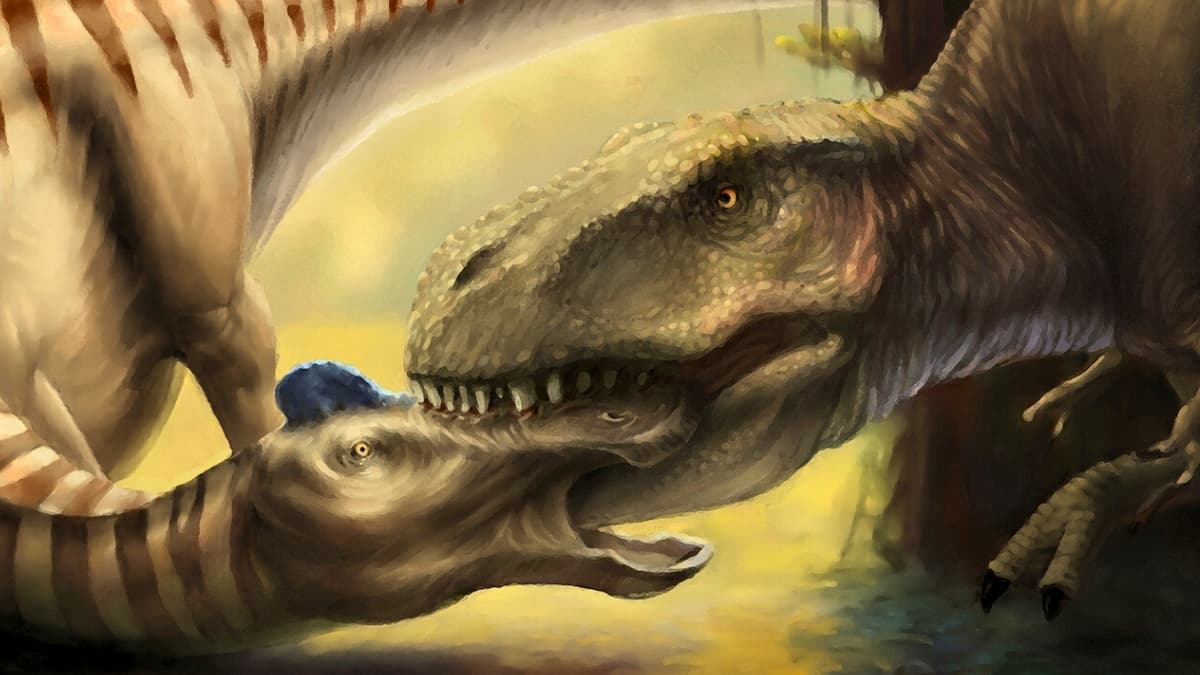
In a discovery that rewrites our understanding of one of Earth’s most fearsome predators, paleontologists have uncovered direct fossil evidence that a Tyrannosaurus rex not only hunted a duck-billed Edmontosaurus but also consumed its carcass in a predation event that occurred roughly 66 million years ago. The nearly complete skull of the herbivorous Edmontosaurus, housed at the Museum of the Rockies in Bozeman, Montana, contains a partial T. rex tooth lodged in its nasal cavity—a rare artifact that offers an unprecedented window into the hunting and feeding behaviors of the iconic carnivorous dinosaur. Discovered in 2005 on federal lands managed by the Bureau of Land Management, the specimen has been meticulously analyzed using CT scans and comparative morphology, revealing how T. rex interacted with its prey in ways previously only theorized.
Key Takeaways: What This Fossil Tells Us About T. rex Hunting
- A T. rex tooth embedded in an Edmontosaurus skull provides rare fossil evidence of direct predation.
- The lack of healing around the embedded tooth suggests the Edmontosaurus died during the attack.
- CT scans and bite mark analysis confirm the tooth belonged to an adult T. rex with a skull over one meter long.
- Bite marks concentrated on the Edmontosaurus’s jaw and skull indicate the T. rex consumed flesh from the carcass after killing it.
- This discovery supports the theory that T. rex was an active predator, not just a scavenger.
How the Discovery Was Made: A Fossilized Predation Event
The Edmontosaurus skull in question was unearthed in 2005 by a team of researchers led by paleontologists from the Museum of the Rockies during an expedition in eastern Montana. The specimen, cataloged as MOR 1142, consists of a nearly complete skull with several unusual features: a broken T. rex tooth embedded in the snout and multiple bite marks along the skull’s right side and left jaw. Unlike many dinosaur fossils, which only preserve bones or teeth in isolation, this specimen offers a snapshot of a violent encounter that likely occurred during the Late Cretaceous period, when both species roamed the floodplains of what is now the American West.
The Tooth Embedded in Bone: A Clue to the Attack
The most striking feature of the Edmontosaurus skull is the partial T. rex tooth lodged deep within the nasal cavity. Paleontologists used CT scans to map the tooth’s precise position, revealing that it had been driven through the bone with enough force to fracture the tooth itself. According to the study’s lead author, John Scannella, who collaborated with the University of Alberta’s Taia Wyenberg-Henzler, the tooth’s orientation suggests it broke off during a face-to-face confrontation. "The penetrating nature of the tooth indicates a powerful bite," Wyenberg-Henzler explained. "The lack of any healing around the embedded tooth suggests it was inserted either shortly before death or immediately after, but in either case, the Edmontosaurus did not survive the encounter."
Why This Fossil Is So Rare in the Fossil Record
Fossilized evidence of direct predation in dinosaurs is exceptionally rare because it requires two conditions: the prey must have been killed by the predator, and both the predator’s tooth and the prey’s remains must be preserved in a way that records the interaction. Most dinosaur fossils are found as isolated bones or teeth, making it difficult to determine whether bite marks were caused by scavenging, post-mortem scavenging, or active hunting. In this case, the embedded tooth and the pattern of bite marks—particularly the way they are clustered on areas of the skull that would have contained the most flesh—strongly suggest that the T. rex killed the Edmontosaurus and later fed on its carcass. "Identifying carnivores from bite marks alone is often extremely difficult because the marks rarely preserve information that is specific enough," Wyenberg-Henzler noted. "But when a tooth is embedded in bone, it’s like a fingerprint—it points directly to the perpetrator."
Comparing the Tooth to Known T. rex Specimens
To confirm that the embedded tooth belonged to a T. rex, researchers compared its serrations and size to those of teeth from other carnivorous dinosaurs that coexisted with Edmontosaurus, such as the smaller theropods Dromaeosaurus and Saurornitholestes. The serrations on the embedded tooth matched those of known T. rex teeth, and its size indicated it came from an adult individual with a skull measuring approximately one meter in length. Adult T. rex specimens are known to have reached lengths of up to 12 meters and weighed as much as 9 tons, making them one of the largest terrestrial predators to have ever existed. The presence of an adult’s tooth in the Edmontosaurus skull also suggests that T. rex did not exclusively target juveniles or weaker prey, but was capable of taking down large, well-defended herbivores.
Analyzing the Bite Marks: Evidence of a Feeding Strategy
The bite marks on the Edmontosaurus skull are concentrated in two key areas: the right side of the skull behind the eye and the back third of the left jaw. In duck-billed dinosaurs like Edmontosaurus, this region contains the bulk of the chewing muscles and would have been one of the last areas to retain flesh after the rest of the carcass had been consumed. Modern carnivores, from lions to hyenas, typically follow a predictable feeding pattern—they target the most nutritious parts of a carcass first, such as the limbs and organs, and work their way toward less meaty areas like the skull. The location of the bite marks on the Edmontosaurus suggests a similar strategy: after killing the Edmontosaurus, the T. rex likely stripped the majority of the flesh from the body before the skull was buried and fossilized. "The pattern of bite marks tells us that the T. rex wasn’t just killing its prey—it was systematically processing the carcass," Wyenberg-Henzler said. "This supports the idea that T. rex was not merely a scavenger, but an active predator with a sophisticated feeding behavior."
Debating T. rex Behavior: Predator, Scavenger, or Both?
The question of whether T. rex was primarily a predator or a scavenger has been a subject of intense debate among paleontologists for decades. Pop culture often portrays the dinosaur as an apex hunter, but some scientists have argued that its robust build, powerful jaw, and small arms may have been better suited for scavenging than active hunting. The discovery of the Edmontosaurus skull with the embedded T. rex tooth adds significant weight to the argument that T. rex was indeed a hunter. "This fossil provides direct evidence that T. rex was capable of taking down large prey," Scannella explained. "While scavenging may have played a role in its diet, it’s clear that T. rex was also an active predator capable of killing animals as large as itself."
Historical Context: How This Discovery Fits Into Paleontology
Paleontologists have long relied on indirect evidence to study dinosaur behavior, such as fossilized footprints, stomach contents, and bite marks. However, direct evidence of predation—such as a predator’s tooth embedded in prey bone—is exceedingly rare. One of the few comparable examples is a Velociraptor tooth found embedded in a Protoceratops skull, discovered in the Gobi Desert in the 1970s. Like the Edmontosaurus specimen, that fossil provided clear evidence of a violent encounter. The Edmontosaurus discovery, however, is particularly significant because it involves two of the most iconic dinosaurs of the Late Cretaceous, both of which are well-represented in the fossil record. This allows researchers to draw more confident conclusions about the behavior of T. rex and its ecological role as an apex predator.
The Role of CT Scans and Modern Technology in Paleontology
The analysis of the Edmontosaurus skull would not have been possible without advanced imaging technology. CT scans allowed researchers to visualize the embedded tooth’s position within the skull without damaging the fossil. This non-invasive technique has revolutionized paleontology in recent decades, enabling scientists to study internal structures, such as brain cavities and tooth roots, in unprecedented detail. "CT scanning has opened up a new frontier in fossil analysis," Wyenberg-Henzler said. "We can now see things that were invisible to us just a few decades ago, which is helping us rewrite the story of how dinosaurs lived, hunted, and interacted with their environment."
What This Means for Our Understanding of Dinosaur Ecology
The Edmontosaurus skull discovery underscores the complexity of Late Cretaceous ecosystems, where T. rex occupied the role of apex predator. Edmontosaurus, a large herbivore with a duck-like beak and a body length of up to 13 meters, was one of the most abundant dinosaurs in North America during the Maastrichtian stage of the Cretaceous period. Its presence in the fossil record suggests that T. rex had a varied diet and was capable of preying on large, well-armored herbivores. This challenges previous assumptions that T. rex primarily targeted smaller, easier prey. "This discovery shows that T. rex was a versatile predator," Scannella noted. "It wasn’t limited to scavenging or hunting small animals—it could take down prey its own size or larger."
The Broader Implications for Paleontological Research
While the Edmontosaurus skull provides a dramatic example of predation, it also highlights the challenges of interpreting fossil evidence. Not all bite marks or embedded teeth necessarily indicate a predation event; some may result from scavenging or post-mortem interactions. However, the combination of an embedded tooth, the lack of healing, and the specific pattern of bite marks in this specimen strongly suggests a hunting event. As paleontologists continue to discover and analyze new fossils, discoveries like this one will help refine our understanding of dinosaur behavior, diet, and ecological roles. "Every fossil tells a story," Wyenberg-Henzler said. "But some stories are louder than others, and this one is shouting that T. rex was a formidable predator."
Where to See the Edmontosaurus Skull and Ongoing Research
The Edmontosaurus skull with the embedded T. rex tooth, cataloged as MOR 1142, is currently on display at the Museum of the Rockies in Bozeman, Montana. The museum, affiliated with Montana State University, is one of the leading institutions for dinosaur research in the United States and houses one of the most extensive collections of Late Cretaceous fossils in the world. Researchers continue to study the specimen, and future analyses may reveal additional details about the attack, such as the angle of the bite or the precise moment of impact. For now, the fossil stands as a testament to the raw power and predatory prowess of T. rex.
Frequently Asked Questions About the T. rex Predation Discovery
Frequently Asked Questions
- How do scientists know the T. rex tooth embedded in the Edmontosaurus skull wasn’t from scavenging?
- The lack of healing around the tooth and its precise embedding in bone suggest it was inserted during a live encounter. Additionally, the bite marks are concentrated on meat-rich areas, consistent with a feeding strategy used by active predators rather than scavengers.
- What does this discovery tell us about T. rex hunting behavior?
- It provides direct evidence that T. rex was capable of taking down large prey like Edmontosaurus, contradicting theories that it was primarily a scavenger. The fossil suggests T. rex used powerful bites to subdue prey and systematically consumed carcasses.
- Where was the Edmontosaurus skull with the T. rex tooth found?
- The fossil was discovered in 2005 on federal lands managed by the Bureau of Land Management in eastern Montana. It is now housed at the Museum of the Rockies in Bozeman.