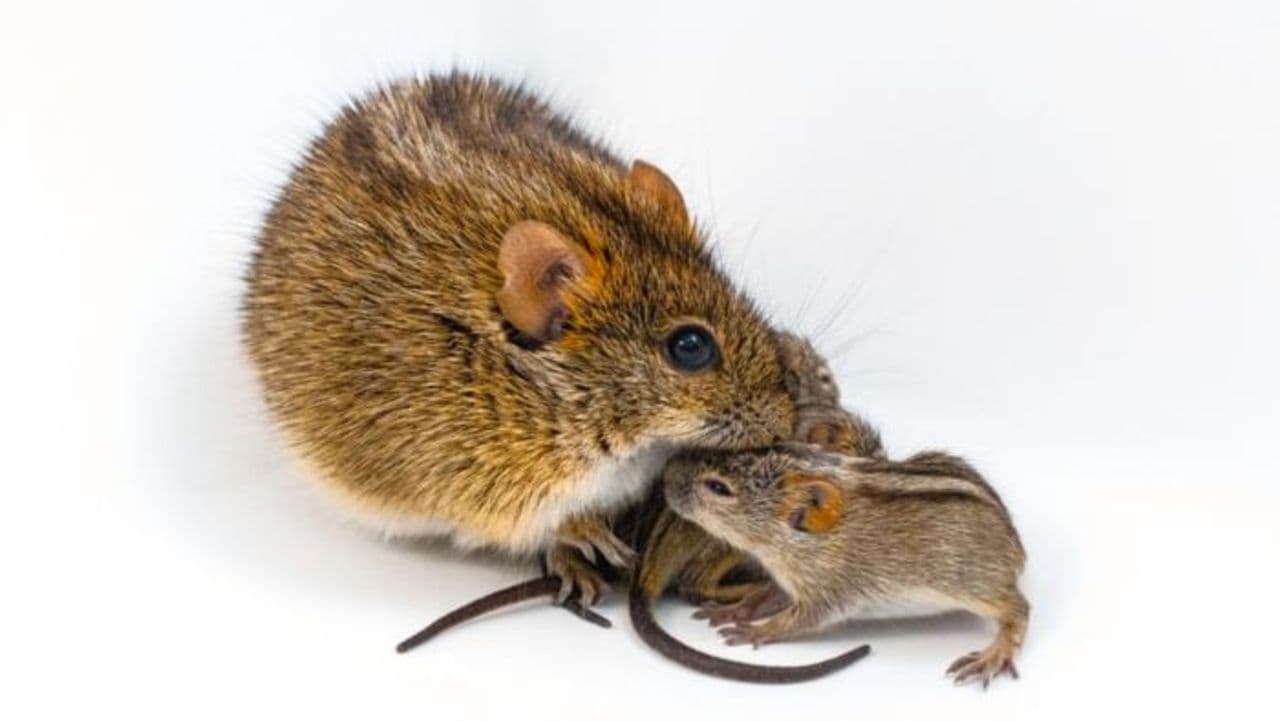
A new study suggests that the Agouti gene in the brains of male African striped mice can act as a molecular "switch," making them caring or violent toward their young.
When you purchase through links on our site, we may earn an affiliate commission. Here’s how it works.
Unlock instant access to exclusive member features.
By submitting your information you agree to the Terms & Conditions and Privacy Policy and are aged 16 or over. You are now subscribed
Once a week Life's Little Mysteries Feed your curiosity with an exclusive mystery every week, solved with science and delivered direct to your inbox before it's seen anywhere else.
Get full access to premium articles, exclusive features and a growing list of member rewards.
Flipping a single genetic switch can make doting dads attack their offspring, at least in African striped mice, new research suggests. But the gene itself wasn't solely responsible for this switch from attentive to aggressive fathering; social conditions also played a role in how the male mice behaved.
The findings could reveal more about the genetic mechanisms that lead some species of mammals to act as caring fathers while others abandon their young. Active fathering is rare in mammals, with only 5% of the 6,000 mammalian species having involved dads. Because of this, scientists know far less about how paternal care works in mammals than they know about maternal care in mammals. African striped mice (Rhabdomys pumilio) are useful for studying mammalian paternal care because males show a wide range of behaviors toward pups, from huddling to keep pups warm to actively ignoring their progeny.
In a study published Feb. 18 in the journal Nature, researchers placed male African striped mice in cages either alone with a group of pups or in group housing with other dads and their pups. They found males kept in groups were more likely to ignore the pups or to try to kill them.
- Lab mice that 'touch grass' are less anxious — and that highlights a big problem in rodent research
- DNA from ancient viral infections helps embryos develop, mouse study reveals
- In a first, study links maternal genes to risk of pregnancy loss
To determine the brain regions that mediated this behavior, the team exposed male mice to pups, then monitored their brain activity. They found the attentive dads had greater activity in one brain region, called the medial preoptic area (MPOA).
"Decades of work has shown that the MPOA acts as a hub for maternal care across mammals," lead author and postdoctoral researcher Dr. Forrest Rogers, a researcher at the Princeton Neuroscience Institute, told Live Science in an email.
The team then dissected the brains of the mice and measured gene activity in cells from the MPOA. From this, they discovered that a gene called Agouti was more active in males that attacked pups than in males that cared for the pups.
"Agouti is better known for its roles in skin pigmentation and metabolism, so discovering this previously unknown role in the brain for parenting behavior was exciting," Rogers said in a statement.
Get the world’s most fascinating discoveries delivered straight to your inbox.
To confirm that Agouti expression was responsible for the transition between attentive and aggressive behavior, the team first exposed mice to pups, then injected a virus that amped up the expression of the Agouti gene in the MPOA. When the males were exposed again to pups, their behavior changed.
"We found that those males, when Agouti was increased, became aggressive toward pups," Rogers told Live Science in an email, suggesting that this gene was acting as a sort of "switch" that flipped between aggressive and caring behavior in mouse fathers.
While the Agouti gene found within the MPOA may have a strong link to the change in paternal care, Rogers cautioned that this molecular switch wasn't the whole story.
- Lab mice that 'touch grass' are less anxious — and that highlights a big problem in rodent research
- DNA from ancient viral infections helps embryos develop, mouse study reveals
- In a first, study links maternal genes to risk of pregnancy loss
"It certainly seems that for some striped mice, increasing Agouti expression is sufficient to induce infanticide," he said. "However, we also found that there were other factors at play, for example, the current social housing, which could moderate this effect."
—Why do some animals adopt other animals' young?
—Chinese scientists created mice with 2 dads — and they survived to adulthood
—What is the maximum number of biological parents an organism can have?
When the researchers moved males from group housing to solitary cages, Agouti levels dropped and caregiving increased, suggesting that the gene is influenced more by social context than by food availability.
While this study may have uncovered a possible genetic switch for fathering, there were key limitations. Notably, only male African striped mice were studied. And although fathering behavior varied within the species, the researchers cautioned against translating those findings to other species.