The types of glass that we encounter in everyday life, such as window glass or smartphone screens, are disordered solids. This means that they consist of particles locked in place, like those in solids, but arranged randomly, similarly to how they would be in a liquid.
Almost a century ago, Walter Kauzmann, who was a chemistry professor at Princeton University at the time, was confronted with the possible existence of a so-called ideal glass, an amorphous system with the entropy of a crystal. This is a glass in which particles are still arranged randomly, but the particles fill space so efficiently that there is only one possible arrangement, as opposed to the many disordered arrangements of conventional glass.
Kauzmann's theoretical proposals inspired numerous other physicists to explore the idea of this perfectly equilibrated glass. Previous studies suggested that this elusive state could not be reached using conventional cooling processes.
Researchers at University of Oregon, University of Pennsylvania and Syracuse University ran simulations suggesting that an ideal glass could be constructed in other ways, which don't entail cooling. Their paper, published in Physical Review Letters, could contribute to the resolution of this decades-long physical mystery.
"The concept of an equilibrated glass (ideal) has been around for decades," Eric Corwin, senior author of the paper, told Phys.org.
"In 1948, Kauzmann knew that the more a liquid is supercooled, the lower will be the entropy. He realized that there's a point where the supercooled liquid will have the same entropy as a crystal of the same material. To reach this point would take a diverging timescale (i.e. it would require one to wait infinitely long) but we would argue that it should exist nevertheless."
In his original work published in 1948, Kauzmann concluded that reaching an ideal glass state led to an apparent paradox, as the resulting system would be a liquid with the same entropy as a crystal.
The resulting unusual liquid state would thus be both amorphous (i.e., without a clearly defined structure) and highly ordered, as this would be necessary for the entropy to be equal to that of the crystal. Kauzmann used this paradox to dismiss the possibility of a fully equilibrated, or ideal, glass.
"We think that we've hit upon a resolution, by showing that such a state is not a paradox at all; indeed we can construct it," said Corwin.
"We've shown that one can't hope to achieve these structures just by waiting, but that they nevertheless exist. The fact that a structure with no spatial ordering (i.e. an amorphous structure) can still be highly ordered in a more abstract sense (i.e. zero configurational entropy) is an enormous surprise."
The ideal glass simulated by the researchers would have mechanical properties that are almost identical to those of its underlying crystal. This suggests that its distinguishing feature is not its spatial ordering, but its entropy.
"It's interesting that one can decouple the two," explained Corwin. "This is something that most people would have claimed to be intimately intertwined and inseparable."
Initially, Corwin and his colleagues were merely trying to create unusually stable and strong glassy states in 3D systems, while also shedding new light on their underlying physics. They realized that the techniques for creating ultrastable glasses in 3D could be used in the pursuit of an ideal glass in 2D.
"We realized that when these methods are applied to 2D you find something spectacular, in that you are able to easily construct ideal systems," explained Corwin.
"To make a strong glass, you must let it cool extremely slowly and allow it to 'equilibrate' for a very long time. One can find such examples in nature, in the form of glass made from extremely old amber, or one can manufacture extremely thin films of such 'ultra-stable' glasses using exotic mechanisms. Alternatively, one can simulate the formation of a glass like this, using non-physical tricks to speed up the construction."
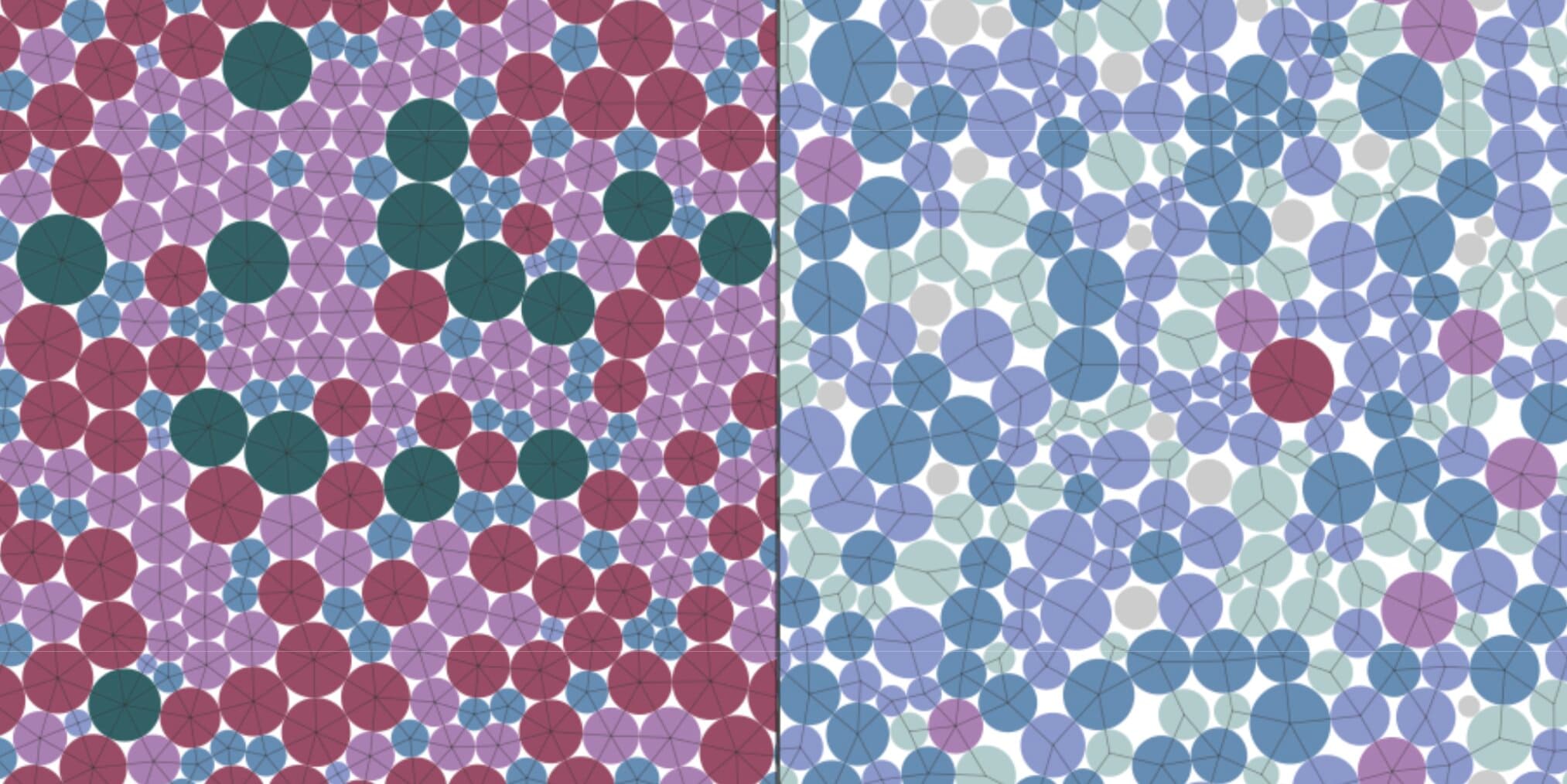
As part of their study, the researchers simulated 2D systems in which soft particles were tightly packed. As they were running simulations, they could modify various variables, beyond just jiggling the particles. For instance, they could grow and shrink particles, which would allow them to nestle together more tightly and become more compact.
"There's an interesting counting argument to figure out how many contacts there must be in a system of particles to achieve mechanical stability," said Corwin.
"Since every 2D particle has 2 degrees of freedom (i.e. it can move left-right and up-down), you will need an average of two constraints to hold it in place. These constraints come in the form of contacts with neighbors. Since each contact is shared between a pair of neighbors, you will need an average of 2*2=4 contacts to hold each particle in place.
"This is typically the case in disk packings of polydisperse systems (i.e. if you just push together a whole bunch of pennies, nickels, dimes, and quarters and then count the contacts you will find about 4 per particle on average, even as some coins have only three contacts and others have five or six or seven)."
By shrinking or growing the size (i.e., radius) of particles, the researchers were able to simulate 2D systems in which particles were more densely packed. This introduces a further degree of freedom, which needs to be constrained with 2 additional contacts per particle, on average.
"Thus, we'll need an average of 6 contacts per disk (i.e., particles) to achieve mechanical stability," said Corwin.
"This is a surprisingly magical number, as it's also the maximum average number of contacts per disk that one can have for a circle packing in 2D, due to a result from Euler (the 'Euler Characteristic' tells us that any tiling of polygons in 2D that completely tiles the plane must also have an average of exactly 6 sides per particle, even as the individual polygons can have any number of sides).
"What this means is that the network of contacts is perfectly triangulated and thus, you can tell at a glance that it's impossible to make anything denser by moving particles."
While each particle may have any number of contacts, from 3 on up, the average number of contacting neighbors is exactly 6. Each particle is touching all its neighbors with no gaps in between them, forming a structure referred to as "triangulated packing." A perfect crystal of monodisperse (i.e. all disks are the same size) particles is one example of a triangulated packing.
"This means that you couldn't possibly move things around in the crystal to make things better because each particle is already 'locally optimal,'" said Corwin.
"The same is true in our packings, with the difference being that since ours are constructed of particles of different sizes, the triangulated packing has no crystalline order at all. There's a small caveat involved in constructing these triangulated packings, which occupies a lot of the paper, but is in some sense just a small correction."
Even when the team allowed the radii of all particles in their simulated systems to jiggle and adjusted them to make them fit together better, they were always left with some small gaps between the particles. This suggested that stronger and slightly better configurations were possible.
"These came because we had to apply a few additional constraints when we were adjusting the radii of particles, to keep them all from shrinking to zero size, for example, or any of them taking on negative radii," said Corwin.
"We were able to make use of a result from the math world, called the 'circle packing theorem,' to systematically close each of these small gaps and arrive at a perfectly triangulated packing of disks."
Towards the resolution of a long-standing physical puzzle
Ultimately, the main goal of this recent study was to probe the possible existence of "ideal" configurations. The team showed that approaching the ideal glass problem from a different perspective could shed some new light on its underlying mysteries.
"Glasses are the quintessential example of a nonequilibrium system. It doesn't matter how long you wait; they never equilibrate," said Corwin.
"But, we have a huge advantage over nature: we can cheat. We managed to equilibrate a glass by playing with the particles in nonphysical ways. The mere fact that these ideal states exist tells us that, at least in two dimensions, the nature of the glass transition is, at least in part, dynamical. Glasses fail to equilibrate not because it's impossible, but because the paths to equilibration are unreachable by nature."
The ideal glass is among the oldest unresolved physical problems. While it has not yet been unraveled and its resolution will most likely take some time, the work of Corwin and his colleagues offers new concrete hints about its underlying nature.
"Kauzmann believed that he had discovered a paradox," said Corwin. "How can it be that a disordered system (an ideal glass) has a lower entropy than an ordered system (a crystal)? It turns out that this isn't a paradox at all. This is a reality."
The results of this study are already inspiring further research focusing on the ideal glass and other ideal configurations. For instance, some teams have started to adapt the systems simulated by the authors or examining them in their own studies.
"The properties of these systems are interesting and strange," added Corwin. "They don't behave exactly like crystals or exactly like ordinary glasses. We've only scratched the surface when it comes to their properties. Our next step is to perform a detailed measurement of entropy as a function of pressure (or density) for the ideal glass, to understand how it differs from that of the conventionally prepared glasses."
In the long-term, Corwin and his colleagues hope to also realize and simulate 3D ideal glasses and sphere packings, arrangements that allow spherical particles to fill a space as efficiently and tightly as possible. As the methods used in their recent study cannot be extended to 3D systems, they are now trying to identify alternative approaches that can be applied in 3D.
Written for you by our author Ingrid Fadelli, edited by Sadie Harley, and fact-checked and reviewed by Robert Egan—this article is the result of careful human work. We rely on readers like you to keep independent science journalism alive. If this reporting matters to you, please consider a donation (especially monthly). You'll get an ad-free account as a thank-you.
Viola M. Bolton-Lum et al, Ideal Glass and Ideal Disk Packing in Two Dimensions, Physical Review Letters (2026). DOI: 10.1103/vldy-r77w.