Some single-celled organisms are known to transition to multicellularity during their lifetimes, usually either by cloning themselves or when many similar cells come together to form a larger multicellular organism. A new study published in Nature suggests that a combination of the two routes may be more common than previously thought—even in organisms distantly related to animals.
Choanoflagellates are single-celled flagellate eukaryotes considered to be the closest living relatives of animals. They are bacterium-eating aquatic organisms with a flagellum (a long, hair-like appendage that helps them swim) and a collar of microvilli, primarily used for absorption, secretion, and sensory functions.
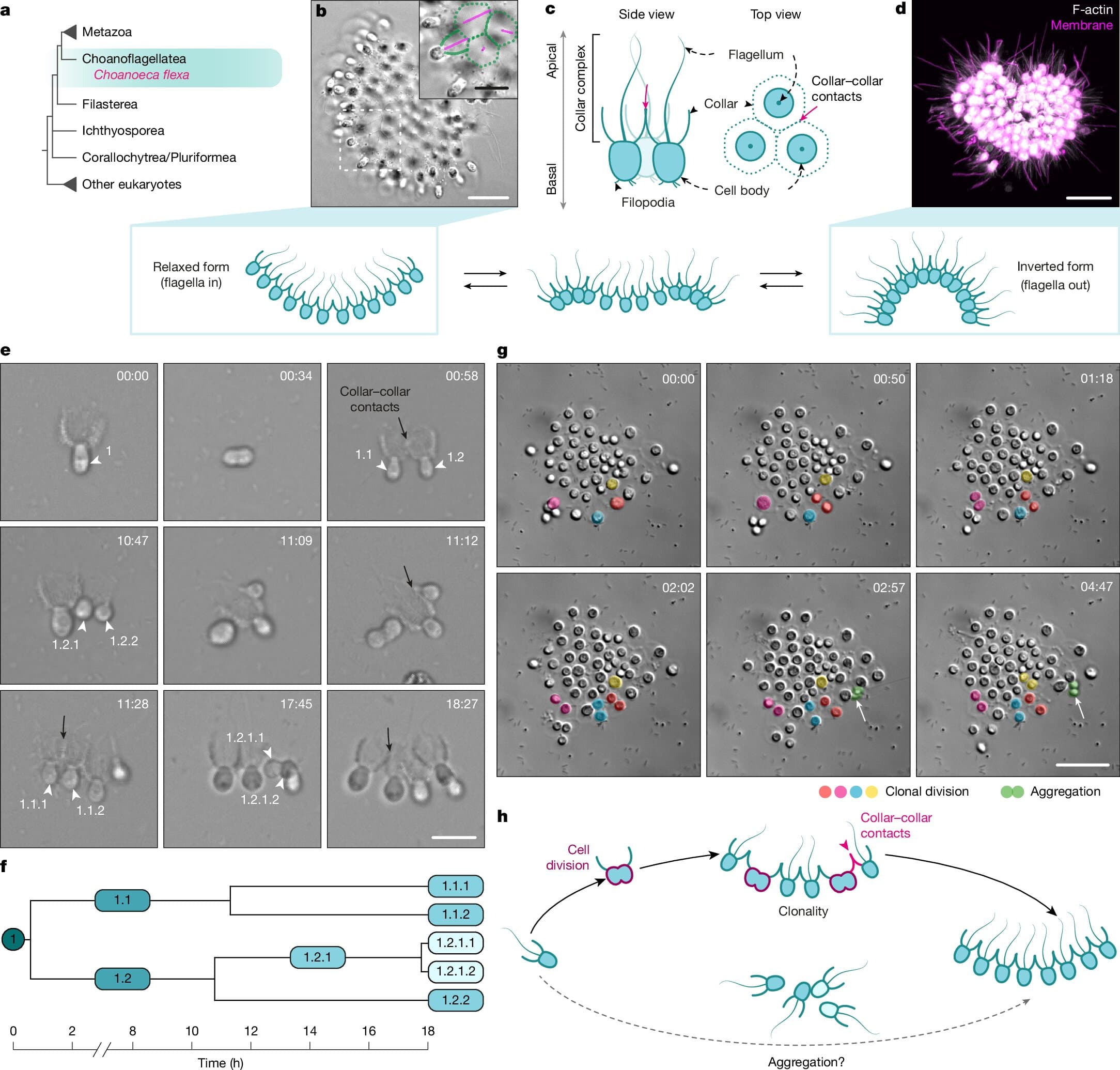
Choanoflagellates possess the ability to form multicellular bodies. Like animals, they were thought to be purely clonal, but this has not been previously tested across different types. The choanoflagellate Salpingoeca rosetta, for example, only exhibits clonal multicellularity. However, other close relatives of animals have been shown to form aggregative groups.
"Notably, although animal multicellularity is purely clonal, other close relatives of animals exhibit diverse forms of multicellularity, including aggregation in filastereans and cellularization of multinucleated cells or cleavage-like serial cell divisions in ichthyosporeans," explain the authors of the new study.
The researchers set out to determine whether choanoflagellates can ever form aggregate groups by conducting multiple field surveys of 150 splash pools in Shete Boka National Park in Curaçao, where choanoflagellates were first discovered. They were surprised by what they found. Not only did the choanoflagellates form clonal groups and aggregate groups separately, but they also formed mixed clonal-aggregative groups under certain conditions. They also found that the purely aggregative sheets were morphologically, behaviorally, and functionally equivalent to clonally grown sheets.
Furthermore, the team showed that the push to aggregative multicellularity was an active process. They write, "Finally, we wondered whether aggregation was an active process or whether it might result from passive cell stickiness. Whereas live cells readily aggregated, fixed cells did not (even under orbital agitation forcing cell encounters), suggesting that aggregation requires living cells and is therefore an active process."
Drivers and constraints of clonal division and aggregation
The splash pools containing the choanoflagellates were subject to varying concentrations of salinity. The pools go through regular cycles of drying up and refilling, causing increases in salinity as water evaporated. This made the team question if these factors would affect whether the organisms used clonal division, aggregation, or the mixed pathway.
Through a series of experiments tracking the frequency of aggregation and division of cells under varying salinities, the team determined some of the drivers and constraints of these processes. When checking the naturally occurring pools, the team only found multicellular sheets in pools with a salinity of 73 parts per thousand (ppt) or less. They found that as salinity rises, multicellular sheets tend to dissociate, and cells turn into tough, unicellular cysts. When the pools are rehydrated, these cysts "wake up" and reform sheets using both division and aggregation methods.
The team also found that cell density had an interesting effect on whether the cells chose clonal or aggregative routes to multicellularity.
"The aggregation efficiency increased monotonically with cell density and peaked at the highest density tested (105 cells per ml). By contrast, clonality efficiency remained constant across intermediate densities (102–104 cells per ml) but decreased at the highest density (105 cells per ml), possibly due to depletion of bacterial prey limiting proliferation. Thus, low densities favor clonal multicellularity, high densities favor aggregative multicellularity and intermediate densities support mixed clonal-aggregative formation.
In some cases of aggregation, the ability of kin recognition arose, in which certain strains would recognize others of their kind, form groups with them and restrict other strains. This can lead to limited genetic diversity. However, not all strains showed quantifiable preference for self aggregation.
The findings of this study showed that life near the base of the animal family tree uses a surprisingly flexible strategy to become multicellular, raising some questions about whether the early evolution toward animal life may have involved varying routes to multicellularity. The team notes that further research should include surveys of more choanoflagellate species to see if clonal‑aggregative multicellularity is common or unique to C. flexa, and can integrate findings into comparative models of animal multicellularity origins, testing whether early animals may have exploited mixed strategies.
Written for you by our author Krystal Kasal, edited by Lisa Lock, and fact-checked and reviewed by Robert Egan—this article is the result of careful human work. We rely on readers like you to keep independent science journalism alive. If this reporting matters to you, please consider a donation (especially monthly). You'll get an ad-free account as a thank-you.
Núria Ros-Rocher et al, Clonal-aggregative multicellularity tuned by salinity in a choanoflagellate, Nature (2026). DOI: 10.1038/s41586-026-10137-y
Citation: Single-celled organism becomes multicellular via three different pathways (2026, February 26) retrieved 28 February 2026 from https://phys.org/news/2026-02-celled-multicellular-pathways.html
This document is subject to copyright. Apart from any fair dealing for the purpose of private study or research, no part may be reproduced without the written permission. The content is provided for information purposes only.