Conventional crystals are materials in which atoms arrange themselves in repeating spatial patterns. Time crystals, on the other hand, are phases of matter characterized by repeating motions over time without constantly heating up, breaking a physical rule known as time-translation symmetry.
Researchers at East China Normal University and Shanghai Jiao Tong University recently predicted the formation of a new type of time crystal, dubbed a two-dimensional (2D) moiré time crystal. This crystal was theorized to emerge when periodic perturbations (i.e., regular, repeated disturbances) are applied to ultracold atoms held in a smooth, continuous trap, as opposed to an optical lattice trap. The paper is published in the journal Physical Review Letters.
"We were inspired by two exciting concepts in physics," Keye Zhang, professor at East China Normal University and co-senior author of the paper, told Phys.org. "The first is the concept of 'twistronics,' where twisting atom-thin layers creates moiré patterns with exotic material properties. While the second is that of 'time crystals' (a new phase of matter with persistent rhythmic motion). We wondered: could we combine these ideas by treating time itself as a dimension that can be 'twisted'?"
From spatial moiré to temporal moiré patterns
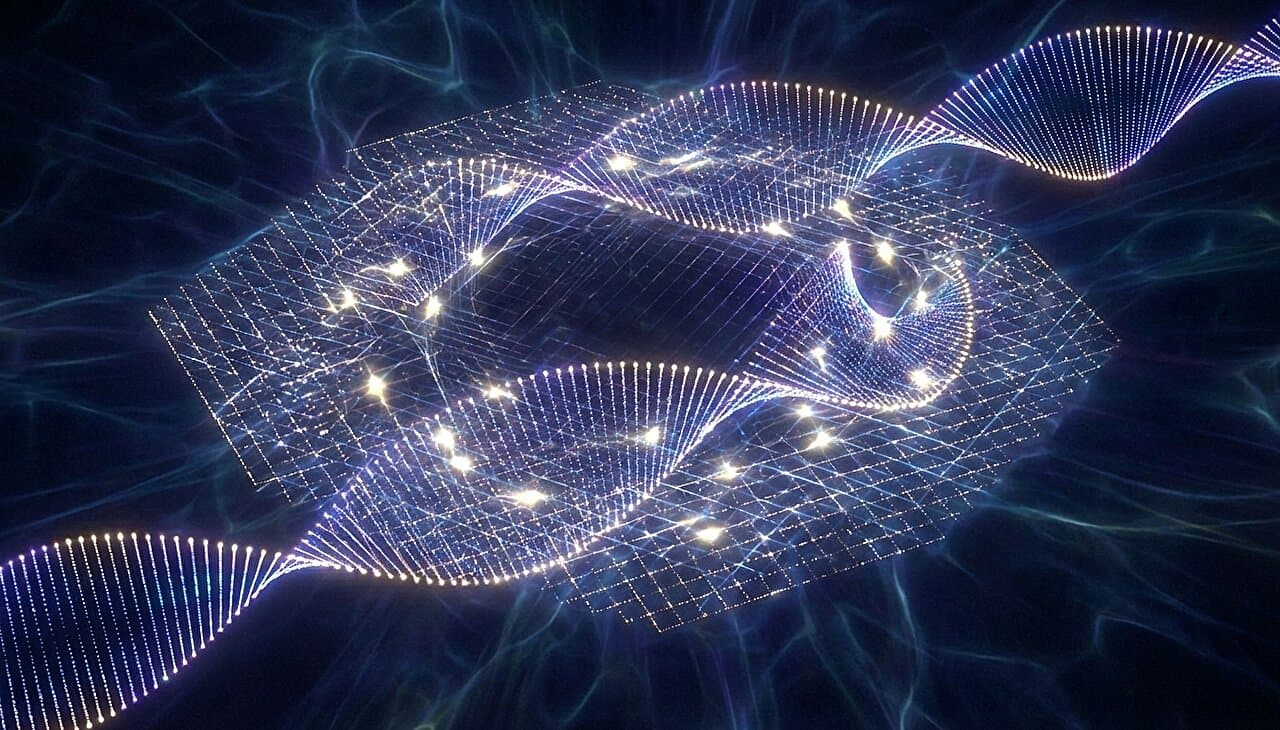
Moiré patterns are unique patterns that emerge when two similar physical systems are placed on top of each other with a slight mismatch. Zhang and his colleagues wanted to theoretically demonstrate that moiré patterns can also arise purely in time, without the need to physically stack any materials and introduce a blueprint to realize these moiré time crystals experimentally using trapped ultracold atoms.
"Imagine ultracold atoms confined in a smooth, structureless box," explained Zhang. "We 'shake' this box with laser beams or magnetic fields that flicker at multiple carefully chosen frequencies. These frequencies resonate with the atoms' natural motion, causing them to spontaneously organize into a perfect 2D moiré lattice pattern, but in an abstract 'phase space' rather than real space. We then identified the conditions under which this pattern can be mapped without distortion onto either the physical time dimension or the spatial dimension."
To further examine the system that they theorized about, the researchers also ran simulations involving thousands of interacting atoms. They showed that atoms in the simulated moiré time crystals formed a regional superfluid, a phase of matter that flows with zero viscosity (i.e., internal friction) and in which quantum coherence follows the moiré pattern engineered by the researchers in space, time, or both.
"Our study extends twistronics from purely spatial physics into the time dimension," said Zhang. "We demonstrated that 2D moiré patterns can emerge from 'time' itself, creating a new platform—a moiré time crystal that offers extreme tunability. Simply by adjusting laser pulse sequences, we can dynamically design quantum material properties without changing any hardware.
"Beyond removing the constraint of complex physical stacking in fabricating moiré materials, this implies that we can not only use the 'flow' of time to simulate physical phenomena normally requiring spatial dimensions, but we can also stimulate the exploration of novel quantum many-body problems in hybrid time-space dimensions."
Towards the experimental realization of moiré time crystals
The 2D moiré time crystals introduced by the authors could soon inspire further research in this area or could pave the way for these crystals' experimental realization. Zhang and his colleagues are now pursuing collaborations with experimental physicists aimed at realizing their predicted systems in the lab using cold atoms.
In the future, their efforts could contribute to the design of new materials that exhibit programmable quantum phases and could be used to develop new quantum technologies. Meanwhile, they are theoretically exploring the possible emergence of other exotic quantum phases in this type of time crystal.
"We soon also aim to explore more exotic quantum states within these time crystals, such as topological and strong-correlation phases," added Zhang. "The framework also naturally extends to three dimensions, potentially leading to ideal 'spacetime crystals'—systems with perfect periodic order across all spatial dimensions and time. We're excited to see where this new approach to designing quantum matter will lead."
Written for you by our author Ingrid Fadelli, edited by Gaby Clark, and fact-checked and reviewed by Robert Egan—this article is the result of careful human work. We rely on readers like you to keep independent science journalism alive. If this reporting matters to you, please consider a donation (especially monthly). You'll get an ad-free account as a thank-you.
Weijie Liang et al, Atomic Regional Superfluids in Two-Dimensional Moiré Time Crystals, Physical Review Letters (2026). DOI: 10.1103/thvw-pdtd. On arXiv: DOI: 10.48550/arxiv.2504.07782
Citation: Superfluids emerge in 2D moiré crystal formed from time, study predicts (2026, March 2) retrieved 3 March 2026 from https://phys.org/news/2026-02-superfluids-emerge-2d-moir-crystal.html
This document is subject to copyright. Apart from any fair dealing for the purpose of private study or research, no part may be reproduced without the written permission. The content is provided for information purposes only.