A sleek white capsule rests on a sandy shoreline in product renderings, its hatch agape as children sprint toward it while a towering wave crashes in the distance. This isn’t a scene from a sci-fi film—it’s the visual pitch for LifePods, a line of portable survival capsules engineered by France’s Momentum Technologies to provide last-second refuge when disaster strikes too quickly to escape. Designed to seal in just 10 seconds, these capsules are marketed as extreme flood shelters capable of withstanding tsunamis, severe flooding, submersion, and other sudden-onset catastrophes. But the company’s broader vision extends far beyond water-related threats: the LifePods lineup now includes models tailored for ballistic attacks, fires, explosions, and seismic collapses, positioning the product not just as a niche safety device but as a new category in emergency preparedness equipment for homes, schools, and high-risk facilities.
The urgency behind the LifePods concept traces back to a single, catastrophic event: the 2011 Tōhoku earthquake and tsunami in Japan, which claimed over 20,000 lives and triggered the Fukushima nuclear disaster. For Cédric Choffat, founder of Momentum Technologies, the event underscored a critical flaw in disaster response infrastructure: when evacuation routes vanish in seconds and public rescue systems are overwhelmed, individuals need an immediate, self-contained shelter capable of keeping them alive until help arrives. This realization led to the development of a compact, rapidly deployable capsule that prioritizes speed and survivability over long-term habitation—essentially a portable mini-bunker that can be reached when there’s no time left to run.
Why LifePods Matter: The Growing Demand for Rapid-Response Disaster Shelters
As climate change intensifies the frequency and severity of extreme weather events—from flash floods to Category 5 hurricanes—governments, insurers, and homeowners are increasingly investing in preparedness solutions that go beyond traditional emergency kits. The global disaster preparedness market is projected to reach $15.9 billion by 2027, according to industry analysts at MarketsandMarkets, driven by rising urbanization in flood-prone and seismically active regions. LifePods taps into this demand by offering a turnkey solution that requires no advance preparation beyond installation, making it particularly appealing to families in coastal communities, schools in tornado alley, and businesses in wildfire zones. Unlike underground bunkers, which can cost hundreds of thousands of dollars and require extensive excavation, LifePods are designed for installation on rooftops, balconies, or even indoors, with deployable models for outdoor use. Their modular pricing—ranging from €18,000 to €26,000—positions them as a mid-tier option between DIY preparedness kits and luxury survival retreats.
The Science of Survival: How the W-01 Flood Pod Resists the Worst Conditions
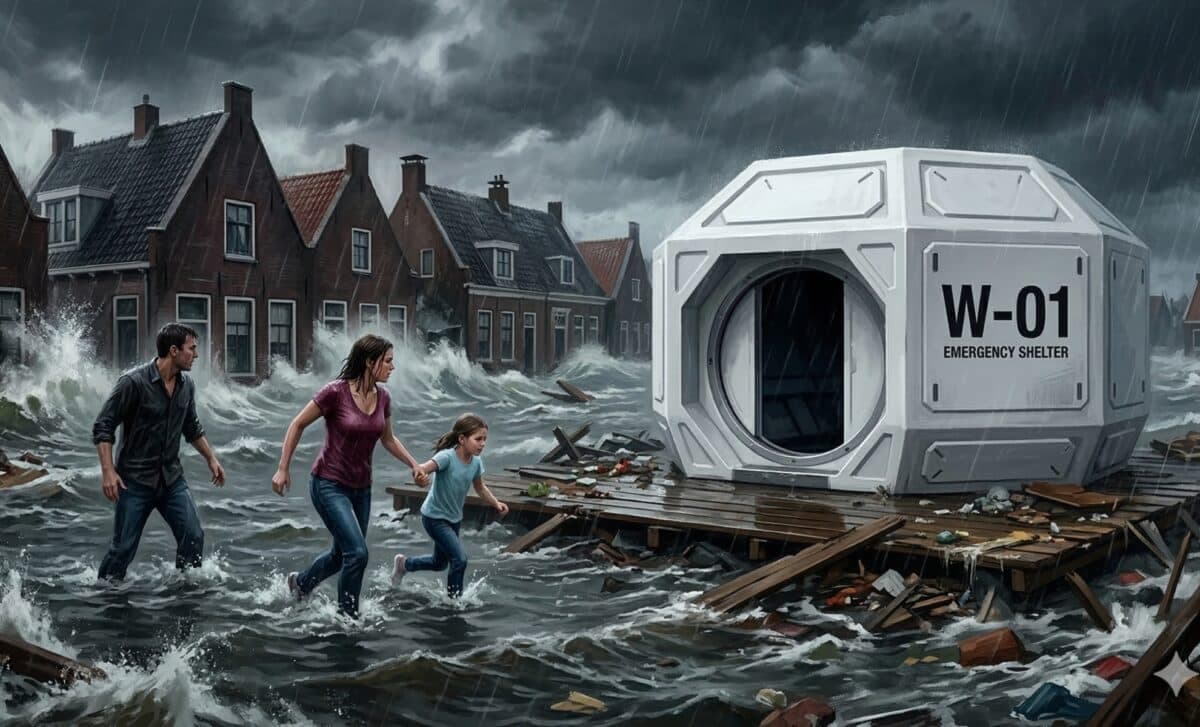
The LifePods W-01 flood-resistant model is built to endure some of nature’s most unforgiving forces. Its outer shell is constructed from 4mm-thick Aluminum 5083, a marine-grade alloy known for its corrosion resistance and high strength-to-weight ratio. This material is sandwiched in a double-shell structure with welded transverse reinforcements, creating a rigid framework capable of withstanding debris impacts at high velocities. The lower section of the pod is reinforced to twice the thickness, specifically engineered to resist collisions with rocks, logs, or other heavy objects propelled by floodwaters. To ensure buoyancy and stability, the W-01 incorporates an integrated ballast system that automatically rights the capsule if it tips over, a critical feature given that floodwaters can generate forces strong enough to flip vehicles and small buildings.
Inside the pod, survival is a matter of controlled confinement. The interior volume of approximately 2.5 cubic meters is designed to house up to 3 occupants comfortably, with seats equipped with safety harnesses to prevent injury during turbulent conditions. The pod’s ventilation system includes six 10 cm² channels that can be sealed to prevent water ingress during submersion, while an internal air filtration system removes pollutants and maintains breathable air. The company claims the W-01 offers up to 72 hours of respiratory autonomy with its integrated CO2 scrubbers, though technical sheets for the flood model note a shorter duration without supplemental oxygen cylinders. This discrepancy highlights ongoing refinements in the product’s specifications as it moves toward commercial release.
Surviving the Unsurvivable: Fire, Earthquakes, and Ballistic Threats
While the W-01 is the flagship flood model, Momentum Technologies has expanded the LifePods line to address a wider spectrum of disasters. The B-01 is designed for ballistic threats, fires, and explosions, featuring reinforced walls and fireproof insulation to protect occupants from shrapnel, extreme heat, and structural collapse. The Q-01, scheduled for release in mid-2027, targets seismic risks, particularly in multi-story buildings where rapid evacuation is impossible. At €18,000, it’s the most affordable model, reflecting its lighter construction and targeted use case—ideal for apartment dwellers in earthquake-prone regions like California or Japan. All models share a core philosophy: they are not meant for long-term habitation but for short-term survival until external rescue becomes feasible. Optional add-ons, such as GPS tracking beacons, inflatable rafts, and 14-day food and water supplies, further enhance the capsules’ utility in scenarios where external aid may be delayed.
A Market-Ready Product: Pricing, Launch Timeline, and Commercial Strategy
What sets LifePods apart from other emergency shelters is its unusually detailed commercial roadmap. Momentum Technologies has already showcased the capsules at major industry events, including Milipol Paris 2025 and CES 2026, signaling its dual appeal as both a civil protection tool for governments and a consumer product for proactive homeowners. The B-01 and W-01 models are slated for release in April and September 2026, respectively, each priced at €26,000 including tax. The Q-01, targeted at earthquake-prone urban areas, is planned for the third quarter of 2027 at €18,000. These prices place LifePods in the same bracket as high-end home security systems or premium electric vehicles, positioning them as a discretionary purchase for households prioritizing disaster resilience. Early adopters may qualify for discounts or bundled insurance packages, as insurers increasingly recognize the value of certified survival equipment in reducing liability claims.
The Limits of LifePods: What the Capsules Can—and Can’t—Do
Despite their robust design, LifePods are not a panacea for all disaster scenarios. Their effectiveness hinges on rapid deployment—occupants must reach the capsule and seal it within 10 seconds of a threat’s onset, a window that may prove impossible in densely populated or chaotic evacuation scenarios. The capsules also lack advanced life-support systems, such as medical kits or long-term power sources, meaning their utility is confined to immediate survival rather than extended sheltering. Additionally, the company’s technical materials reveal inconsistencies in autonomy claims, with some documents citing 3 hours of basic functionality and others touting 72 hours with optional upgrades. These discrepancies underscore the product’s evolving nature as it transitions from prototype to market-ready solution.
Who’s Buying LifePods—and Why?
Momentum Technologies is targeting three primary customer segments: affluent homeowners in disaster-prone regions, institutions like schools and hospitals, and government agencies responsible for civil protection. In Japan, where earthquake and tsunami preparedness is ingrained in public consciousness, the company has already sparked interest among coastal municipalities looking for scalable shelter solutions. Similarly, in the United States, where FEMA reports that flood insurance claims have surged by 45% over the past decade, homeowners in floodplains are exploring LifePods as a complement to traditional evacuation plans. Schools in tornado alley are another key market, as the capsules provide a practical alternative to costly underground storm shelters. For businesses, the capsules offer a way to meet workplace safety regulations while minimizing operational downtime during disasters—a selling point highlighted in the company’s marketing materials.
The Future of Disaster Preparedness: A Paradigm Shift or a Niche Solution?
LifePods represent a broader trend in disaster preparedness: the shift from reactive measures to proactive, technology-driven solutions. Companies like LifePods are responding to a growing awareness that traditional emergency protocols—evacuation orders, community shelters, and first-responder response—may not suffice in an era of climate extremes and geopolitical instability. However, critics argue that such products could create a false sense of security, encouraging individuals to forgo community-based preparedness in favor of personal escape pods. Others question the ethics of marketing survival capsules to wealthy consumers while underserved communities lack basic infrastructure. Momentum Technologies counters that its products are designed to fill gaps in existing systems, particularly in scenarios where time is the most critical factor. As the LifePods line prepares for launch, its success may hinge on whether it can transcend its niche appeal and become a standard component of global disaster resilience strategies.
Key Takeaways: What You Need to Know About LifePods
- LifePods are portable survival capsules developed by France’s Momentum Technologies to provide last-second refuge during tsunamis, floods, fires, earthquakes, and ballistic threats.
- The capsules seal in 10 seconds and are priced between €18,000 and €26,000, with models launching between 2026 and 2027.
- Built from marine-grade aluminum and designed to withstand debris impacts, the W-01 flood model offers up to 72 hours of respiratory autonomy with optional upgrades.
- LifePods target affluent homeowners, institutions, and governments, reflecting a growing market for rapid-response disaster preparedness solutions.
- While promising, the capsules have limitations, including strict deployment time requirements and inconsistencies in autonomy claims.
Frequently Asked Questions
Frequently Asked Questions
- How much does a LifePod survival capsule cost?
- The LifePods lineup is priced between €18,000 and €26,000, depending on the model. The B-01 and W-01 are both €26,000, while the Q-01 earthquake model is €18,000.
- How long can a LifePod keep occupants alive?
- The W-01 flood model is designed to provide up to 72 hours of respiratory autonomy with integrated CO2 scrubbers and optional oxygen cylinders, though some technical sheets cite shorter durations without upgrades.
- Can LifePods be installed indoors, or are they only for outdoor use?
- LifePods are designed for both indoor and outdoor installation. Some models are designed for rooftop or balcony placement, while others can be installed in interior spaces like basements or garages for earthquake or ballistic protection.