The computers of tomorrow may abandon silicon in favor of a far more energy-efficient technology: spintronics. Pioneering research from a German-Japanese collaboration has demonstrated a critical step forward—converting terahertz-frequency spin waves into electrical signals compatible with current computing infrastructure. Led by physicist Davide Bossini at the University of Konstanz, the team has unlocked a pathway to integrate magnons, the quantum units of spin waves, into practical data processing systems, potentially revolutionizing how information is stored, transmitted, and computed.
Why Spintronics Could Replace Silicon in Future Computers
Silicon-based transistors have powered computing for decades, but their physical limits are rapidly approaching. As processors shrink to atomic scales, heat dissipation and energy consumption become prohibitive barriers. Spintronics offers a radical alternative by using the intrinsic angular momentum—spin—of electrons to encode and process data. This approach eliminates the need for electrical charge movement in traditional transistors, significantly reducing energy use.
Hard drives already employ spintronics in the form of giant magnetoresistance (GMR), a technology recognized with the 2007 Nobel Prize in Physics. However, the full potential of spintronics extends beyond storage. Researchers are now exploring dynamic spin waves—collective excitations of electron spins known as magnons—that can carry information at terahertz frequencies, millions of times faster than today’s electronics. The challenge has been bridging the gap between these high-speed spin signals and the electrical signals used in conventional computers.
The Magnon Challenge: From Spin Waves to Usable Signals
Magnons travel through magnetic materials as coordinated waves of spin orientation, but they are not inherently electrical signals. To be useful in computing, these spin waves must be converted into charge-based signals that modern processors can interpret. This spin-to-charge conversion is one of the most formidable hurdles in spintronic development. "If we develop a concept to perform computer calculations with magnons, it must be compatible with the technology we currently use," Bossini explains. "To reach this goal, you have to convert the spin wave into an electrical charge signal."
Prior attempts to achieve this conversion often relied on exotic or complex materials with limited scalability. Bossini’s team sought a different approach—one that could be implemented with widely available technology. Their solution hinges on an overlooked optical property of magnons: under specific conditions, spin waves can influence the optical characteristics of a material, effectively converting a magnetic signal into an optical one.
Optical Bridge: How Lasers Unlock Spin Wave Data Processing
In their groundbreaking study published in Nature Communications , the researchers demonstrated that terahertz magnons can modulate the optical properties of certain crystals when exposed to laser pulses. This process, known as coherence transfer, allows the magnetic information carried by spin waves to be temporarily encoded in light. "Under certain conditions, the magnetic signal of spin waves can be converted into an optical signal," Bossini says. "We show that magnons can also influence the optical properties of a material. It remains a magnetic signal, but it has measurable optical properties."
The Role of Laser Pulses in Magnon-Optical Coupling
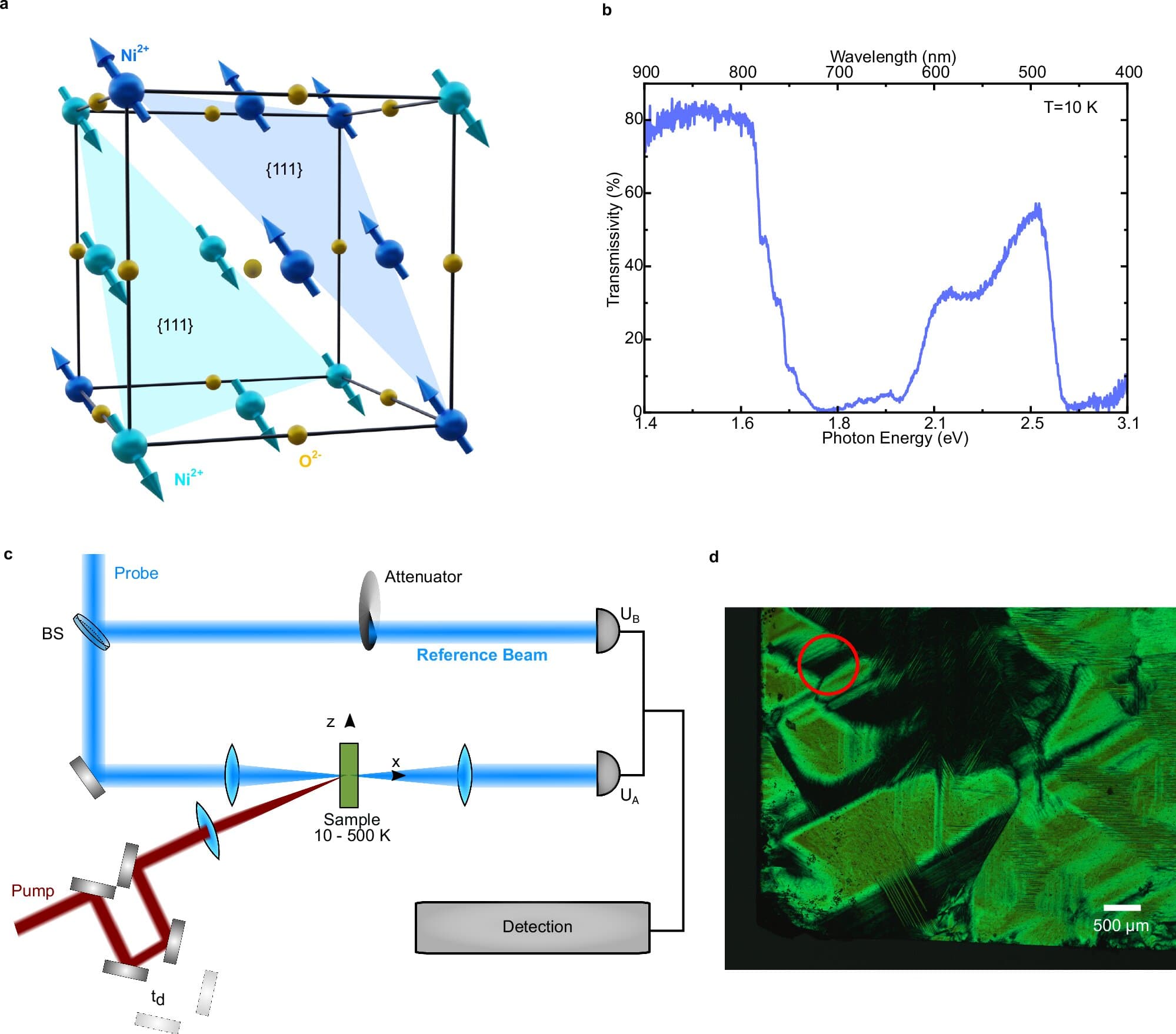
The team used ultrafast laser pulses with wavelengths in the visible and near-infrared spectrum, ranging from 400 to 900 nanometers. These pulses interact with the crystal lattice of the material, temporarily altering its electronic structure in a way that couples to the spin wave’s magnetic field. The wavelength required depends on the specific material, but the underlying principle is transferable. "You don’t need highly specialized signals for our process," Bossini notes. "But you need to fulfill certain conditions, and we have now identified these conditions."
Critically, the experiments were conducted at cryogenic temperatures of 10 kelvins (-263°C), which is necessary to maintain the coherence of magnons. While this may seem impractical for real-world applications, Bossini emphasizes that the core discovery—demonstrating feasibility with standard materials—is the breakthrough. "The characteristic of our research team is that we deliberately avoid using exotic materials," he says. "The process can be easily implemented in industrial applications and by other research groups."
From Lab to Reality: The Path to Spintronic Computers
The implications of this research extend far beyond academic curiosity. Spintronics promises computers that are not only faster but also far more energy-efficient than today’s silicon-based systems. Current data centers consume roughly 1% of global electricity, a figure that could double by 2030 without innovation. Spin-based systems could reduce this burden by orders of magnitude, as magnons require minimal energy to propagate and can carry information without Joule heating.
The conversion of spin waves to optical signals is only the first step. The next critical phase involves transducing these optical signals into electrical ones that processors can use. Bossini’s team is already exploring pathways to achieve this final conversion, potentially using hybrid photonic-spintronic circuits. Such systems could integrate seamlessly with existing semiconductor manufacturing processes, accelerating adoption.
Beyond Computing: Spintronics in Communications and Sensors
While the immediate focus is on computing, the applications of terahertz spin waves extend to other fields. High-frequency spintronic devices could enable ultra-fast wireless communication, surpassing the limits of 5G and millimeter-wave technology. They may also revolutionize medical imaging, where terahertz radiation offers superior resolution without ionizing radiation hazards. Additionally, spin waves are highly sensitive to magnetic fields, making them ideal for next-generation sensors in navigation, automotive systems, and quantum computing.
Key Takeaways: What This Discovery Means for Technology
- Researchers have demonstrated a method to convert terahertz spin waves (magnons) into optical signals using standard lasers and crystals, a critical step toward spintronic computing.
- The process avoids exotic materials, relying instead on commercially available technology, which accelerates industrial adoption potential.
- Spintronics could drastically reduce energy consumption in computing by eliminating the need for electrical charge movement in data processing.
- The breakthrough was achieved at cryogenic temperatures, but the core technique is scalable and adaptable to higher temperatures with further research.
- Applications extend beyond computing to include ultra-fast communication, medical imaging, and advanced sensors.
The Science Behind the Spin: How Magnons Work
To understand the significance of Bossini’s work, it’s essential to grasp the nature of magnons. Unlike photons, which are particles of light, magnons are quasiparticles representing collective excitations of electron spins in a magnetic material. When a spin wave propagates, it creates a ripple in the alignment of electron spins, much like a wave on the surface of water. These waves can carry information without moving physical charge, which is why they are so energy-efficient.
Terahertz magnons operate at frequencies between 0.1 and 10 terahertz (10^12 Hz), placing them between microwave and infrared radiation on the electromagnetic spectrum. This high-frequency range enables data transmission speeds far exceeding those of conventional electronics, which typically operate in the gigahertz range. However, capturing and converting these ultra-fast signals has been a persistent challenge—until now.
Challenges Ahead: Temperature, Scalability, and Integration
Despite the promise, several hurdles remain before spintronic computers become a reality. The need for cryogenic cooling is a major limitation, though Bossini’s team is optimistic about progress in room-temperature magnonics. Materials science will play a crucial role, as researchers seek compounds that can sustain coherent spin waves at higher temperatures without excessive energy input.
Integration with existing semiconductor fabrication is another critical challenge. Spintronic devices must be compatible with silicon-based manufacturing to achieve cost-effective mass production. The use of standard lasers and crystals in this study is a positive sign, but scaling up will require overcoming material defects and signal degradation over longer distances.
The Roadmap to Spintronic Adoption: What’s Next?
Bossini and his collaborators are already planning the next phase of research, which will focus on direct spin-to-charge conversion without the intermediate optical step. This would simplify the architecture of spintronic devices and bring them closer to practical use. Collaborations with semiconductor manufacturers and tech giants are anticipated, as the computing industry seeks alternatives to Moore’s Law stagnation.
Government and private funding for spintronics has surged in recent years, with initiatives like the U.S. National Spintronics Initiative and the EU’s Graphene Flagship program allocating hundreds of millions to research. The potential economic impact is enormous, with spintronic devices expected to dominate next-generation memory, processors, and quantum computing components.
Expert Reactions: A Paradigm Shift in Computing?
This is a landmark achievement in spintronics. The ability to convert high-frequency spin waves into usable signals using standard tools is a game changer. It demonstrates that we’re not just theorizing about the future of computing—we’re now building the bridges to get there."
—Dr. Claudia Felser, Director of the Max Planck Institute for Chemical Physics of Solids and a pioneer in spintronic materials
Frequently Asked Questions
Frequently Asked Questions
- What is spintronics and how is it different from traditional computing?
- Spintronics uses the intrinsic spin of electrons instead of their charge to store and process data. Unlike traditional computing, which relies on silicon transistors and electrical currents, spintronics can operate with minimal energy loss and at much higher speeds, particularly in the terahertz range.
- Why do terahertz spin waves matter for future technology?
- Terahertz spin waves (magnons) enable data transmission and processing at frequencies far beyond current electronics. This could lead to computers that are thousands of times faster while consuming a fraction of the energy, addressing both performance and sustainability challenges in computing.
- Will spintronic computers require extreme cooling like quantum computers?
- Current demonstrations, including this study, rely on cryogenic temperatures (around 10 kelvins) to maintain spin wave coherence. However, researchers are actively working on materials and techniques to achieve room-temperature operation, which would make spintronics commercially viable.