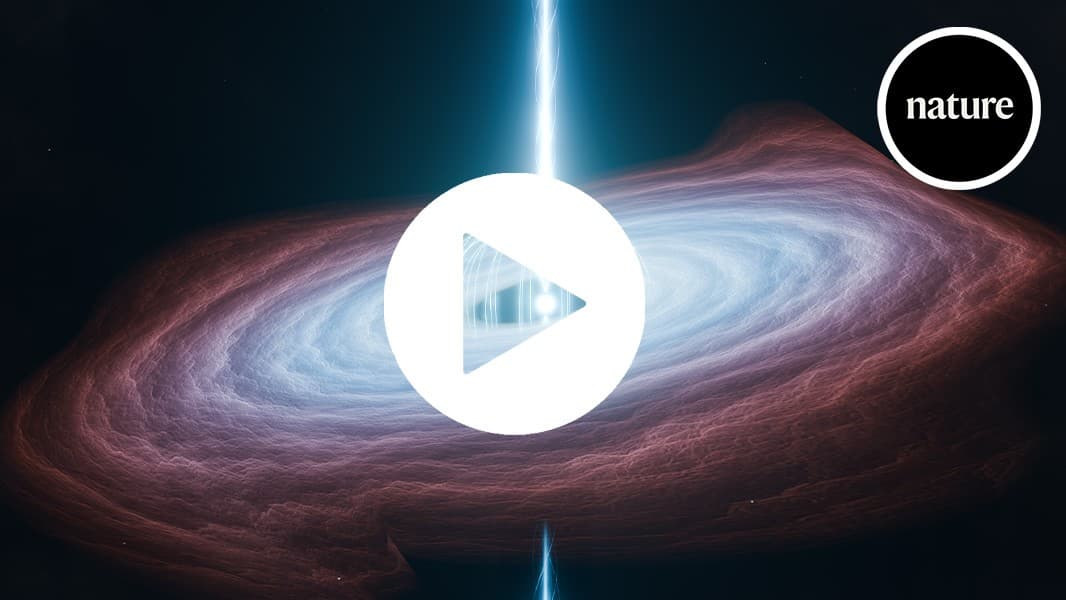
Wobbling signal could explain some extremely bright supernovae
You have full access to this article via your institution.
Supernovae are colossal explosions triggered as ancient stars come to the end of their lives.
Scientists have done huge amounts of work to identify and understand these cosmic fireworks but, in the last 20 years or so, astronomers have spotted some supernovae that don’t make sense.
Read the paper: Lense–Thirring precessing magnetar engine drives a superluminous supernova
Superluminous supervnovae are 10 to 100 times brighter than expected, and while different theories exist, no-one is quite sure how that’s possible.
Now the wobbling signal from one of these super bright explosions has provided a possible answer.
- Flying a helicopter on Mars: NASA’s Ingenuity
- Inside a comet: Philae’s final secret
- Radiation for dummies: the female mannequins testing space-travel safety
- The future of detecting gravitational waves: A three minute guide
- Origami-inspired structures could be deployed in disaster zones
Flying a helicopter on Mars: NASA’s Ingenuity
Inside a comet: Philae’s final secret
Radiation for dummies: the female mannequins testing space-travel safety
The future of detecting gravitational waves: A three minute guide
Origami-inspired structures could be deployed in disaster zones
- Lense–Thirring precessing magnetar engine drives a superluminous supernova Article 11 MAR 26
- Ultra-bright supernova wobbles like a spinning top News & Views 11 MAR 26
- Jam-packed star system is most compact of its kind ever found Research Highlight 03 MAR 26
Lense–Thirring precessing magnetar engine drives a superluminous supernova
Ultra-bright supernova wobbles like a spinning top
Jam-packed star system is most compact of its kind ever found
- Physics at risk: UK science leader on what's wrong with the latest funding cuts News Q&A 11 MAR 26
- Lense–Thirring precessing magnetar engine drives a superluminous supernova Article 11 MAR 26
- Nanophotonic waveguide chip-to-world beam scanning Article 11 MAR 26
Physics at risk: UK science leader on what's wrong with the latest funding cuts
- Ten years since the first reported observation of gravitational waves News & Views 11 FEB 26
- From quantum computing to mRNA therapeutics: seven technologies to watch in 2026 Technology Feature 21 JAN 26
- Argentina must finish building the CART radio telescope Correspondence 09 DEC 25
Ten years since the first reported observation of gravitational waves
From quantum computing to mRNA therapeutics: seven technologies to watch in 2026
Argentina must finish building the CART radio telescope