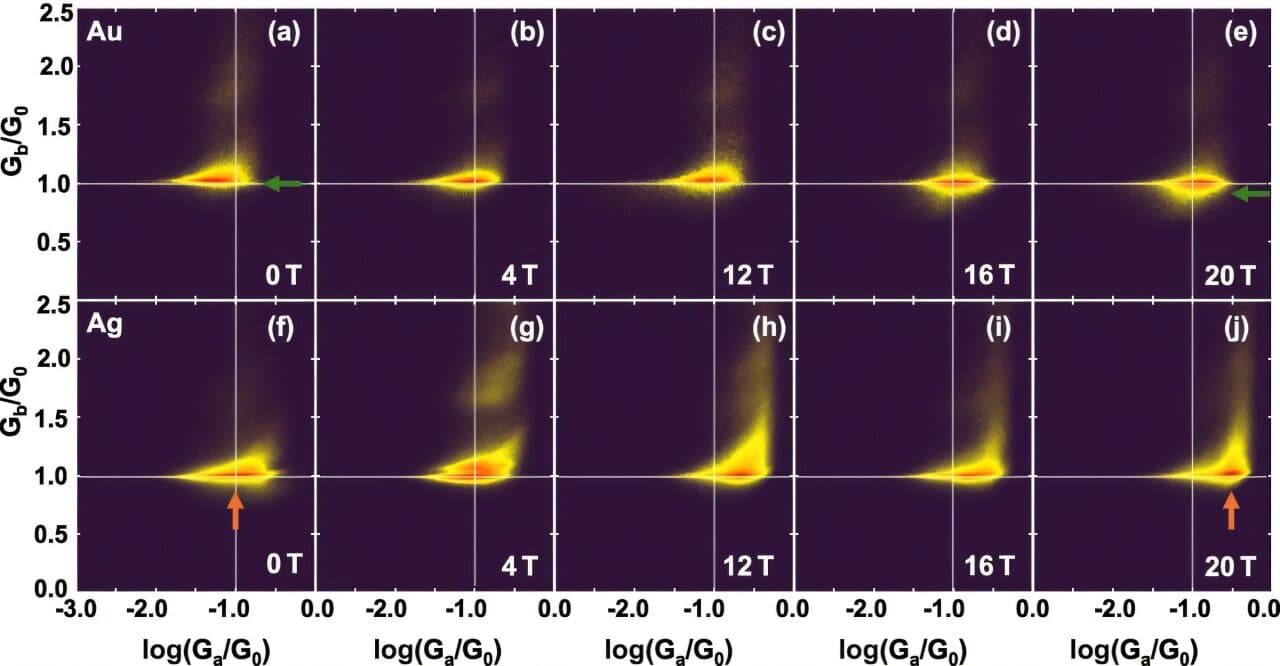
Researchers from the Department of Physics and the University Institute of Materials at the University of Alicante (UA) and the Low Temperature and High Magnetic Field Laboratory at the Autonomous University of Madrid (UAM) have succeeded in measuring, for the first time, the electrical conductance of gold and silver atomic contacts subjected to extreme magnetic fields of up to 20 teslas, an intensity equivalent to 400,000 times Earth's magnetic field.
The team observed that, when applying these fields, the conductance of the gold contacts decreases by around 15%, an unexpected result in noble metals such as gold (Au) and silver (Ag). Furthermore, they detected modifications in the formation process of the atomic contact itself, which were particularly marked in silver. These findings contradict previous theoretical predictions, which anticipated a practically non-existent magnetic dependence in pure Au and Ag.
The discovery, published in Physical Review Research, adds a new piece to the knowledge of electronic transport physics at the atomic scale. Achieving a noticeable response to a magnetic field from a conductor consisting of a single atomic channel, as occurs in these metals, is extremely difficult. The results suggest that functional materials can be designed by combining noble metals with magnetically active systems.
Potential applications include ultra-sensitive nanoscale magnetic sensors and more efficient spintronics devices. Beyond specific examples such as MRAM memories, which are fast, durable, and can retain data without power, spintronics is the electronics of the future. According to researcher and expert in nanoelectronics at the UA Carlos Sabater, by relying on electron spin (a property highly sensitive to magnetic fields), this technology allows for the development of much more advanced and versatile technologies.
In the medium term, these advances could have an impact on technologies ranging from quantum computing to the biomedical detection of weak magnetic fields.
The researchers, led by Carlos Sabater and Andrés Martínez from the UA, and Hermann Suderow, Isabel Guillamón, and Juan José Palacios from the UAM, performed experiments using a cryogenic scanning tunneling microscope coupled to a 20-tesla superconducting magnet. This combination allowed them to record conductance measurements under extreme conditions never before achieved in atomic contacts.
In particular, the team generated atomic contacts between a sharp metal tip and a gold or silver sample through repeated mechanical indentations at 4.2 Kelvin (−269°C). For each magnetic field value, they recorded tens of thousands of conductance curves as a function of distance, enabling the construction of high-precision statistical histograms.
The experimental measurements were complemented by advanced theoretical calculations. The models revealed the underlying mechanism: Small residual oxygen molecules attached near the contact generate a spin-polarized current when the magnetic field is applied. This current is responsible for the observed reduction in conductance.
The results of this work open a new line of research: The engineering of atomic conductors with adjustable magnetic properties without resorting to ferromagnetic materials such as iron, cobalt, or nickel. This strategy could expand the repertoire of future nanoelectronics and spintronics.
Beilun Wu et al, Conductance of atomic size contacts of Ag and Au at high magnetic fields, Physical Review Research (2026). DOI: 10.1103/cmh2-frmf
Citation: Unexpected magnetic response in gold and silver atomic contacts contradicts previous theoretical predictions (2026, March 10) retrieved 11 March 2026 from https://phys.org/news/2026-03-unexpected-magnetic-response-gold-silver.html
This document is subject to copyright. Apart from any fair dealing for the purpose of private study or research, no part may be reproduced without the written permission. The content is provided for information purposes only.