- Seven defected, but the rest reluctantly boarded a plane. What horror awaits Iran's brave women footballers at home?
- Cargo ship 'attacked' in Strait of Hormuz: Projectile hits vessel, forcing crew to evacuate, after US destroyed 16 Iranian minelaying warships to prevent waterway closing
- Pro-Iran hate march is BANNED: Home Secretary bows to huge pressure and halts London rally by backers of Tehran's murderous, women-oppression regime
- ANDREW NEIL: Trump has gambled his presidency on Iran - and right now it's far from clear it will pay off. This is why Britain will be one of the losers...
- 'It's disgusting. What message does it send?': Fresh row as friends of 'distraught' Karen Hauer blast BBC after star is cut in Strictly bloodbath - and sources tell CODIE BULLEN surprising reason Katya Jones avoided axe
- Shellharbour Beach, NSW: Horror as two British tourists drown at popular Australian beach after brave witnesses tried to save them
- How 'the most beautiful girl in the world' Thylane Blondeau struggled to live up to the title bestowed on her when she was just six years old
- Nothing I tried could shift my 'meno-middle'... Then a miracle method banished it in just four weeks - without jabs or a single visit to the gym
- 'Phantom investment' scandal rocking Britain: These firms pledged billions to revolutionise the UK... but, a year on, FRED KELLY reveals what's really happened to their plans... and why one planned site is now a scrapyard
- Meghan to headline £1,400 'girls' weekend' in Australia: Duchess to give Q&A and pose for photos with VIP guests at luxury retreat with yoga, sound healing and manifestation exercises
- The horrifying life of 'Hannibal the Cannibal'... and the TRUTH about his 'glass cell'. Read it in The Crime Desk newsletter
- A £100m London property portfolio, a squad of brutal enforcers and a fanatical dream: Truth about new Ayatollah, why insiders warn he's more dangerous than fifty nukes... and his troubling links to Britain, by DAVID PATRIKARAKOS
- Pupils' drawings could be blasphemous under Islamic law, Labour councils tell schools - while music and dance classes may go against the teachings of Islam
- The urgent guide to stop your energy bill rocketing to £25,000: With Iran crisis set to send prices soaring, what you must do to protect yourself
- MasterChef The Professionals star Matt Tebbutt 'is axed from presenting gig after just one series'
- Liza Minnelli lays into Gene Hackman after first anniversary of his death: 'Downright rude!'
- At least six dead 'as man douses himself in petrol and sets himself alight on bus in Switzerland': More victims are hurt - police 'won't comment' on whether it is terror, local reports say
- Labour MP warns that Government's new definition of Islamophobia will result in over-policing
- I kept Princess Kate's first pregnancy a secret, reporter tells court
- Lucky UK ticket-holder wins £181million EuroMillions jackpot
- I tried on everything in the new M&S collection so you don't have to. Here are my 7 must-buys - from this insanely flattering dress to thigh-skimming culottes and a 'goes with everything' jacket: SHANE WATSON
- Moment city lawyer's wife scuffles with neighbour as he tries to stop her erecting security fence in row over her plans to transform £850,000 village home
- Labour's Digital ID card scheme could go far beyond initial proposals - making it easier to claim benefits and even telling you when to put your bins out
- I left for work one morning and asked my wife to call a plumber. I never thought it would end with my family being held to ransom. These are the signs you can't ignore
By XANTHA LEATHAM, EXECUTIVE SCIENCE EDITOR
Published: 16:23 GMT, 10 March 2026 | Updated: 16:35 GMT, 10 March 2026
Scientists are reconstructing the oldest known map of the night sky – long thought lost to time – by using X–rays to reveal its secrets.
The map, which was created around 2,000 years ago, has spent centuries hidden under a medieval manuscript.
It is thought to be the work of famous Greek astronomer Hipparchus, who lived from around 190 to 120BC – long before the invention of the telescope.
Four years ago, in 2022 , analysis of a 6th century monastery text revealed it could contain the ancient star map underneath.
Now, experts at the SLAC National Accelerator Laboratory in California are using X–rays to bring the ancient cosmos back to life.
'The goal is to recover as many of these coordinates as possible,' Victor Gysembergh, the lead scholar on the experiment, told KQED .
'And this will help us answer some of the biggest questions on the birth of science. Why did they start doing science 2,000 and more years ago? How did they get so good at it so fast?
'The coordinates we are finding are incredibly accurate for something that is done with the naked eye.'
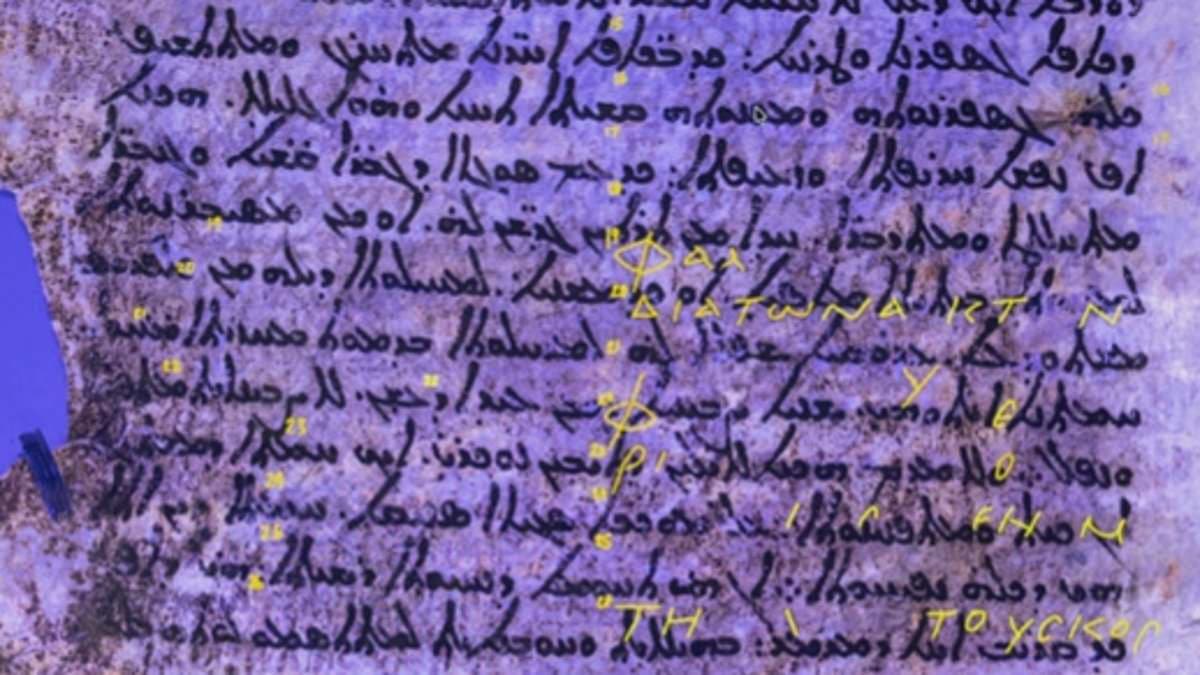
The map, which was created nearly 2,000 years ago, has spent centuries hidden under a medieval manuscript
While the original text contained ink with hints of calcium, the overwritten version used ink rich in iron – allowing the team to visually separate the two
The medieval manuscript, called the Codex Climaci Rescriptus, is thought to have been originally recovered from St Catherine's Monastery in Egypt.
Since parchment was expensive in the Middle Ages, material was often scraped clean of ink and reused – which scientists expect may have happened here.
In order to closely analyse the parchment, the researchers used an X–ray that can distinguish between different chemicals in a material without damaging it.
While the original text contained ink with hints of calcium, the overwritten version used ink rich in iron – allowing the team to visually separate the two.
The team have already identified the word for 'Aquarius' and descriptions of 'bright' stars within that constellation.
'This new scan that we started…line after line of text showed up in ancient Greek from the astronomical manuscript,' Dr Gysembergh said.
The team said they can now use the information to try and answer questions about how ancient astronomers achieved such accurate results without the use of magnifying instruments.
A total of 11 pages are currently being scanned at the SLAC lab. The entire manuscript runs to around 200 pages in total – but the rest of the pages are scattered around the world.
The team said they can use the information to try and answer questions about how ancient astronomers achieved such accurate results without the use of magnifying instruments
Hipparchus (c. 190–120 BCE) was an ancient Greek astronomer and mathematician.
He is often called one of the greatest astronomers of antiquity and sometimes the father of scientific astronomy.
Hipparchus is famous for creating one of the first star catalogues, recording the positions of hundreds of stars in the sky.