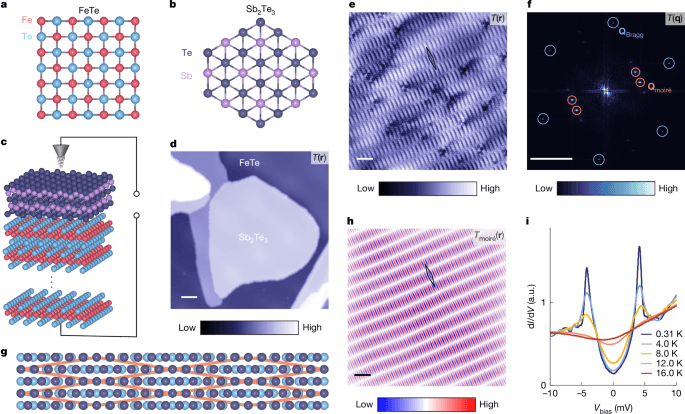
In a landmark discovery published January 2025 in Nature, an international team of physicists announced the direct imaging of spatially modulated superconducting gaps in moiré superlattices composed of antimony telluride (Sb2Te3) and iron telluride (FeTe). Using Josephson scanning tunneling microscopy and spectroscopy (JS-STM), the researchers visualized Cooper-pair density waves—patterns of electron pairing that break translational symmetry in the lattice—within these engineered quantum materials. The findings, led by corresponding author Dr. Liang Kong of Tsinghua University, represent a pivotal advancement in the field of unconventional superconductivity and open new avenues for designing quantum devices with tunable electronic properties.
- First direct visualization of Cooper-pair density modulation in an iron-based moiré superlattice using JS-STM.
- Superconducting gaps were spatially modulated and tunable by substituting Sb2Te3 with bismuth telluride (Bi2Te3).
- Experiment validates theoretical models predicting pair-density-wave (PDW) states in layered heterostructures.
- Discovery offers a platform for engineering quantum materials with customizable superconducting properties.
How Moiré Superlattices Enable Unconventional Superconductivity
Moiré superlattices form when two atomically thin materials are stacked with a slight rotational misalignment or lattice mismatch, creating a periodic potential landscape that alters electronic behavior. In this study, researchers constructed a heterostructure combining topological insulator Sb2Te3 with the iron-based superconductor FeTe. The resulting interface exhibited interfacial superconductivity—a phenomenon first observed over a decade ago in similar systems like Bi2Te3/FeTe, where the presence of Dirac fermions in the topological layer enhances pairing in the adjacent superconducting layer. Unlike conventional superconductors, which exhibit uniform energy gaps, the moiré superlattice introduced a periodic modulation in the superconducting gap, indicative of a Cooper-pair density wave state.
The Role of Topological Insulators in Pairing Enhancement
Topological insulators like Sb2Te3 and Bi2Te3 host Dirac surface states that are robust against disorder and can interact strongly with adjacent superconducting layers. In the Sb2Te3/FeTe system, these surface states facilitate the formation of Cooper pairs across the interface, a process known as proximity-induced superconductivity. The moiré pattern further modulates this interaction by creating regions of enhanced or suppressed superconducting order, leading to the observed density wave. Prior work, including studies from Yi et al. (2023) in Nature Communications, demonstrated that Dirac-fermion-assisted interfacial superconductivity can be finely tuned by adjusting layer thickness or twist angle, providing a versatile platform for engineering quantum states.
Josephson Scanning Tunneling Microscopy: The Tool That Unlocked the Breakthrough
The visualization of Cooper-pair density waves was made possible by Josephson scanning tunneling microscopy, a technique that combines the atomic-resolution imaging of STM with the ability to probe superconducting order parameters. Unlike conventional STM, which measures electronic density of states, JS-STM detects the phase coherence of Cooper pairs through Josephson junction behavior. In this experiment, a superconducting niobium tip was used to scan the Sb2Te3/FeTe heterostructure at cryogenic temperatures, revealing periodic modulations in the Josephson current that directly mapped the density of Cooper pairs. This method has previously been used to image pair-density-wave states in cuprate superconductors, such as Bi2Sr2CaCu2O8+δ (Bi-2212), as reported by Hamidian et al. in Nature (2016).
JS-STM allows us to ‘see’ the quantum mechanical phase of the superconducting order parameter. In moiré superlattices, we observed a periodic modulation of this phase, which is the hallmark of a Cooper-pair density wave. This is not just a theoretical prediction—we have imaged it with atomic precision."
Tunability Through Material Substitution: From Sb2Te3 to Bi2Te3
One of the most significant findings of the study is the tunability of the superconducting state through material substitution. When Sb2Te3 was replaced with Bi2Te3—a closely related topological insulator with a larger spin-orbit coupling—the researchers observed a shift in the periodicity and amplitude of the Cooper-pair density modulation. This tunability arises from differences in the electronic structure of the two materials. Sb2Te3 and Bi2Te3 both belong to the group-V chalcogenides and share similar layered crystal structures, but Bi2Te3 has a larger bandgap and stronger spin-orbit interactions. These properties influence the interfacial coupling strength and the resulting moiré potential, allowing researchers to ‘dial in’ specific superconducting behaviors.
Chemical and Structural Factors in Superconductivity
The structural compatibility between Sb2Te3 and FeTe is critical to the observed superconductivity. Both materials crystallize in layered structures, with Sb2Te3 adopting a rhombohedral phase and FeTe forming a tetragonal lattice. The interfacial superconductivity in such heterostructures has been linked to charge transfer and magnetic interactions across the interface. Studies by Liang et al. (2020) in PNAS showed that the superconducting transition temperature (Tc) in Sb2Te3/Fe1+yTe heterostructures can exceed 10 K, significantly higher than the bulk FeTe Tc of ~1.5 K. The moiré engineering approach builds on this foundation by introducing a periodic potential that further stabilizes or modulates the superconducting state.
Broader Implications: From Quantum Computing to Energy-Efficient Electronics
The discovery of tunable Cooper-pair density waves in moiré superlattices has far-reaching implications for both fundamental physics and applied technology. In quantum computing, superconducting qubits rely on stable and controllable coherent states. The ability to engineer spatially modulated superconductivity could enable the creation of topological qubits or protected quantum states resistant to decoherence. Additionally, the moiré platform offers a route to high-temperature superconductivity in two-dimensional materials, a long-standing goal in condensed matter physics. Recent advances in twisted bilayer graphene (TBG) and transition metal dichalcogenides (TMDs) have already demonstrated correlated insulating states and superconductivity at relatively high temperatures for 2D systems. The current study extends this toolkit to iron-based superconductors, which often exhibit higher Tc values than cuprates in bulk form.
Historical Context: Pair-Density-Wave States in High-Temperature Superconductors
The concept of pair-density-wave (PDW) states dates back to theoretical work by Fulde and Ferrell (1964) and Larkin and Ovchinnikov (1965), who predicted spatially inhomogeneous superconducting states in the presence of magnetic fields or strong spin interactions. For decades, PDW states were considered exotic and difficult to observe directly. However, in 2016, Hamidian et al. reported the first direct imaging of a PDW in the cuprate superconductor Bi-2212 using STM. Subsequent studies, including those by Edkins et al. (Science, 2019) and Du et al. (Nature, 2020), confirmed PDW states in underdoped cuprates and linked them to the enigmatic pseudogap phase. The current work in moiré superlattices generalizes these findings to a new class of materials—iron-based superconductors—where PDW states can be engineered and tuned.
Comparing Moiré Superlattices to Other Quantum Platforms
Moiré superlattices are part of a broader family of quantum materials where electronic behavior is controlled by geometric design. Magic-angle twisted bilayer graphene (MATBG), first demonstrated by Cao et al. in 2018, revolutionized the field by showing superconductivity and correlated insulating states at twist angles near 1.1°. Similarly, twisted transition metal dichalcogenides like WSe2 and MoTe2 have exhibited superconductivity, quantum anomalous Hall effects, and Wigner crystals. The moiré platform used in the current study differs in that it combines a topological insulator with an iron-based superconductor, creating a hybrid system where superconductivity arises from interfacial coupling rather than intrinsic properties of a single material.
Advantages of Iron-Based Superconductors
Iron-based superconductors (IBS) such as FeTe and its derivatives offer several advantages over cuprates and graphene-based systems. First, IBS exhibit higher critical temperatures in bulk form, with some compounds like SmFeAsO reaching Tc values above 50 K. Second, IBS are less sensitive to disorder, making them more robust for device applications. Third, the presence of multiple Fermi surface pockets in IBS allows for rich electronic interactions, including spin fluctuations that may enhance superconductivity. The moiré engineering approach leverages these properties by introducing a periodic potential that further stabilizes or modulates the superconducting state.
The Future: Engineering Quantum States with Moiré Patterns
The success of this study paves the way for a new era of quantum material design, where moiré patterns are used to engineer electronic states with unprecedented control. Researchers are now exploring other combinations of materials, including magnetic topological insulators and superconductors, to create systems with exotic topological orders. For example, Yi et al. (Science, 2024) recently demonstrated interface-induced superconductivity in magnetic topological insulators, suggesting that the combination of magnetism and superconductivity could lead to novel quantum phenomena like Majorana fermions. The current findings underscore the importance of interfacial engineering in unlocking new states of matter.
Challenges and Next Steps in Moiré Superconductivity Research
Despite the breakthrough, significant challenges remain. First, the microscopic mechanism underlying the moiré-induced superconductivity in Sb2Te3/FeTe heterostructures is not fully understood. While interfacial charge transfer and magnetic interactions are likely contributors, the precise role of Dirac fermions and spin-orbit coupling requires further investigation. Second, scaling moiré devices for practical applications will demand precise control over twist angles and layer alignment, which is currently achieved through manual stacking techniques. Third, the stability of these engineered states at higher temperatures and under external perturbations (e.g., magnetic fields) remains an open question. Future work will likely focus on optimizing material combinations and exploring alternative moiré patterns to enhance Tc and robustness.
Key Takeaways for Scientists and Industry
- Moiré superlattices in Sb2Te3/FeTe bilayers enable direct visualization of Cooper-pair density waves using JS-STM, confirming theoretical predictions of PDW states in iron-based superconductors.
- Material substitution (Sb2Te3 to Bi2Te3) provides tunability of superconducting properties, offering a new route to engineer quantum materials.
- The discovery expands the toolkit for quantum material design, with potential applications in quantum computing, high-temperature superconductivity, and energy-efficient electronics.
- Interfacial engineering in topological insulator/superconductor heterostructures emerges as a powerful strategy for creating customizable superconducting states.
- Future research will focus on optimizing moiré patterns, understanding microscopic mechanisms, and scaling devices for real-world applications.
Frequently Asked Questions about Moiré Superlattices and Cooper-Pair Density Waves
Frequently Asked Questions
- What is a moiré superlattice?
- A moiré superlattice is formed when two atomically thin materials are stacked with a slight misalignment or lattice mismatch, creating a periodic potential that alters electronic behavior. This effect is commonly observed in twisted bilayer graphene and layered heterostructures.
- How does Josephson scanning tunneling microscopy detect Cooper-pair density waves?
- JS-STM combines atomic-resolution imaging with Josephson junction sensitivity. A superconducting tip probes the phase coherence of Cooper pairs, revealing periodic modulations in the superconducting order parameter that indicate a density wave state.
- Why are iron-based superconductors important for this discovery?
- Iron-based superconductors like FeTe exhibit higher critical temperatures and robust superconductivity compared to other 2D systems. Their rich electronic interactions and tolerance to disorder make them ideal candidates for moiré engineering.