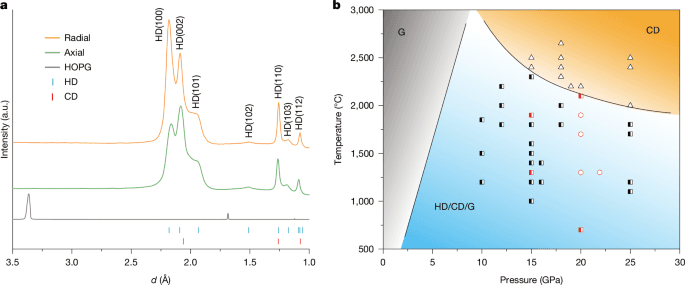
- Ergun, S. & Alexander, L. E. Crystalline forms of carbon: a possible hexagonal polymorph of diamond. Nature 195, 765–767 (1962).Article ADS CAS Google Scholar
- Bundy, F. P. & Kasper, J. S. Hexagonal diamond—a new form of carbon. J. Chem. Phys. 46, 3437–3446 (1967).Article ADS CAS Google Scholar
- Frondel, C. & Marvin, U. B. Lonsdaleite, a hexagonal polymorph of diamond. Nature 214, 587–589 (1967).Article ADS CAS Google Scholar
- Hanneman, R. E., Strong, H. M. & Bundy, F. P. Hexagonal diamonds in meteorites: implications. Science 155, 995–997 (1967).Article ADS CAS PubMed Google Scholar
- Pan, Z., Sun, H., Zhang, Y. & Chen, C. Harder than diamond: superior indentation strength of wurtzite BN and lonsdaleite. Phys. Rev. Lett. 102, 055503 (2009).Article ADS PubMed Google Scholar
- Qingkun, L., Yi, S., Zhiyuan, L. & Yu, Z. Lonsdaleite – a material stronger and stiffer than diamond. Scr. Mater. 65, 229–232 (2011).Article Google Scholar
- Israde-Alcántara, I. et al. Evidence from central Mexico supporting the Younger Dryas extraterrestrial impact hypothesis. Proc. Natl Acad. Sci. USA 109, E738–E747 (2012).Article PubMed PubMed Central Google Scholar
- Tomkins, A. G. et al. Sequential lonsdaleite to diamond formation in ureilite meteorites via in situ chemical fluid/vapor deposition. Proc. Natl Acad. Sci. USA 119, e2208814119 (2022).Article MathSciNet CAS Google Scholar
- Endo, S., Idani, N., Oshima, R., Takano, K. J. & Wakatsuki, M. X-ray diffraction and transmission-electron microscopy of natural polycrystalline graphite recovered from high pressure. Phys. Rev. B 49, 22–27 (1994).Article ADS CAS Google Scholar
- Isobe, F., Ohfuji, H., Sumiya, H. & Irifune, T. Nanolayered diamond sintered compact obtained by direct conversion from highly oriented graphite under high pressure and high temperature. J. Nanomater. 2013, 380165 (2013).Article Google Scholar
- Guillou, C. L., Brunet, F., Irifune, T., Ohfuji, H. & Rouzaud, J.-N. Nanodiamond nucleation below 2273 K at 15 GPa from carbons with different structural organizations. Carbon 45, 636–648 (2007).Article Google Scholar
- Shiell, T. B. et al. Nanocrystalline hexagonal diamond formed from glassy carbon. Sci. Rep. 6, 37232 (2016).Article ADS CAS PubMed PubMed Central Google Scholar
- McCulloch, D. G. et al. Investigation of room temperature formation of the ultra-hard nanocarbons diamond and lonsdaleite. Small 16, 2004695 (2020).Article CAS Google Scholar
- Erskine, D. J. & Nellis, W. J. Shock-induced martensitic phase transformation of oriented graphite to diamond. Nature 349, 317–319 (1991).Article ADS CAS Google Scholar
- Kurdyumov, A. V., Britun, V. F., Yarosh, V. V., Danilenko, A. I. & Zelyavskii, V. B. The influence of the shock compression conditions on the graphite transformations into lonsdaleite and diamond. J. Superhard Mater. 34, 19–27 (2012).Article Google Scholar
- Kraus, D. et al. Nanosecond formation of diamond and lonsdaleite by shock compression of graphite. Nat. Commun. 7, 10970 (2016).Article ADS CAS PubMed PubMed Central Google Scholar
- Turneaure, S. J., Sharma, S. M., Volz, T. J., Winey, J. M. & Gupta, Y. M. Transformation of shock-compressed graphite to hexagonal diamond in nanoseconds. Sci. Adv. 3, eaao3561 (2017).Article PubMed PubMed Central Google Scholar
- Armstrong, M. R. et al. Highly ordered graphite (HOPG) to hexagonal diamond (lonsdaleite) phase transition observed on picosecond time scales using ultrafast x-ray diffraction. J. Appl. Phys. 132, 055901 (2022).Article ADS CAS Google Scholar
- Németh, P. et al. Lonsdaleite is faulted and twinned cubic diamond and does not exist as a discrete material. Nat. Commun. 5, 5447 (2014).Article ADS PubMed Google Scholar
- Nakamuta, Y. & Toh, S. Transformation of graphite to lonsdaleite and diamond in the Goalpara ureilite directly observed by TEM. Am. Mineral. 98, 574–581 (2013).Article ADS CAS Google Scholar
- Németh, P. & Garvie, L. A. J. Questionable lonsdaleite identification in ureilite meteorites. Proc. Natl Acad. Sci. USA 120, e2304890120 (2023).Article PubMed PubMed Central Google Scholar
- Németh, P. et al. Complex nanostructures in diamond. Nat. Mater. 19, 1126–1131 (2020).Article ADS PubMed Google Scholar
- Németh, P. et al. Shock-formed carbon materials with intergrown sp3- and sp2-bonded nanostructured units. Proc. Natl Acad. Sci. USA 119, e2203672119 (2022).Article PubMed PubMed Central Google Scholar
- Yang, X. et al. Centimeter-sized diamond composites with high electrical conductivity and hardness. Proc. Natl Acad. Sci. USA 121, e2316580121 (2024).Article CAS PubMed PubMed Central Google Scholar
- Salzmann, C. G., Murray, B. J. & Shephard, J. J. Extent of stacking disorder in diamond. Diam. Relat. Mater. 59, 69–72 (2015).Article ADS CAS Google Scholar
- Irifune, T. et al. Formation of pure polycrystalline diamond by direct conversion of graphite at high pressure and high temperature. Phys. Earth Planet. Inter. 143–144, 593–600 (2004).Article ADS Google Scholar
- Bundy, F. P. et al. The pressure-temperature phase and transformation diagram for carbon; updated through 1994. Carbon 34, 141–153 (1996).Article CAS Google Scholar
- Niwase, K. et al. Quenchable compressed graphite synthesized from neutron-irradiated highly oriented pyrolytic graphite in high pressure treatment at 1500 °C. J. Appl. Phys. 123, 161577 (2018).Article ADS Google Scholar
- Luo, K. et al. Coherent interfaces govern direct transformation from graphite to diamond. Nature 607, 486–491 (2022).Article ADS CAS PubMed PubMed Central Google Scholar
- Sumiya, H., Irifune, T., Kurio, A., Sakamoto, S. & Inoue, T. Microstructure features of polycrystalline diamond synthesized directly from graphite under static high pressure. J. Mater. Sci. 39, 445–450 (2004).Article ADS CAS Google Scholar
- Sumiya, H., Yusa, H., Inoue, T., Ofuji, H. & Irifune, T. Conditions and mechanism of formation of nano-polycrystalline diamonds on direct transformation from graphite and non-graphitic carbon at high pressure and temperature. High Press. Res. 26, 63–69 (2006).Article ADS CAS Google Scholar
- Honda, S. et al. In situ observation of transformation of neutron-irradiated highly oriented pyrolytic graphite (HOPG) by X-ray diffraction under high-pressure and high-temperature treatment. Jpn. J. Appl. Phys. 60, 095002 (2021).Article ADS CAS Google Scholar
- Fan, Z. et al. GPUMD: a package for constructing accurate machine-learned potentials and performing highly efficient atomistic simulations. J. Chem. Phys. 157, 114801 (2022).Article ADS CAS PubMed Google Scholar
- Shi, J. et al. Double-shock compression pathways from diamond to BC8 carbon. Phys. Rev. Lett. 131, 146101 (2023).Article ADS CAS PubMed Google Scholar
- Pan, S. et al. Shock compression pathways to pyrite silica from machine learning simulations. Phys. Rev. B 110, 224101 (2024).Article ADS CAS Google Scholar
- Feng, X. et al. Nanosecond structural evolution in shocked coesite. Sci. Adv. 11, eads3139 (2025).Article CAS PubMed PubMed Central Google Scholar
- Khaliullin, R. Z., Eshet, H., Kühne, T. D., Behler, J. & Parrinello, M. Nucleation mechanism for the direct graphite-to-diamond phase transition. Nat. Mater. 10, 693–697 (2011).Article ADS CAS PubMed Google Scholar
- Luo, D. et al. Atomistic evidence of nucleation mechanism for the direct graphite-to-diamond transformation. Carbon 229, 119538 (2024).Article CAS Google Scholar
- Xie, Y.-P., Zhang, X.-J. & Liu, Z.-P. Graphite to diamond: origin for kinetics selectivity. J. Am. Chem. Soc. 139, 2545–2548 (2017).Article ADS CAS PubMed Google Scholar
- Xie, H., Yin, F., Yu, T., Wang, J.-T. & Liang, C. Mechanism for direct graphite-to-diamond phase transition. Sci. Rep. 4, 5930 (2014).Article ADS CAS PubMed PubMed Central Google Scholar
- Chen, G.-W. et al. The transformation mechanism of graphite to hexagonal diamond under shock conditions. JACS Au 4, 3413–3420 (2024).Article CAS PubMed PubMed Central Google Scholar
- Volz, T. J. & Gupta, Y. M. Elastic moduli of hexagonal diamond and cubic diamond formed under shock compression. Phys. Rev. B 103, L100101 (2021).Article ADS CAS Google Scholar
- Yan, C. et al. Ultrahard diamond single crystals from chemical vapor deposition. Phys. Status Solidi A 201, R25–R27 (2004).Article ADS CAS Google Scholar
- Huang, Q. et al. Nanotwinned diamond with unprecedented hardness and stability. Nature 510, 250–253 (2014).Article ADS CAS PubMed Google Scholar
- Teter, D. M. Computational alchemy: the Search for new superhard materials. MRS Bull. 23, 22–27 (1998).Article ADS CAS Google Scholar
- Shang, Y. et al. Ultrahard bulk amorphous carbon from collapsed fullerene. Nature 599, 599–604 (2021).Article ADS CAS PubMed Google Scholar
- Sun, Q. & Alam, M. Relative oxidation behavior of chemical vapor deposited and type II a natural diamonds. J. Electrochem. Soc. 139, 933 (1992).Article ADS CAS Google Scholar
- Rowe, P., Deringer, V. L., Gasparotto, P., Csányi, G. & Michaelides, A. An accurate and transferable machine learning potential for carbon. J. Chem. Phys. 153, 034702 (2020).Article ADS CAS PubMed Google Scholar
- Kresse, G. & Furthmüller, J. Efficient iterative schemes for ab initio total-energy calculations using a plane-wave basis set. Phys. Rev. B 54, 11169–11186 (1996).Article ADS CAS Google Scholar
- Blochl, P. E. Projector augmented-wave method. Phys. Rev. B 50, 17953–17979 (1994).Article ADS CAS Google Scholar
- Sun, J., Ruzsinszky, A. & Perdew, J. P. Strongly constrained and appropriately normed semilocal density functional. Phys. Rev. Lett. 115, 036402 (2015).Article ADS PubMed Google Scholar
- Peng, H., Yang, Z.-H., Perdew, J. P. & Sun, J. Versatile van der Waals density functional based on a meta-generalized gradient approximation. Phys. Rev. X 6, 041005 (2016). Google Scholar
- Stukowski, A. Visualization and analysis of atomistic simulation data with OVITO–the Open Visualization Tool. Model. Simul. Mater. Sci. Eng. 18, 015012 (2010).Article ADS Google Scholar
- Momma, K. & Izumi, F. VESTA 3 for three-dimensional visualization of crystal, volumetric and morphology data. J. Appl. Crystallogr. 44, 1272–1276 (2011).Article ADS CAS Google Scholar
Bundy, F. P. & Kasper, J. S. Hexagonal diamond—a new form of carbon. J. Chem. Phys. 46, 3437–3446 (1967).
Frondel, C. & Marvin, U. B. Lonsdaleite, a hexagonal polymorph of diamond. Nature 214, 587–589 (1967).
Hanneman, R. E., Strong, H. M. & Bundy, F. P. Hexagonal diamonds in meteorites: implications. Science 155, 995–997 (1967).
Article ADS CAS PubMed Google Scholar
Pan, Z., Sun, H., Zhang, Y. & Chen, C. Harder than diamond: superior indentation strength of wurtzite BN and lonsdaleite. Phys. Rev. Lett. 102, 055503 (2009).
Qingkun, L., Yi, S., Zhiyuan, L. & Yu, Z. Lonsdaleite – a material stronger and stiffer than diamond. Scr. Mater. 65, 229–232 (2011).
Israde-Alcántara, I. et al. Evidence from central Mexico supporting the Younger Dryas extraterrestrial impact hypothesis. Proc. Natl Acad. Sci. USA 109, E738–E747 (2012).
Article PubMed PubMed Central Google Scholar
Tomkins, A. G. et al. Sequential lonsdaleite to diamond formation in ureilite meteorites via in situ chemical fluid/vapor deposition. Proc. Natl Acad. Sci. USA 119, e2208814119 (2022).
Endo, S., Idani, N., Oshima, R., Takano, K. J. & Wakatsuki, M. X-ray diffraction and transmission-electron microscopy of natural polycrystalline graphite recovered from high pressure. Phys. Rev. B 49, 22–27 (1994).
Isobe, F., Ohfuji, H., Sumiya, H. & Irifune, T. Nanolayered diamond sintered compact obtained by direct conversion from highly oriented graphite under high pressure and high temperature. J. Nanomater. 2013, 380165 (2013).
Guillou, C. L., Brunet, F., Irifune, T., Ohfuji, H. & Rouzaud, J.-N. Nanodiamond nucleation below 2273 K at 15 GPa from carbons with different structural organizations. Carbon 45, 636–648 (2007).
Shiell, T. B. et al. Nanocrystalline hexagonal diamond formed from glassy carbon. Sci. Rep. 6, 37232 (2016).
Article ADS CAS PubMed PubMed Central Google Scholar
McCulloch, D. G. et al. Investigation of room temperature formation of the ultra-hard nanocarbons diamond and lonsdaleite. Small 16, 2004695 (2020).
Erskine, D. J. & Nellis, W. J. Shock-induced martensitic phase transformation of oriented graphite to diamond. Nature 349, 317–319 (1991).
Kurdyumov, A. V., Britun, V. F., Yarosh, V. V., Danilenko, A. I. & Zelyavskii, V. B. The influence of the shock compression conditions on the graphite transformations into lonsdaleite and diamond. J. Superhard Mater. 34, 19–27 (2012).
Kraus, D. et al. Nanosecond formation of diamond and lonsdaleite by shock compression of graphite. Nat. Commun. 7, 10970 (2016).
Turneaure, S. J., Sharma, S. M., Volz, T. J., Winey, J. M. & Gupta, Y. M. Transformation of shock-compressed graphite to hexagonal diamond in nanoseconds. Sci. Adv. 3, eaao3561 (2017).
Armstrong, M. R. et al. Highly ordered graphite (HOPG) to hexagonal diamond (lonsdaleite) phase transition observed on picosecond time scales using ultrafast x-ray diffraction. J. Appl. Phys. 132, 055901 (2022).
Németh, P. et al. Lonsdaleite is faulted and twinned cubic diamond and does not exist as a discrete material. Nat. Commun. 5, 5447 (2014).
Nakamuta, Y. & Toh, S. Transformation of graphite to lonsdaleite and diamond in the Goalpara ureilite directly observed by TEM. Am. Mineral. 98, 574–581 (2013).
Németh, P. & Garvie, L. A. J. Questionable lonsdaleite identification in ureilite meteorites. Proc. Natl Acad. Sci. USA 120, e2304890120 (2023).
Németh, P. et al. Complex nanostructures in diamond. Nat. Mater. 19, 1126–1131 (2020).
Németh, P. et al. Shock-formed carbon materials with intergrown sp3- and sp2-bonded nanostructured units. Proc. Natl Acad. Sci. USA 119, e2203672119 (2022).
Yang, X. et al. Centimeter-sized diamond composites with high electrical conductivity and hardness. Proc. Natl Acad. Sci. USA 121, e2316580121 (2024).
Article CAS PubMed PubMed Central Google Scholar
Salzmann, C. G., Murray, B. J. & Shephard, J. J. Extent of stacking disorder in diamond. Diam. Relat. Mater. 59, 69–72 (2015).
Irifune, T. et al. Formation of pure polycrystalline diamond by direct conversion of graphite at high pressure and high temperature. Phys. Earth Planet. Inter. 143–144, 593–600 (2004).
Bundy, F. P. et al. The pressure-temperature phase and transformation diagram for carbon; updated through 1994. Carbon 34, 141–153 (1996).
Niwase, K. et al. Quenchable compressed graphite synthesized from neutron-irradiated highly oriented pyrolytic graphite in high pressure treatment at 1500 °C. J. Appl. Phys. 123, 161577 (2018).
Luo, K. et al. Coherent interfaces govern direct transformation from graphite to diamond. Nature 607, 486–491 (2022).
Sumiya, H., Irifune, T., Kurio, A., Sakamoto, S. & Inoue, T. Microstructure features of polycrystalline diamond synthesized directly from graphite under static high pressure. J. Mater. Sci. 39, 445–450 (2004).
Sumiya, H., Yusa, H., Inoue, T., Ofuji, H. & Irifune, T. Conditions and mechanism of formation of nano-polycrystalline diamonds on direct transformation from graphite and non-graphitic carbon at high pressure and temperature. High Press. Res. 26, 63–69 (2006).
Honda, S. et al. In situ observation of transformation of neutron-irradiated highly oriented pyrolytic graphite (HOPG) by X-ray diffraction under high-pressure and high-temperature treatment. Jpn. J. Appl. Phys. 60, 095002 (2021).
Fan, Z. et al. GPUMD: a package for constructing accurate machine-learned potentials and performing highly efficient atomistic simulations. J. Chem. Phys. 157, 114801 (2022).
Shi, J. et al. Double-shock compression pathways from diamond to BC8 carbon. Phys. Rev. Lett. 131, 146101 (2023).
Pan, S. et al. Shock compression pathways to pyrite silica from machine learning simulations. Phys. Rev. B 110, 224101 (2024).
Feng, X. et al. Nanosecond structural evolution in shocked coesite. Sci. Adv. 11, eads3139 (2025).