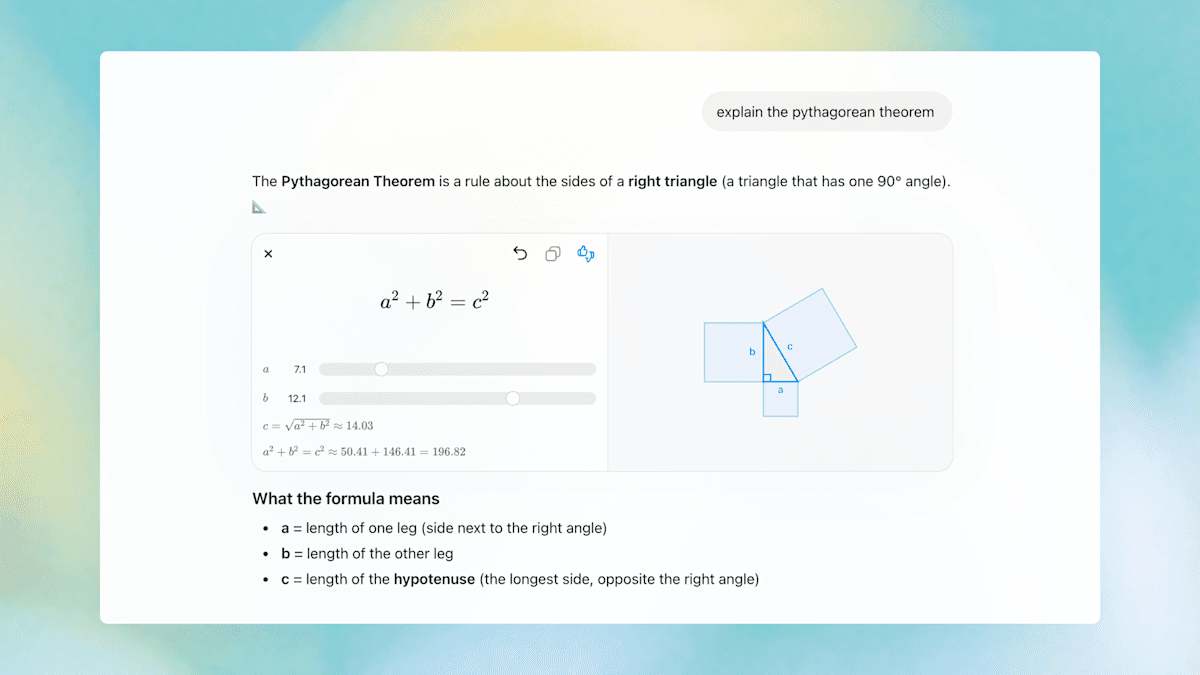
OpenAI is rolling out new interactive responses in ChatGPT it says are designed to make the chatbot more useful for learners. Starting today, ChatGPT will generate dynamic visuals when you ask it to explain select scientific and mathematical concepts, including the Pythagorean theorem, Coulomb's law and lens equations. When ChatGPT responds with an interactive visual, you'll be able to tweak any variables and the equation itself, allowing you to see how those changes affect the solution.
With today's release, OpenAI says ChatGPT will respond with interactive visuals when asked about more than 70 concepts, with support for additional topics to come down the line. The visuals are available to all ChatGPT users, regardless of subscription status. However, OpenAI notes high school- and college-aged students are likely to get the most out of the new feature.
The more interactive responses from ChatGPT follow the release of Study Mode last summer. Released in response to the sheer amount of students using chatbots to complete their coursework, that feature guides the user toward finding an answer themselves, rather than provide an outright solution. "This is just the beginning," OpenAI says of its latest feature. "Over time, we plan to expand interactive learning with additional subjects and continue building tools that strengthen learning with ChatGPT."