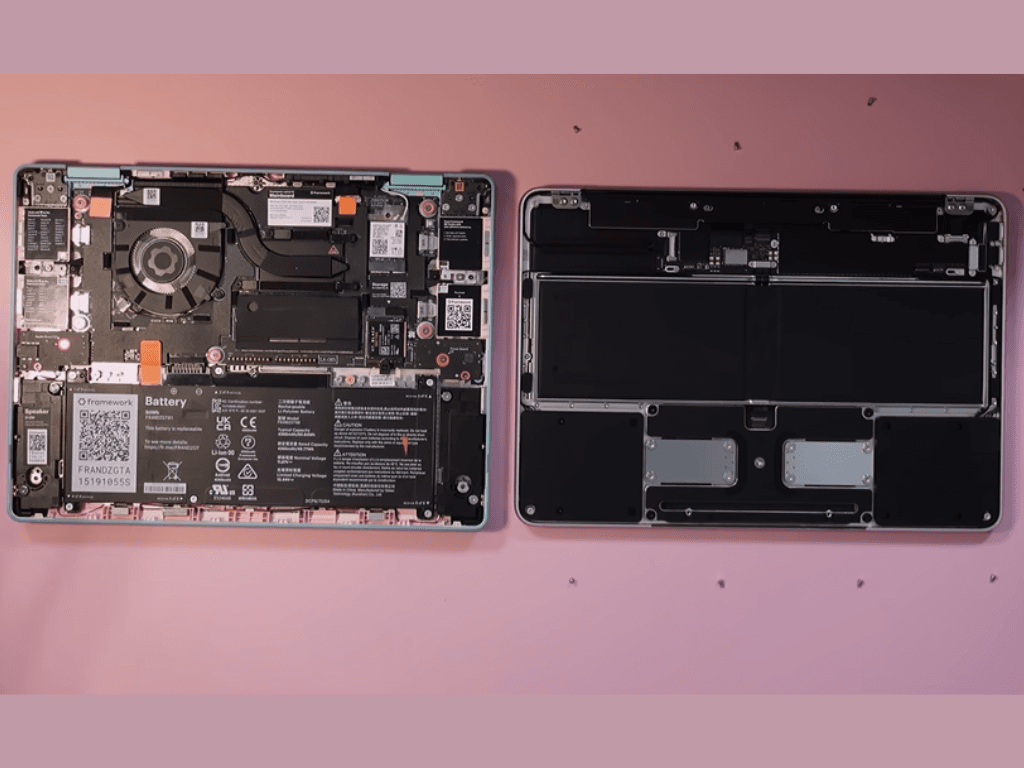
In a bold critique that has reignited the debate over laptop design philosophy, Framework CEO Nirav Patel dismantled Apple’s newly released $599 MacBook Neo in a widely shared YouTube teardown video, directly contrasting it with his company’s own Framework Laptop 12. Patel’s 33-minute analysis, which has garnered over 500,000 views since its April 1, 2026 release, argues that while both laptops cater to budget-conscious buyers—particularly students and light users—they represent fundamentally opposing visions for the future of personal computing. Patel’s core assertion, encapsulated in his mantra 'A computer should be yours,' frames Apple’s approach as a strategic 'walled garden' designed to funnel users toward pricier upgrades, whereas Framework champions a modular, upgradeable ethos aimed at reducing e-waste and extending product lifespans.
Why the MacBook Neo Teardown Went Viral: A Clash of Laptop Design Philosophies
The viral teardown video posted by Patel on April 1, 2026, has become a lightning rod in tech circles, sparking discussions about repairability, sustainability, and consumer choice in the laptop market. At the heart of the debate is a fundamental question: Should laptops be disposable, upgradeable tools designed for longevity, or entry points into a proprietary ecosystem that locks users into a cycle of costly replacements?
Apple’s MacBook Neo: A Step Forward with Limits
Apple’s MacBook Neo, launched in March 2026, is the company’s most repairable laptop in 14 years, earning a 6/10 repairability score from iFixit—the highest grade Apple has achieved for any MacBook since the 2012 MacBook Pro with Retina Display. Patel acknowledged these improvements in his teardown, highlighting Apple’s use of easily accessible components like the battery, ports, and speakers. However, he quickly pivoted to the device’s critical limitations: soldered RAM and storage, which lock users into fixed configurations that cannot be upgraded post-purchase. With only 8GB of unified memory and storage options capped at 256GB or 512GB, the MacBook Neo is positioned as an entry-level device with a ceiling on its capabilities.
Patel also pointed out the prohibitive cost of replacing the MacBook Neo’s display, which requires swapping the entire top chassis—a process that costs several hundred dollars and effectively discourages repairs. In contrast, the Framework Laptop 12’s display slides out in minutes, thanks to a modular design secured by simple POGO pins. This contrast underscores Apple’s incremental improvements in repairability while stopping short of true modularity.
Framework’s Laptop 12: Built for Upgrades, Not Obsolescence
Framework’s Laptop 12, which retails for the same $599 starting price as the MacBook Neo, is engineered from the ground up for disassembly and customization. In his teardown, Patel demonstrated how every major component—from the motherboard and memory to the storage, cooling system, screen, and keyboard—can be swapped out with basic tools. This modularity is enabled by a system of POGO pins, small spring-loaded connectors that secure parts in place without solder, allowing for tool-free replacements.
The Framework Laptop 12’s design philosophy is rooted in sustainability. The company’s mission, as articulated by Patel, is to 'eliminate e-waste by making the product easy to use for as long as you want.' Unlike Apple’s approach, which Patel argues is designed to shepherd users from the MacBook Neo to pricier models like the MacBook Air or Pro, Framework’s laptops are intended to evolve with the user. Patel emphasized this point in his video, stating, 'If you’ve got a Framework Laptop, we want you to be able to continue to upgrade it so that it works well for you for as long as you need it.'
The 'Walled Garden' Strategy: How Apple Locks Users Into Its Ecosystem
Patel’s most provocative claim is that Apple’s MacBook Neo is a Trojan horse—a budget-friendly device strategically designed to lure new users into its 'walled garden' of macOS, proprietary accessories, and higher-priced hardware. In the teardown video, he laid out a clear upgrade path: 'Once you’re a MacBook Neo owner, you run out of storage space, it gets a bit too slow, you need more ports, and you’re in the macOS world. Maybe you’ll buy that MacBook Pro or that MacBook Air at that $1,000, $2,000, or $3,000 price point.'
This critique taps into a longstanding criticism of Apple’s ecosystem, where hardware and software are tightly integrated to encourage repeat purchases. The MacBook Neo’s soldered RAM and storage ensure that users cannot expand their device’s capabilities independently, forcing them to either live with limitations or upgrade to a more expensive model. Patel’s teardown frames this as a deliberate strategy to capture and retain customers within Apple’s premium tier, even if it comes at the cost of sustainability and user autonomy.
Repairability Scores and Real-World Implications: What the Numbers Say
To quantify the differences between the two laptops, Patel referenced iFixit’s repairability ratings, where the MacBook Neo scored a 6/10—the highest for any Apple laptop in over a decade. For context, the 2012 MacBook Pro with Retina Display also scored a 6/10, while most modern MacBooks score between 1/10 and 4/10. However, Patel argued that these scores are misleading without considering the fundamental design choices that limit long-term usability. The Framework Laptop 12, by contrast, has not yet been rated by iFixit, but its modular design suggests a score closer to the 9/10 or 10/10 range, aligning with Framework’s reputation for prioritizing repairability.
The Environmental and Economic Impact of Modular vs. Soldered Design
The debate over laptop design is not just philosophical; it has tangible environmental and economic consequences. According to the United Nations Environment Programme, electronic waste is the world’s fastest-growing waste stream, with over 50 million metric tons generated annually. Devices like the MacBook Neo, with their soldered components and high repair costs, contribute to this crisis by discouraging repairs and encouraging premature replacement.
In contrast, Framework’s modular approach aligns with circular economy principles, where products are designed to be repaired, upgraded, and reused. The company’s laptops are built with replaceable parts, including standardized screws and labeled internals, making them accessible to DIY enthusiasts and repair shops alike. Patel emphasized this in his video, stating, 'Schools need repairability. We want to eliminate that e-waste by making the product easy to use for as long as you want.'
Key Takeaways: The Framework vs. Apple Laptop Showdown
- Apple’s $599 MacBook Neo marks a rare repairability improvement for the company, earning a 6/10 from iFixit, but its soldered RAM and storage limit long-term upgradeability.
- Framework’s Laptop 12, priced identically, is designed for modular upgrades, allowing users to swap components like the motherboard, RAM, storage, and display with basic tools.
- Patel argues the MacBook Neo is a 'walled garden' strategy to funnel users toward pricier Apple devices, whereas Framework aims to reduce e-waste by extending product lifespans.
- The teardown highlights a broader industry divide: disposable, upgrade-resistant devices vs. repairable, future-proof laptops.
- Environmental advocates praise Framework’s modular design, which aligns with circular economy principles, while critics argue Apple’s incremental improvements are insufficient.
Industry Reactions: What Tech Analysts and Repair Experts Are Saying
Since the teardown video’s release, tech analysts and repair advocates have weighed in on the debate. Kyle Wiens, CEO of iFixit, praised Apple’s progress in repairability but cautioned that soldered components still pose a major barrier. 'Apple deserves credit for making the MacBook Neo more accessible than most of its laptops,' Wiens said in a statement to *The Verge*. 'But until RAM and storage are user-upgradable, these devices will always be limited by design.'
On the other side, modular computing advocates like Louis Rossmann, a well-known repair activist, hailed Framework’s approach as a step toward true user ownership. 'What Framework is doing is revolutionary,' Rossmann said in a tweet. 'They’re proving that laptops don’t have to be disposable. This is how we fight e-waste.'
The Broader Implications for the Laptop Market
Patel’s teardown arrives at a pivotal moment for the laptop industry, where regulatory pressure and consumer demand for sustainability are reshaping corporate priorities. The European Union’s Right to Repair laws, set to take full effect in 2027, mandate that manufacturers provide spare parts and repair documentation for devices sold in the EU. While Apple has made concessions—such as selling parts directly to consumers—its soldered component strategy remains a loophole that limits true repairability.
Framework, meanwhile, is positioning itself as a leader in the Right to Repair movement. The company’s laptops are designed to comply with stringent repairability standards, and its open-source approach to parts and documentation makes it a favorite among DIY enthusiasts and repair professionals. Patel’s teardown serves as both a critique of Apple’s walled garden and a manifesto for Framework’s vision of user-controlled technology.
What’s Next for Modular Computing?
The success of Framework’s Laptop 12 and Apple’s MacBook Neo will likely hinge on consumer demand for repairability and sustainability. If Patel’s teardown resonates with buyers, it could accelerate the shift toward modular laptops, pressuring Apple and other manufacturers to adopt more open designs. Framework has already expanded its lineup with a 13-inch model and plans to introduce additional sizes and configurations in 2026.
For Apple, the challenge will be balancing its walled garden ecosystem with growing regulatory and consumer pressure for repairability. The company has made strides in recent years, such as offering self-service repair kits for the MacBook Air, but its reliance on soldered components remains a sticking point for advocates like Patel.
Frequently Asked Questions About the MacBook Neo vs. Framework Laptop Debate
Frequently Asked Questions
- Is the MacBook Neo really Apple’s most repairable laptop?
- Yes, the MacBook Neo earned a 6/10 repairability score from iFixit, the highest for any MacBook in 14 years. However, its soldered RAM and storage still limit long-term upgrades compared to truly modular designs.
- Can I upgrade the RAM or storage on the Framework Laptop 12?
- Yes, the Framework Laptop 12 is designed for upgrades. Users can swap out RAM, storage, and other components thanks to a modular design secured by POGO pins. The process is tool-assisted but straightforward.
- Why does Apple solder RAM and storage into its laptops?
- Apple typically solder components to save space, reduce manufacturing costs, and improve performance consistency. However, this design choice locks users into fixed configurations and discourages repairs, contributing to e-waste.