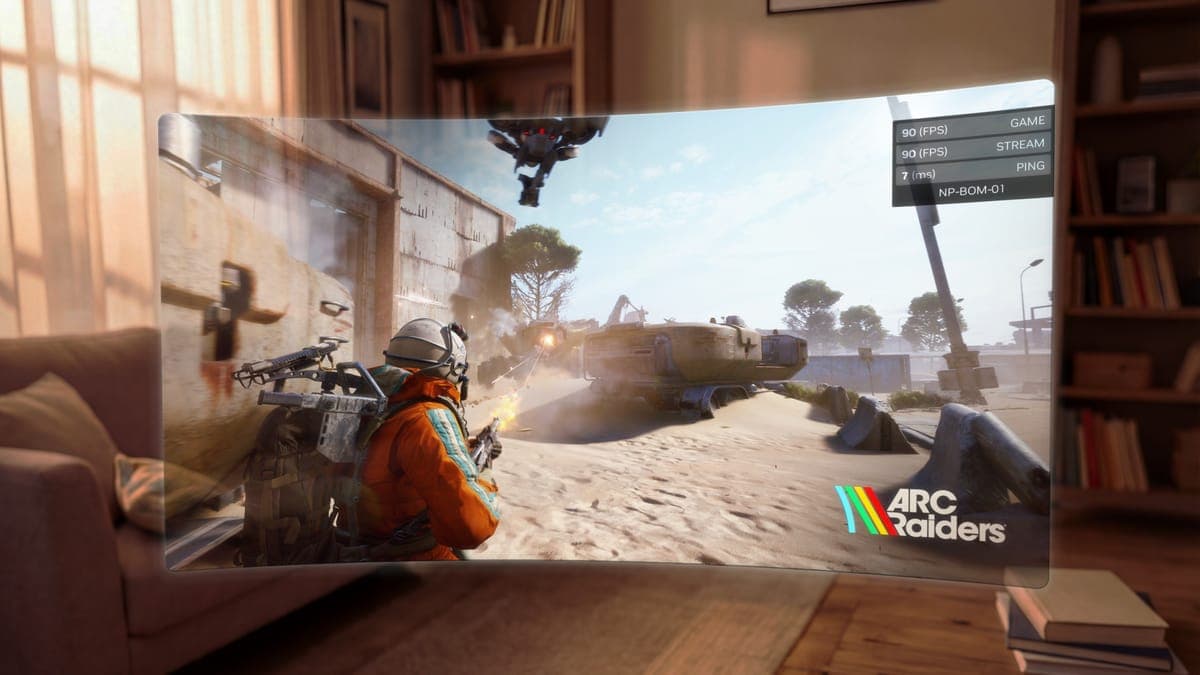
Nvidia’s GeForce Now cloud gaming service has rolled out a significant upgrade for virtual and mixed reality headset users, enabling up to 90 frames-per-second streaming in the web browsers of Meta Quest 3, Pico 4, and Apple Vision Pro—but only for subscribers on the Ultimate tier. The update, which takes effect immediately, represents a milestone in cloud gaming accessibility, allowing players to stream high-performance PC titles directly to XR devices without the need for a dedicated gaming rig. This move comes as the broader gaming industry continues to embrace extended reality (XR) platforms as viable gaming endpoints, reflecting how cloud infrastructure is reshaping how and where people play.
What Is GeForce Now and How Does It Work on XR Headsets?
GeForce Now is Nvidia’s cloud gaming platform that allows users to stream PC games from supported digital storefronts—including Steam, Epic Games Store, Ubisoft Connect, Microsoft Store, EA App, and GOG—directly to a variety of devices. Unlike traditional gaming consoles or gaming PCs, GeForce Now operates entirely in the cloud, rendering game sessions on remote servers equipped with high-end Nvidia GPUs and streaming the video feed to the user’s device over the internet.
Supported Headsets and Browser-Based Access
The service initially gained support for XR headsets in early 2023, when Nvidia announced official browser compatibility for Meta Quest 3, Quest 3S, Pico 4, Pico 4 Ultra, and Apple Vision Pro. This browser-based approach eliminates the need for dedicated apps and allows users to access GeForce Now through the headset’s native web browser, such as Meta Quest Browser or Apple’s Safari on Vision Pro. The move was part of a broader strategy to make cloud gaming more accessible across platforms, especially as XR adoption accelerates among consumers and developers.
Tiered Subscriptions: From Free to Ultimate Performance
- The Free tier is limited to 1080p resolution, features ads, and restricts sessions to 1 hour.
- The $10/month Performance tier removes ads, supports up to 1440p streaming, and includes an RTX GPU, doubling vCPU cores and RAM compared to Free.
- The $20/month Ultimate tier enables up to 4K 240 FPS locally and now streams at up to 90 FPS in XR headsets, with quadruple vCPU and RAM of the Free tier and RTX 5080-class GPU rendering for demanding titles.
What the 90 FPS Update Means for Players
With the new 90 FPS streaming capability in XR headsets, Ultimate subscribers can now experience smoother gameplay on supported devices. By default, the Balanced quality mode streams at 1080p 90 FPS. Users can switch to Custom mode to increase resolution—up to 1440p 90 FPS on Quest and Pico headsets, or 4K 90 FPS on Apple Vision Pro. This represents a substantial leap in visual fluidity, especially for fast-paced or competitive titles that benefit from higher refresh rates.
How GeForce Now Fits Into the Broader XR Gaming Ecosystem
GeForce Now is not the only cloud gaming service available on XR devices. Microsoft’s Xbox Cloud Gaming, which launched on Quest headsets in late 2023, offers a curated library of Xbox titles playable directly in the Quest browser. While GeForce Now supports a broader range of PC games from multiple storefronts, both platforms rely on the same fundamental principle: delivering high-quality gaming experiences without requiring local hardware. However, neither service currently leverages the stereoscopic nature of VR headsets by rendering flatscreen games in true 3D—a feature that could become a major differentiator as technology evolves.
The Missing Piece: True 3D Gaming in XR
Most cloud gaming services, including GeForce Now and Xbox Cloud Gaming, stream traditional 2D flatscreen games to VR headsets. This means players experience a flat, monoscopic view inside a virtual environment, rather than a fully immersive stereoscopic 3D world. To achieve true 3D, developers typically use SDKs or injection tools to convert 2D games into VR-ready experiences. However, recent advances in AI could change this. Nvidia or Microsoft might soon leverage AI models—such as those used in Google’s Android XR Autospatialization system—to dynamically generate 3D spatial audio and depth cues from existing 2D game feeds. This could allow legacy PC games to feel more immersive in VR without developer intervention.
Apple Vision Pro Gets Official Support for Flight Sim and Racing Games via CloudXR
Beyond GeForce Now, Nvidia is also bringing official support for high-fidelity simulation and racing games to Apple Vision Pro through its CloudXR platform. Titles like X-Plane 12 and iRacing will be playable on Vision Pro, streamed directly from a user’s PC with mixed reality passthrough blending physical accessories into the virtual cockpit. This integration is made possible through Nvidia’s collaboration with Apple to optimize CloudXR with the VR foveated streaming feature in visionOS 26.4, which reduces bandwidth usage by rendering only the portion of the screen the user is looking at in full detail.
Will Nvidia Bring True VR Games to GeForce Now?
Despite the growing capabilities of GeForce Now on XR devices, one major question remains unanswered: Will Nvidia expand GeForce Now to support native VR games? Currently, the service is designed for flatscreen PC games, which are displayed as 2D applications within a virtual environment. This limits immersion and accessibility for titles built specifically for VR. During a recent briefing with UploadVR, Nvidia was asked whether it planned to add VR-native game support to GeForce Now, particularly for games optimized for head-mounted displays. The company declined to comment.
The Future of Cloud Gaming in XR: Smoother, Smarter, and More Immersive
The expansion of GeForce Now to support 90 FPS streaming on XR devices signals a broader trend in cloud gaming: the shift from mere accessibility to performance parity with traditional gaming setups. As XR hardware becomes more powerful and cloud infrastructure improves, the line between local and cloud gaming continues to blur. Features like 90 FPS streaming, VR foveated rendering, and AI-enhanced spatialization are paving the way for richer, more responsive experiences. With Apple, Meta, and Pico all investing heavily in XR ecosystems, the demand for high-performance cloud gaming on these platforms is only expected to grow.
Why This Matters for Gamers and Developers
- For gamers, 90 FPS streaming enhances smoothness and responsiveness, especially in fast-paced or competitive games.
- For developers, it lowers the barrier to entry for XR gaming by allowing existing PC titles to reach VR audiences without major re-engineering.
- For the industry, it validates XR devices as legitimate gaming platforms, encouraging further investment in hardware and software.
Key Takeaways
- GeForce Now now streams at up to 90 FPS in the web browsers of Quest 3, Pico 4, and Apple Vision Pro—exclusively for Ultimate subscribers.
- The Ultimate tier ($20/month) supports 4K 240 FPS locally and 90 FPS streaming, with RTX 5080-class GPU rendering on demanding titles.
- Xbox Cloud Gaming is also available on Quest but does not currently offer true 3D rendering for flatscreen games.
- Nvidia is leveraging Apple’s VR foveated streaming in visionOS 26.4 to bring official support for X-Plane 12 and iRacing to Vision Pro via CloudXR.
- The industry is moving toward AI-driven 3D spatialization, potentially enabling true VR immersion for legacy PC games in the future.
Frequently Asked Questions
Frequently Asked Questions
- Which headsets support GeForce Now’s new 90 FPS streaming?
- Meta Quest 3, Pico 4, and Apple Vision Pro are currently supported. The feature is available through their built-in web browsers and requires an Ultimate subscription.
- Do I need a gaming PC to use GeForce Now on XR headsets?
- No. GeForce Now streams games from remote servers, so you only need a stable internet connection and a compatible headset. Your existing PC game libraries from supported stores are streamed to you.
- Can GeForce Now play VR-native games like Beat Saber or Half-Life: Alyx?
- Currently, GeForce Now only supports flatscreen PC games streamed into a virtual environment. Native VR games are not supported, though Nvidia has not ruled out future expansion.