Modding communities Inside the quixotic team trying to build an entire world in a 20-year-old game Stories and lesson learned from an impossibly large community modding project.
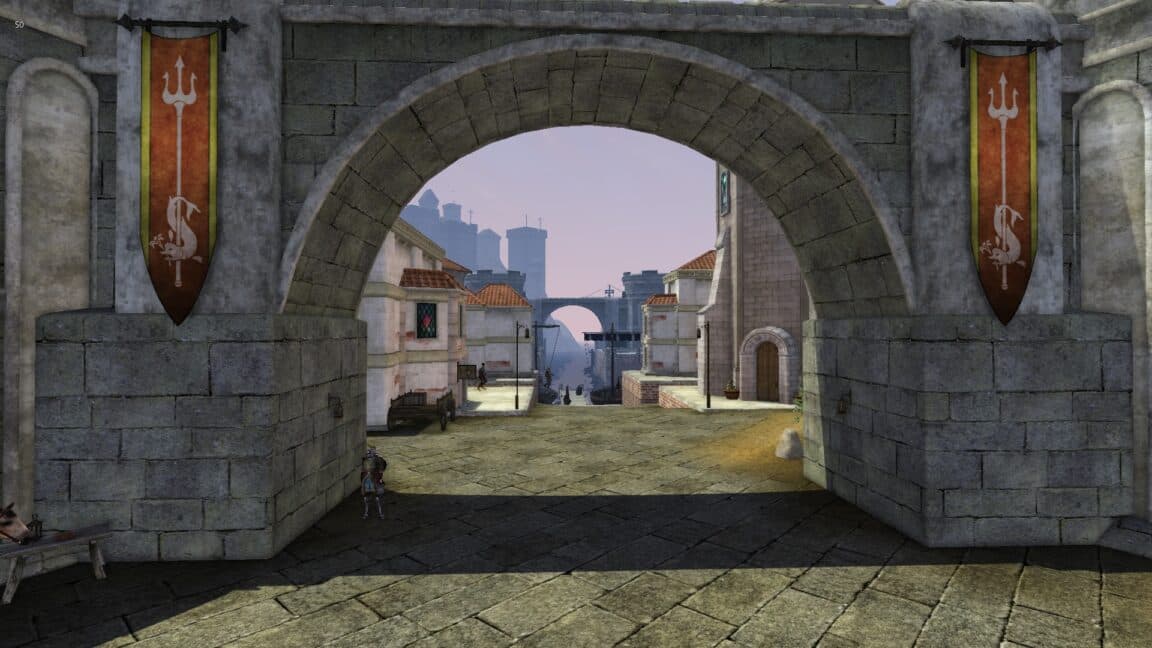
76 The city of Anvil, rendered in The Elder Scrolls III: Morrowind. Credit: Daniel Larlham Jr. The city of Anvil, rendered in The Elder Scrolls III: Morrowind. Credit: Daniel Larlham Jr. Text settings Story text Size Small Standard Large Width * Standard Wide Links Standard Orange * Subscribers only Learn more Minimize to nav Despite being regarded as one of the greatest role-playing games of all time, The Elder Scrolls III: Morrowind disappointed some fans upon its release in 2002 because it didn’t match the colossal scope of its predecessor, The Elder Scrolls II: Daggerfall. Almost immediately, fans began modding the remaining parts of the series’ fictional continent, Tamriel, into the game.
Over 20 years later, thousands of volunteers have collaborated on the mod projects Tamriel Rebuilt and Project Tamriel, building a space comparable in size to a small country. Such projects often sputter out, but these have endured, thanks in part to a steady stream of small, manageable updates instead of larger, less frequent ones.
It’s true that Daggerfall included an entire continent’s worth of content, but it was mostly composed of procedurally generated liminal space. By contrast, Morrowind contained just a single island—not even the entire province after which the game was named. The difference was that it was handcrafted.
Still, a player called “Ender,” stewing in disappointment over Morrowind’s perceived scope, took to an Elder Scrolls forum to propose a collaborative effort to mod the rest of Tamriel into the game. Tamriel Rebuilt was born.
After realizing that re-creating the entire continent was too lofty a goal, the group decided to instead focus on the rest of the Morrowind province alone—but that didn’t last long.
There had been others working toward similar goals. The makers of the fan project “Skyrim: Home of The Nords” were working on putting the province of Skyrim into Morrowind well before that location was officially made the setting of the 2011 sequel The Elder Scrolls V: Skyrim.
Other modders were working on “Project Cyrodilll,” an attempt to put The Elder Scrolls IV: Oblivion’s province into Morrowind. In 2015, those two projects combined to form Project Tamriel, reigniting the goal of adding the remaining provinces of Tamriel.
Tamriel Rebuilt and Project Tamriel first became connected when the modders decided to combine their asset repositories into Tamriel_Data, but they have since grown closer through their shared developers, training protocols, and tools.
“The entirety of Tamriel is, in our scale, roughly the size of the real-life country of Malta, which is small in real life, but quite big from a human perspective,” said Tiny Plesiosaur, a senior developer who has done mapping and planning for both projects but who spends most of her time on Project Tamriel these days.
Both projects aim to create a cohesive, lore-accurate representation of these realms as they would have looked during the fictional historical period in which Morrowind takes place. So far, they’ve made substantial progress.
One thing in their favor, said Mort, a 13-year veteran quest-designer of Tamriel Rebuilt, is that Morrowind design makes it especially amenable to large-scale modding.
“I’d say the thing that makes Morrowind most conducive to these kinds of projects is no voiced dialogue,” Mort said. “The reason that you see so many quest mods for Morrowind as opposed to Oblivion and Skyrim and even Fallout is that the barrier to make a quest is essentially nothing.”
Frequent, contained public releases also work to their advantage. “I know for a lot of projects, they want to [do a] ‘we’ll release it when it’s done’ kind of thing,” said Mort. “We’ve found that releasing content builds hype, it gives players what they want, and perhaps most importantly, it serves as a proof of life and a fantastic recruitment tool.”
Every time Tamriel Rebuilt pushes a release, he said, the team picks up at least a dozen devs almost immediately. So far, Tamriel Rebuilt has seen nine releases; the most recent is titled “Grasping Fortune.” The next release, “Poison Song,” is expected sometime in 2026 and will include a never-before-seen faction. The most optimistic estimate for when the project will be fully finished is 2035.
Project Tamriel has made most of its progress in Skyrim and Cyrodiil. The release of “Abecean Shores,” the coastal section of Cyrodiil, came in late 2024. Together, the projects have added hundreds of hours of hand-crafted quests, dungeons, and landscapes to a game that was already robust.
Lus said the current timeline for Project Tamriel is a new release for Skyrim and then Cyrodill, followed by either High Rock—a comparatively smaller, peninsula province west of Skyrim—or the desert province of Hammerfell.
For many developers, the point isn’t to see these massive projects in a finished state but to complete the next task and hopefully bring the team closer to the next release.
A brief history of Tamriel Rebuilt
Sultan of Rum, a kind of historian for Tamriel Rebuilt, joked that the project was aptly named because of how many times it has been rebuilt—partly because the tools the modders use to build the project have gotten better over time, rendering work done before those advances obsolete.
But even then, Tamriel Rebuilt was more of a Wild West in its infancy: a ragtag bunch of video game enthusiasts working mostly independently and without very much oversight. As the project has become more unified, it has meant a lot of turnover and a fair share of setbacks.
“If you took a satellite picture of the game world in 2005, you’d have essentially a complete province already,” Sultan of Rum said. “But the trouble was that the quality wasn’t good; there was no coherence. The 5 percent of the work to just create a landmass was done, but the management wasn’t there.”
Much of the project’s history has been lost to time as Internet forums disappeared, but Sultan of Rum has been able to piece together some of the growing pains Tamriel Rebuilt has endured. A struggle between the need to centralize and the desire of some modders to remain independent is a recurring theme.
One period is considered a dark age for Tamriel Rebuilt. In the first couple of years, a significant group of modders had been working on a piece of content for the project called “Silgrad Tower,” while the project simultaneously began consolidating to build continuity.
Concept art for the project. ThomasRuz More concept art for the project. ThomasRuz More concept art for the project. ThomasRuz And more concept art for the project! ThomasRuz And more concept art for the project! ThomasRuz More concept art for the project. ThomasRuz And more concept art for the project! ThomasRuz There was debate among the modders about where Silgrid Tower should be located and which faction would have controlled it. This eventually led to an acrimonious split between the two groups. “The Silgrid Tower team was eventually put to the choice of either having to delete their work and restart it or, you know, leave the project. So they left the project,” said Sultan of Rum.