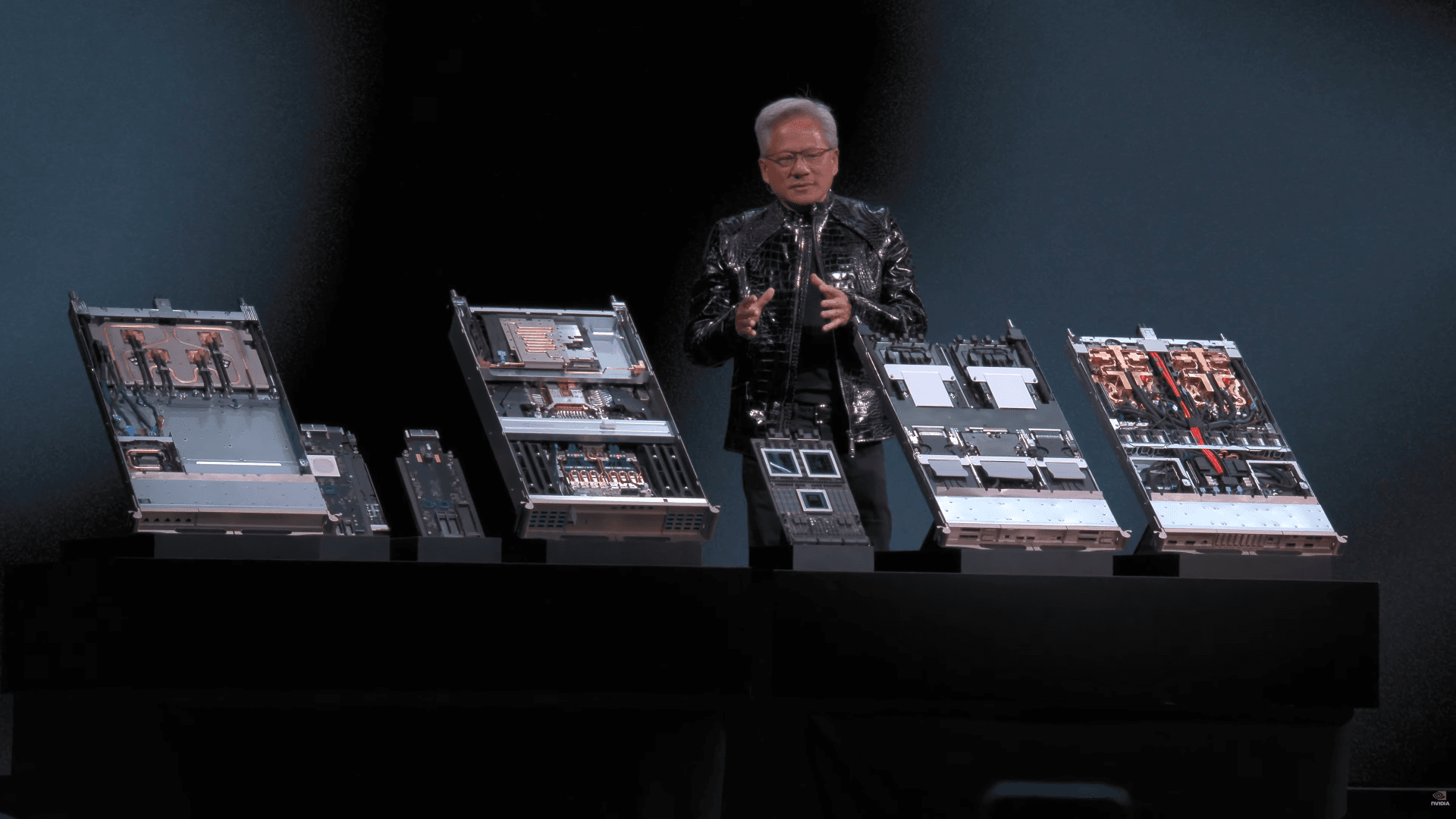
At the GPU Technology Conference (GTC) 2026 in San Jose, NVIDIA once again thrust neural rendering innovation into the spotlight with a live demonstration of its Neural Texture Compression (NTC) technology—a machine learning-powered approach that is redefining how game developers and content creators manage graphical assets. During a session titled “Introduction to Neural Rendering,” Senior DevTech Engineer Alexey Bekin showcased how NTC can slash VRAM consumption by up to 85% without sacrificing visual fidelity, or alternatively, deliver significantly higher texture quality within the same memory budget. While NTC was first unveiled nearly three years ago and made available via a developer beta SDK in early 2026, adoption among game studios has been minimal—prompting NVIDIA to revisit its presentation and emphasize its practical benefits for the broader gaming and interactive media ecosystem.
What Is Neural Texture Compression and How Does It Work?
Neural Texture Compression represents a paradigm shift in how textures are stored, transmitted, and rendered in real time. Unlike traditional compression methods such as Block Compression (BCN), which discard pixel data to reduce file size, NTC employs a learned latent representation of textures. This means instead of storing every individual texel (texture pixel) directly in memory, NTC encodes textures into compact feature vectors that capture the essential visual characteristics of the surface—such as color, reflectivity, roughness, and normal mapping—while using a small neural network running on the GPU to reconstruct those details on demand during rendering. This process is fully deterministic: the same input coordinates and latent code will always produce the same reconstructed texture, eliminating the unpredictability of generative models.
The Dual-Component Architecture of NTC
The system operates using two core components. First, the latent texture is a highly compact representation where each texel stores a low-dimensional vector of learned features rather than a raw color value. This drastically reduces memory footprint. Second, a lightweight multi-layer perceptron (MLP)—a type of neural network—serves as the decoder. It takes as input the UV coordinates of a surface point, applies positional encoding to preserve fine spatial details, combines them with the corresponding latent code, and outputs the reconstructed texel value. This process occurs in real time, with the neural network computing only the textures that are visible or needed at any given moment, rather than loading entire high-resolution assets into VRAM.
Training and Optimization Loop
The latent codes and decoder network are trained through a standard neural optimization loop. During training, the system compares the reconstructed texture against the original high-resolution source material, computes a loss function based on pixel-level differences, and iteratively refines both the latent codes and the weights of the MLP until the output closely matches the ground truth. This ensures that even highly detailed or repetitive patterns—such as brickwork, fabric textures, or intricate foliage—are accurately preserved. Crucially, NTC does not generate new content; it reconstructs existing textures with high fidelity, making it suitable for production environments where consistency and predictability are critical.
NVIDIA’s Demo Proves the Power: Tuscan Villa Scene Shows 85% VRAM Reduction
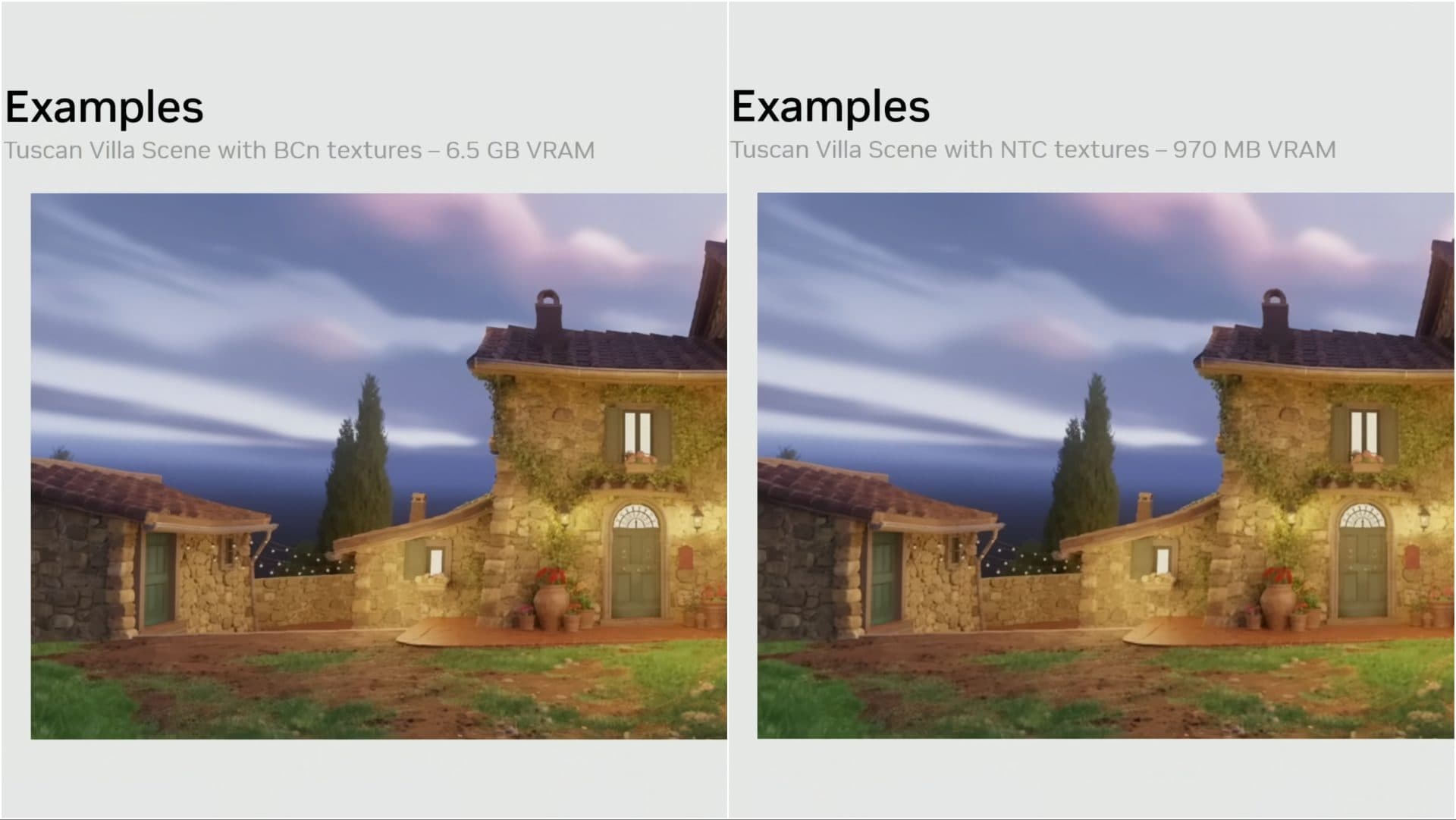
To illustrate the technology’s real-world impact, Bekin presented a live demo using a photorealistic “Tuscan Villa” scene. In this environment, textures compressed with traditional BC7 compression consumed 6.5 GB of VRAM. When the same scene was rendered using NTC, the VRAM footprint plummeted to just 970 MB—a reduction of approximately 85%. This dramatic saving frees up valuable graphics memory for other assets, lighting calculations, or complex physics simulations, enabling developers to push graphical fidelity even further without hardware constraints. Alternatively, NTC can be used to upgrade texture resolution and detail while maintaining the original VRAM budget, effectively eliminating the trade-off between performance and visual quality that has long constrained game development.
Why Traditional Compression Falls Short in Modern Game Development
Block Compression formats like BC1 through BC7 are widely used across the industry due to their hardware support and real-time performance. However, they operate by discarding high-frequency data and quantizing color values, which often leads to visible artifacts such as blurring, banding, or loss of fine surface detail—especially in materials with high gloss, intricate patterns, or subtle color gradients. These limitations become even more pronounced in next-generation consoles and high-end PCs, where developers are pushing 4K and 8K texture resolutions with multiple material channels (albedo, normal maps, roughness, metallic, ambient occlusion, emissive layers, and displacement). NTC, by contrast, supports high channel counts within a single compressed asset. It preserves sharp edges, fine details, and complex surface properties without splitting data across multiple textures—a common workaround today that increases draw calls and memory overhead.
Beyond VRAM: Storage, Bandwidth, and Development Efficiency
The benefits of NTC extend well beyond runtime VRAM savings. Because NTC textures are stored in a highly compact latent format, they also reduce on-disk footprint significantly. A game that previously required 50 GB of install space might now fit into 30 GB or less—without sacrificing visual quality. This translates to faster download times, smaller patch files, reduced bandwidth costs for digital distribution platforms, and a better user experience, especially in regions with limited or metered internet connections. From a developer perspective, the SDK’s integration with existing pipelines is streamlined, allowing teams to compress assets during build time and decompress them on the fly during rendering with minimal overhead.
NTC Is Hardware Agnostic: AMD and Intel Support Confirmed
Though NVIDIA engineered the Neural Texture Compression technology and demonstrated it using CUDA-optimized pipelines, the technique is not tied to proprietary hardware. According to hardware leaker Kepler_L2, NTC is supported across multiple architectures, including AMD GPUs and Intel integrated graphics solutions. This broad compatibility is essential for industry-wide adoption, as it ensures that games using NTC can run smoothly on a wide range of consumer devices—from high-end gaming PCs to mid-tier laptops and even next-generation consoles. The openness of the underlying approach, based on standard neural network techniques and widely available GPU compute APIs, further lowers the barrier to entry for developers.
The Case for PlayStation 6: Could Sony Adopt NTC for Storage Savings?
Rumors are circulating that Sony may leverage Neural Texture Compression in its upcoming PlayStation 6 console, potentially as part of a broader strategy to manage storage constraints. With the PS5 using a 1TB SSD and many modern games approaching or exceeding 100 GB in size, next-gen titles are already pushing the limits of console storage. A move to NTC could allow Sony to reduce install sizes by 30–50% without compromising visual fidelity, enabling developers to include richer environments, longer cinematics, or additional content. Given that the PS6 is expected to continue using a 1TB SSD—while demanding higher asset densities—NTC presents a compelling solution to balance performance, cost, and user experience.
NVIDIA Releases NTC SDK in Beta: How Developers Can Get Started
NVIDIA has made the Neural Texture Compression SDK available to developers since early 2026 via a public beta on GitHub, under a permissive license that allows for commercial use in game engines and applications. The SDK includes tools for compressing textures offline, integrating the decoder into rendering pipelines, and validating compression quality. It supports integration with popular game engines such as Unreal Engine and Unity through custom plugins or native support in future versions. While adoption has been cautious to date, NVIDIA’s renewed push at GTC 2026 signals growing confidence in the technology’s maturity and scalability.
- Neural Texture Compression (NTC) can reduce VRAM usage by up to 85% or significantly boost texture quality within the same memory budget.
- NTC uses a learned latent representation and GPU-based neural decoder, enabling real-time reconstruction of high-fidelity textures from compact data.
- Unlike traditional BCN compression, NTC preserves fine details and supports multiple material channels in a single asset, reducing artifacts and draw calls.
- The technology reduces on-disk storage needs, leading to smaller game install sizes and faster downloads.
- NTC is hardware-agnostic and supported on NVIDIA, AMD, and Intel GPUs, making it viable for cross-platform development.
Industry Impact: Could NTC Become the New Standard for Texture Compression?
The gaming industry has long relied on a handful of well-established texture compression formats, primarily BC1–BC7, which were introduced more than two decades ago. While efficient in terms of speed and hardware support, these formats were not designed for the demands of modern photorealistic rendering or the complexity of physically based rendering (PBR) materials. As developers push for higher visual fidelity, increased asset counts, and larger open worlds, the limitations of legacy compression are becoming increasingly apparent. NTC represents a forward-looking solution that aligns with the rise of neural rendering, machine learning acceleration, and real-time path tracing. If adopted widely, it could become the de facto standard for next-generation asset pipelines, especially in titles targeting high-end PCs, consoles, and cloud gaming platforms.
Challenges to Widespread Adoption
Despite its promise, Neural Texture Compression faces several hurdles on the path to mainstream adoption. First, integration requires engine-level changes and developer education—teams must learn to pre-process assets, tune compression parameters, and validate output quality across different hardware configurations. Second, licensing and GPU driver support must be consistent across platforms, particularly for consoles and mobile devices. Third, content creators and artists may need to rethink texture authoring workflows to fully leverage NTC’s capabilities, especially when balancing compression ratios with visual fidelity. Finally, the gaming community remains cautious about any technology that introduces neural components into core rendering pipelines due to performance unpredictability or compatibility concerns.
What’s Next for NTC and Neural Rendering?
Looking ahead, NVIDIA and the broader graphics research community are exploring extensions of NTC to other asset types, including 3D meshes, lightmaps, and even volumetric data. The company is also investing in hybrid rendering pipelines that combine traditional rasterization with neural techniques to achieve cinematic-quality visuals at interactive frame rates. As GPUs continue to gain more compute cores and dedicated AI accelerators (such as NVIDIA’s Tensor Cores), the overhead of running lightweight MLPs for on-the-fly decompression will continue to shrink. Industry analysts anticipate that within three to five years, neural asset compression could become a standard feature in real-time engines like Unreal and Unity.
The Bottom Line: A Game-Changer for Developers and Players
For game developers, NTC offers a path to richer worlds, smoother performance, and lower distribution costs—without requiring players to upgrade their hardware. For players, it means faster downloads, more detailed environments, and a seamless gaming experience across devices. As NVIDIA continues to evangelize the technology at events like GTC and expands SDK support, the momentum for NTC may finally build. If even a fraction of upcoming titles adopt it, the ripple effects could reshape the entire industry, setting a new benchmark for texture fidelity, efficiency, and innovation in interactive entertainment.
Key Takeaways
- NVIDIA’s Neural Texture Compression (NTC) can reduce VRAM usage by up to 85% or enhance texture quality within the same memory budget.
- It uses a machine learning-based latent representation and real-time GPU decoding, preserving fine details better than traditional BCN compression.
- NTC supports high channel counts in a single asset, reducing artifacts, draw calls, and on-disk storage demands.
- The SDK is available in beta via GitHub and supports NVIDIA, AMD, and Intel GPUs, making it cross-platform compatible.
- Rumors suggest Sony may adopt NTC for the PlayStation 6 to reduce install sizes on a 1TB SSD.
Frequently Asked Questions
- What is Neural Texture Compression (NTC)?
- NTC is a machine learning-based technique that compresses textures into compact latent representations, which are decoded in real time by a small neural network on the GPU. It reduces VRAM usage or increases texture quality without generative unpredictability.
- How much VRAM can NVIDIA's NTC save?
- In NVIDIA's Tuscan Villa demo, NTC reduced VRAM usage from 6.5 GB to 970 MB—an 85% reduction. This saving can be used to improve performance or add more detailed assets.
- Is NTC compatible with AMD and Intel GPUs?
- Yes. Despite being developed by NVIDIA, NTC is hardware-agnostic and supported on AMD and Intel GPUs, making it suitable for cross-platform development.