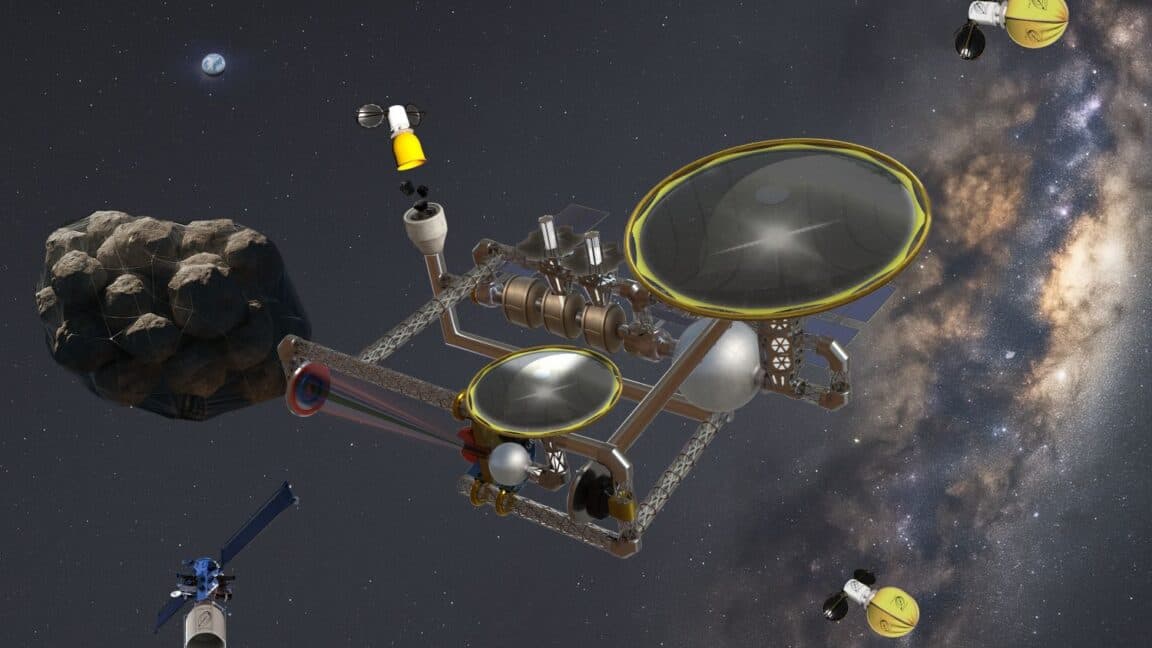
A Los Angeles-based aerospace startup is turning science fiction into a potential reality with its bold plan to capture a small asteroid, encase it in a massive inflatable bag, and tow it back to a staging point near Earth for mining and research. On Wednesday, TransAstra Corporation announced that an as-yet-unnamed customer has commissioned a feasibility study for its “New Moon” mission—a project that could retrieve a roughly house-sized asteroid weighing about 100 metric tons and ferry it to a designated safe orbit by the late 2020s. The initiative, if successful, would mark the first-ever retrieval and relocation of an entire asteroid, offering a potential stepping stone toward sustainable in-space manufacturing, propellant production, and even the construction of off-world habitats.
Why Capturing an Asteroid Could Revolutionize Space Exploration and Industry
The concept of asteroid mining is not new—it has been a staple of futuristic space economy discussions for decades. What sets TransAstra’s plan apart is its practicality and scale. By targeting asteroids rich in water ice and metals, the mission aims to establish a reliable, in-space supply chain for resources that are prohibitively expensive to launch from Earth. Water extracted from hydrated asteroids can be split into hydrogen and oxygen for rocket fuel, while metals like nickel, iron, and platinum could be used to build structures in orbit or on the Moon. Joel Sercel, TransAstra’s founder and CEO, emphasized the long-term potential in a recent interview: “We envision it becoming a base for robotic research and development on materials processing and manufacturing.” This vision aligns with NASA’s Artemis program goals and broader ambitions to create a sustainable lunar economy.
Water from Space: The Fuel of the Future
Water is the most critical resource in space exploration. Not only is it essential for human survival, but it can also be converted into rocket propellant. Launching water from Earth costs tens of thousands of dollars per kilogram, making it economically unfeasible for large-scale missions. However, water-rich asteroids—particularly C-type (carbonaceous) asteroids—could provide an abundant, accessible source. TransAstra estimates that a single 100-ton asteroid could yield tens of thousands of liters of water, enough to refuel multiple spacecraft. This would drastically reduce the cost of deep-space missions and enable the establishment of orbital fuel depots.
Metals and Minerals: Building the Solar System
Beyond water, asteroids contain a treasure trove of metals. M-type (metallic) asteroids, for instance, are composed largely of iron and nickel, with traces of precious metals like platinum and gold. These materials could be used to construct satellites, space stations, and even habitats on the Moon or Mars. The economic value of a single large metallic asteroid has been estimated in the trillions of dollars. TransAstra’s mission plan includes targeting specific asteroid types based on their composition: C-types for water, M-types for metals, and S-types (stony) for a mix of materials. This targeted approach could maximize the mission’s utility and return on investment.
The TransAstra New Moon Mission: How It Works
The New Moon mission is designed to be technologically feasible using existing or near-term propulsion and capture technologies. The core of the plan involves sending a robotic spacecraft equipped with a large, inflatable capture bag to a target asteroid. Once in proximity, the spacecraft would deploy the bag, envelop the asteroid, and secure it. The asteroid would then be towed to a designated safe orbit—TransAstra proposes the Earth-Sun L2 Lagrange point, approximately 1.5 million kilometers from Earth, as the primary destination. This location offers a stable gravitational environment, minimizing the need for frequent course corrections.
Target Selection: A Catalog of Cosmic Opportunities
TransAstra has identified as many as 250 near-Earth asteroids (NEAs) that meet the mission’s criteria: small diameter (up to 20 meters), low mass (around 100 tons), and accessibility within a decade using reusable spacecraft. These asteroids are ideal for capture due to their size and composition. Joel Sercel noted, “We envision aggregating dozens, and then hundreds, of small asteroids at the New Moon processing facility.” Over time, this could create a network of resource depots throughout the inner solar system, supporting human and robotic missions alike.
Partnerships and Expertise: A Team of Space Industry Leaders
TransAstra is not going it alone. The company is collaborating with leading academic and research institutions to refine its mission plan. Partners include the University of Central Florida, Purdue University, and the Jet Propulsion Laboratory (JPL), a division of Caltech. These institutions bring expertise in asteroid science, orbital mechanics, and spacecraft engineering. The feasibility study, expected to be completed by May 2024, will address critical questions such as the optimal trajectory, spacecraft design, and the precise methods for capturing and securing the asteroid. If the study proves successful, TransAstra could seek full funding for a launch as early as 2028, with a rendezvous and capture attempt by 2029.
The Broader Implications: A New Era in Space Economy
The successful execution of the New Moon mission could herald a new era in space exploration and commerce. By demonstrating the feasibility of asteroid capture and resource extraction, TransAstra could pave the way for a robust in-space economy. This economy would not only reduce the cost of space missions but also create new industries and jobs on Earth. Moreover, it aligns with NASA’s Space Act Agreement and the agency’s broader goals of fostering public-private partnerships in space. The mission could also serve as a technological proving ground for future lunar and Martian missions, where similar resource extraction techniques will be essential.
Challenges and Criticisms: Is Asteroid Capture Realistic?
Despite the promise of the New Moon mission, significant challenges remain. Capturing an asteroid is a complex and risky endeavor, requiring precise navigation, robust engineering, and a high tolerance for failure. Critics argue that the mission’s timeline is overly optimistic, given the technological hurdles involved. Additionally, the legal and regulatory landscape for asteroid mining is still evolving. The Outer Space Treaty of 1967, while not explicitly prohibiting resource extraction, leaves many questions unanswered regarding ownership and commercial use of space resources. TransAstra has not yet addressed how it plans to navigate these legal ambiguities.
Technological Hurdles: Precision and Power
The technical challenges of the New Moon mission are formidable. Capturing a tumbling, irregularly shaped asteroid requires advanced autonomous systems capable of real-time decision-making. The spacecraft must be equipped with powerful propulsion to tow the asteroid to its destination, as well as systems to stabilize the asteroid during transit. TransAstra has previously tested inflatable capture bags on the International Space Station, but scaling this technology to capture a 100-ton asteroid is a significant leap. Moreover, the mission’s success depends on the availability of reusable spacecraft, which are still in development.
Regulatory and Ethical Questions: Who Owns an Asteroid?
The legal framework for asteroid mining is a gray area. While the U.S. Commercial Space Launch Competitiveness Act of 2015 grants U.S. companies the right to resources they extract from asteroids, it does not address international concerns or potential conflicts over ownership. The Artemis Accords, a set of principles for lunar exploration and resource use, offer some guidance but are not universally adopted. Without clear international agreements, the New Moon mission could face legal challenges or diplomatic tensions. TransAstra has not yet outlined its strategy for addressing these issues, though the company may look to model its approach on existing space resource frameworks.
Key Takeaways: What You Need to Know About TransAstra’s Asteroid Capture Plan
- TransAstra plans to capture a 100-ton, house-sized asteroid and tow it to a stable orbit near Earth for mining and research, with a feasibility study funded by an unnamed customer and set for completion by May 2024.
- The mission aims to harvest water for rocket fuel and metals for construction, potentially revolutionizing the economics of space exploration by reducing the cost of launching resources from Earth.
- Target asteroids would be selected based on composition—C-types for water, M-types for metals—with as many as 250 near-Earth asteroids meeting the mission’s criteria for size and accessibility.
- TransAstra is collaborating with the University of Central Florida, Purdue University, and NASA’s Jet Propulsion Laboratory to refine its mission plan and address key technical and logistical challenges.
- If successful, the mission could establish a precedent for in-space resource extraction, support NASA’s Artemis program, and lay the groundwork for a sustainable space economy.
Frequently Asked Questions About TransAstra’s New Moon Mission
Frequently Asked Questions
- How would TransAstra tow a 100-ton asteroid back to Earth orbit?
- TransAstra plans to use a robotic spacecraft equipped with an inflatable capture bag to envelop the asteroid. Once secured, the spacecraft would use advanced propulsion—likely solar electric or chemical—to tow the asteroid to the Earth-Sun L2 Lagrange point, a stable location about 1.5 million kilometers from Earth.
- What kinds of asteroids would TransAstra target, and why?
- TransAstra would target C-type asteroids for their high water content, which can be split into hydrogen and oxygen for rocket fuel. M-type asteroids, rich in metals like iron and platinum, would also be prime candidates for construction and manufacturing in space.
- What are the biggest risks or challenges facing this mission?
- The mission faces significant technical hurdles, including the precise capture of a tumbling asteroid and the long-term stability of the towing spacecraft. Additionally, the legal framework for asteroid mining remains unclear, raising questions about ownership and commercial rights in space.