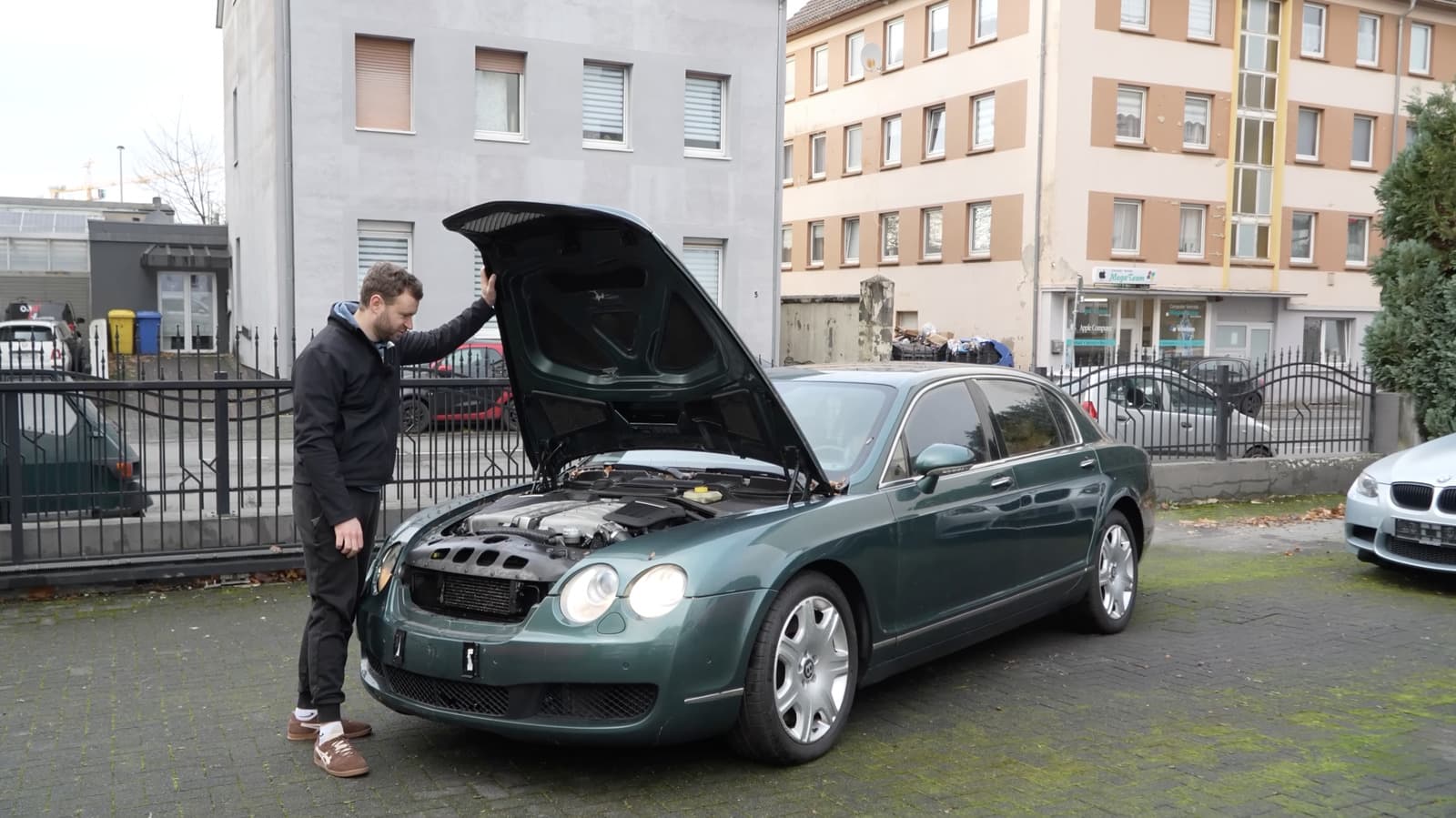
In a testament to engineering durability over extravagance, a battered 2004 Bentley Flying Spur with a Volkswagen W12 engine—purchased for just $12,500 and nearly written off—has become an unlikely poster child for underdog mechanical resilience. YouTuber Sreten, host of the M539 Restorations channel, recently undertook the restoration of what was once a $275,000 luxury sedan, now barely recognizable beneath layers of neglect, mold, and electrical failures. What began as a cautionary tale about the perils of buying cheap luxury cars transformed into a surprising showcase of the W12’s legendary toughness, surviving years of chronic overheating that would destroy lesser engines. After replacing a swollen coolant tank, stretched head bolts, a missing thermostat, and a clogged radiator, the 6.0-liter twelve-cylinder powerplant now purrs as smoothly as it did two decades ago—despite the abuse.
Why This Bentley W12 Restoration Matters: A Lesson in Mechanical Resilience
The saga of Sreten’s Flying Spur is more than a viral car-restoration story—it’s a real-world stress test of Volkswagen’s W12 engine, a powerplant first introduced in 2001 and used across Bentley, Audi, and Volkswagen brands. Designed to deliver opulent performance without sacrificing durability, the W12 combines two VR6-style six-cylinder banks at a 72-degree angle, sharing a single crankshaft and delivering up to 450 horsepower in its most powerful iterations. While the engine is celebrated for its smoothness and torque, critics often question its long-term reliability, especially when subjected to poor maintenance. The Flying Spur’s resurrection proves that, when properly cared for—or even despite neglect—the W12 can endure punishing conditions far beyond typical warranty periods.
The Anatomy of a W12: How This Engine Handles Abuse
At the heart of the Flying Spur’s survival is the W12’s robust design, featuring forged aluminum cylinder heads, a closed-deck aluminum block, and individual cylinder sleeves that resist warping under heat stress. Unlike many high-performance engines that rely on fragile components, the W12’s architecture prioritizes rigidity and heat dissipation. Still, the W12 is not immune to failure—particularly when subjected to repeated overheating cycles, which can warp cylinder heads, stretch head bolts, and degrade coolant system components. The engine’s Achilles’ heel, as Sreten discovered, is its reliance on a complex cooling system that includes a plastic overflow tank and multiple sensors. When one fails, the cascade of issues can mimic more serious failures like blown head gaskets or cracked blocks.
From $12,500 Project to a $16,431 Odyssey: The Cost of Abuse
Sreten’s purchase of the Flying Spur on Copart—an auction site specializing in salvage and insurance write-offs—was a high-risk gamble. With 160,000 miles on the odometer and a laundry list of issues, the car was a shell of its former self. The initial $12,500 price tag seemed like a steal, but within weeks, the true cost of restoring it became clear. The first order of business was addressing the interior, which had become a breeding ground for mold due to chronic water intrusion from a leaking sunroof drain. After drying and sanitizing the cabin, Sreten turned his attention to the engine, only to discover that the overheating problem was far worse than expected.
The Mystery of the Overheating W12
The first clue that something was deeply wrong came when the car overheated shortly after being driven. A block pressure test revealed combustion gases were entering the coolant system—a classic symptom of a blown head gasket or cracked cylinder head. Yet, after borescope inspection, Sreten found no visible damage to the gasket or cylinder walls. The real culprit? Years of overheating had stretched one of the cylinder head bolts, causing the head to lift slightly under load and allowing exhaust gases to seep into the cooling system. The damage was invisible from the outside but had already warped the bolt beyond its elastic limit.
A Thermostat? Never Heard of Her: The Puzzling Removal of a Critical Component
As Sreten dug deeper, he made a startling discovery: the thermostat had been removed years earlier. According to Sreten’s investigation, a previous owner likely removed it in a desperate attempt to keep coolant flowing continuously, hoping to prevent overheating. But the gambit failed. Without a thermostat, the engine could never reach or maintain optimal operating temperature, leading to inconsistent performance and chronic overheating. It was a band-aid solution that ultimately masked the real problem—a clogged radiator and failing cooling system components.
The W12’s Comeback: Radiators, Bolts, and Redemption
After months of trial and error—replacing sensors, testing fans, and even swapping out the coolant overflow tank—it became clear that the radiator was the final bottleneck. A new radiator, along with properly tensioned head bolts and a functional thermostat, brought the engine back to life. The W12, despite years of neglect and abuse, started running smoothly again, though not without lingering issues. A faulty turbo boost solenoid now leaves the engine in limp mode, requiring a full teardown to replace. Still, the core of the engine—its cylinders, pistons, and crankshaft—remains intact and functional, a rarity in high-mileage luxury cars.
What the Flying Spur’s W12 Teaches Us About Engine Reliability
The Flying Spur’s resurrection raises important questions about engine design philosophy. How can a car with a $275,000 sticker price and a reputation for opulence end up costing less than a used Honda Civic to restore? The answer lies in the W12’s resilience. While the W12 isn’t immune to failure, its modular construction and robust architecture allow it to endure conditions that would cripple lesser engines. This resilience is a direct result of Volkswagen’s approach to engine development—a focus on durability over sheer performance. The W12’s design prioritizes longevity, even at the expense of some fuel efficiency and compact packaging.
Key Takeaways: What Every Car Enthusiast Should Know
- The Volkswagen W12 engine is far more durable than its luxury-car reputation suggests, surviving years of overheating, missing thermostats, and stretched head bolts.
- Chronic overheating can cause invisible damage like stretched head bolts and warped cylinder heads, even when head gaskets appear intact.
- Removing a thermostat is a common but ineffective 'fix' for overheating, often masking deeper cooling system failures.
- Luxury cars with high-mileage engines can sometimes be restored for less than their original value if the core components remain intact.
- YouTube restorations like Sreten’s offer real-world insights into engine reliability but come with significant time, money, and mechanical skill investment.
The Broader Implications: Can the W12 Stand the Test of Time?
Sreten’s Bentley Flying Spur is just one example of the W12’s longevity, but it’s not the only one. Across Europe and North America, W12-powered vehicles—from Bentley Flying Spurs to Audi Q7s and Volkswagen Phaetons—continue to rack up high mileage with relatively few catastrophic failures. This endurance has led to a growing community of enthusiasts who view the W12 not as a finicky luxury engine but as a workhorse in disguise. The W12’s durability also reflects broader trends in automotive engineering, where reliability is increasingly prioritized over raw performance. As automakers face pressure to extend vehicle lifespans and reduce waste, engines like the W12 offer a blueprint for balancing power and longevity.
What’s Next for Sreten’s W12-Powered Bentley?
Despite the engine’s revival, Sreten’s Flying Spur is far from road-ready. The turbo boost solenoid failure remains a hurdle, requiring the entire engine to be removed for repairs—a labor-intensive and costly process. Still, the fact that the W12 is running at all is a testament to its design. With additional refinements to the cooling system, electricals, and interior, the car could one day return to its former glory. For now, it serves as a rolling testament to the W12’s resilience—a 12-cylinder engine that refused to die, even after years of abuse.
The Role of YouTube Restorations in Automotive Education
Sreten’s project is part of a growing trend on platforms like YouTube, where mechanics and enthusiasts document the restoration of neglected or damaged vehicles. These channels offer more than entertainment—they provide valuable real-world insights into engine reliability, common failure points, and cost-effective repair strategies. For aspiring mechanics and car owners alike, such content is an invaluable resource. It also highlights the democratization of mechanical knowledge, where anyone with a toolset and a camera can share expertise that was once confined to professional garages. However, the videos also serve as cautionary tales, reminding viewers that not all projects are worth the time, money, or risk involved.
Frequently Asked Questions
Frequently Asked Questions
- How much did Sreten spend restoring the Bentley Flying Spur?
- Sreten has invested $16,431 and countless hours in the project so far, with additional repairs still needed—including a faulty turbo boost solenoid that requires a full engine teardown to fix.
- Why did the Bentley W12 overheat so severely?
- The engine suffered from a combination of a clogged radiator, missing thermostat, stretched head bolts, and a swollen plastic coolant tank—all symptoms of years of chronic overheating and neglect.
- Is the Volkswagen W12 a reliable engine?
- The W12 is known for its durability and smoothness, but it is not immune to overheating-related damage. Proper maintenance is critical, as neglect can lead to costly failures like stretched head bolts or warped cylinder heads.