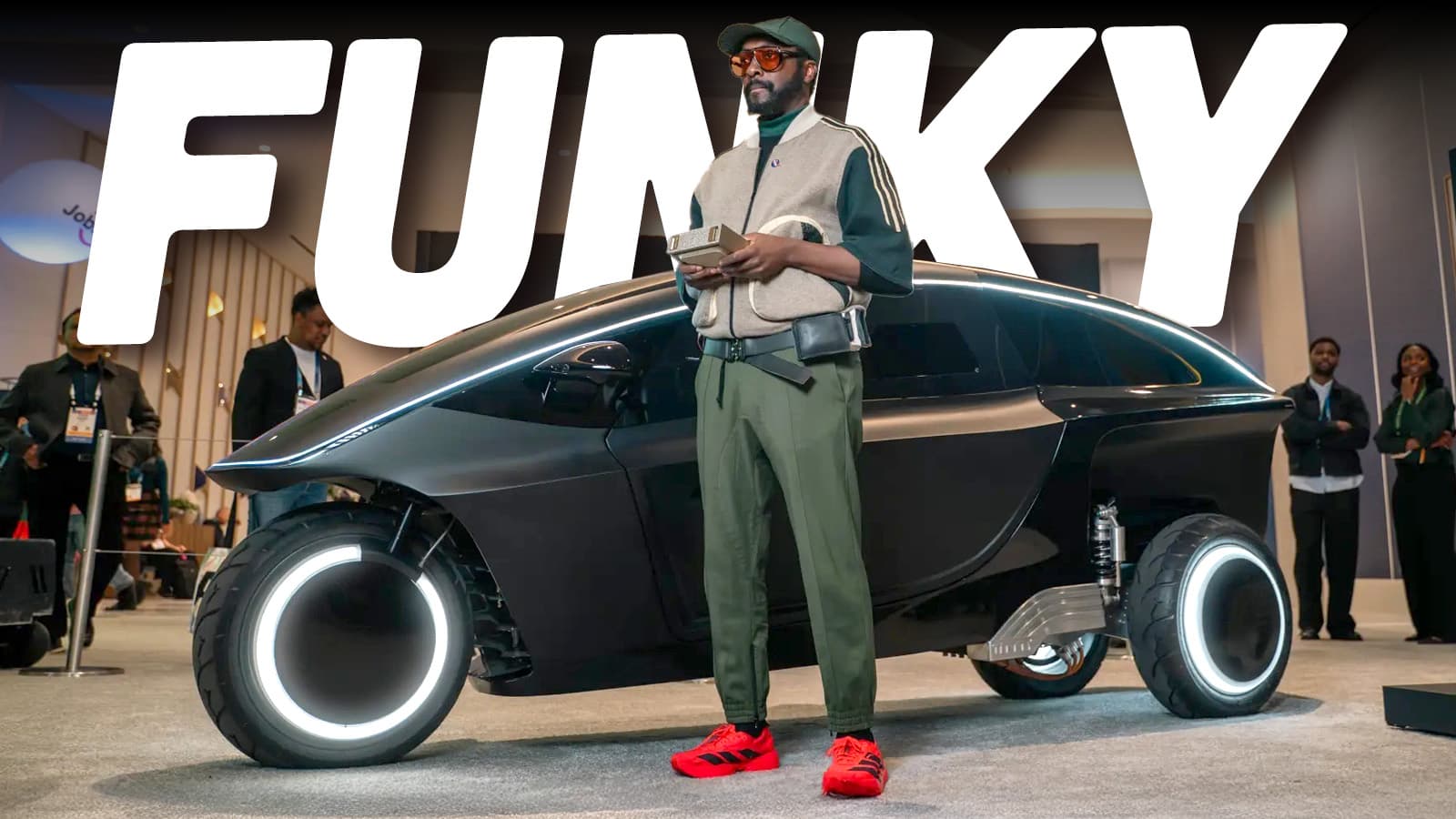
Grammy-winning musician and tech entrepreneur William ‘Will.I.Am’ Adams has once again ventured into the automotive world with a project that blends futuristic design, artificial intelligence, and social impact. At CES 2026 in Las Vegas, Adams unveiled the Trinity—a $30,000 three-wheeled trike featuring Tron Lightcycle-inspired wheels and an AI ‘brain’ capable of handling navigation, emails, and even business strategy. But beyond its flashy specs, the Trinity represents a bold vision for revitalizing America’s inner cities through localized manufacturing and robotics education.
What Is the Trinity Trike? Breaking Down Will.I.Am’s AI-Powered Three-Wheeler
The Trinity is a striking departure from conventional vehicles. Designed as a three-wheeled trike, it features a sleek, futuristic body with wheels positioned in an unconventional layout—more akin to a Tron Lightcycle than a traditional car. Unlike reverse trikes (such as the Polaris Slingshot or Morgan 3 Wheeler), which have two wheels at the front for stability, the Trinity uses a standard trike configuration with a single front wheel. However, it compensates with a self-balancing system developed by DEKA Research & Development and a leaning mechanism similar to motorcycles, ensuring stability during turns.
Design and Performance Specs: A Vehicle Built for Speed and Innovation
Under the hood—or rather, beneath the futuristic shell—the Trinity is powered by a pair of Yasa P400R hub motors, delivering a combined output of up to 800 horsepower. This electric trike boasts a projected range of 176 miles, a 0-60 mph acceleration time of 1.8 seconds, and a top speed of 120 mph. Charging the Trinity takes just 1.1 hours, making it a practical option for urban commuters. The vehicle’s exterior appears to be constructed from lightweight materials like plastic or fiberglass, while its interior features rudimentary side windows reminiscent of kit-built trikes.
The AI ‘Brain’: More Than Just a Smart Assistant
What truly sets the Trinity apart is its AI ‘brain,’ powered by NVIDIA DGX Spark AI technology. Unlike traditional infotainment systems, the Trinity’s AI is designed to engage in conversational interactions, handling tasks like navigation, email management, and even plotting business strategies. Will.I.Am envisions the AI as a ‘workforce’—a digital assistant capable of performing a variety of tasks to enhance productivity. This level of integration represents a significant leap in AI-driven vehicle technology, positioning the Trinity as a pioneer in the ‘agentic internet’ era.
Will.I.Am’s Vision: Revitalizing Inner Cities Through Robotics and Manufacturing
Will.I.Am’s ambitions for the Trinity extend far beyond its technical specifications. He envisions the trike as a catalyst for economic transformation in underserved urban communities. His plan involves building new manufacturing facilities in inner cities, where local community colleges would offer robotics and AI education programs. The goal? To empower residents with the skills needed to thrive in a tech-driven economy. By fostering a pipeline of talent, Will.I.Am hopes to replicate the success of Shenzhen, China—a city that transformed from an industrial hub into a global leader in technology and innovation during the mobile internet era.
How do we have our inner cities transform like Shenzhen was transformed during the mobile internet? In the agentic internet, how does Watts change forever? How does Oakland change forever?
This vision aligns with Will.I.Am’s long-standing commitment to philanthropy and education. Through his i.am/Angel Foundation, he has championed STEAM (Science, Technology, Engineering, the Arts, and Mathematics) education, providing opportunities for underprivileged youth to engage with technology and innovation. The Trinity project is a natural extension of this mission, aiming to create jobs, foster education, and inspire the next generation of tech leaders.
From Music Icon to Tech Entrepreneur: Will.I.Am’s Unconventional Career
Will.I.Am’s journey from a Grammy-winning musician to a tech entrepreneur and automotive innovator is nothing short of remarkable. As a founding member of the Black Eyed Peas, he achieved global fame with hits like ‘Where Is the Love?’ and ‘I Gotta Feeling,’ selling over 50 million records worldwide. Beyond music, he has collaborated with industry legends like Michael Jackson, Justin Timberlake, and Lady Gaga, and even launched his own record label, which signed artists such as LMFAO and Fergie.
The Shift to Technology and Robotics
In the early 2010s, Will.I.Am’s fascination with technology led him to explore robotics, AI, and wearable devices. His involvement with the FIRST Robotics Competition in 2011 sparked a passion for STEM education, which he has since championed through his foundation. This passion has driven him to invest in futuristic projects, from co-designing Beats by Dre headphones to launching the $299 XUPERMASK during the COVID-19 pandemic—a connected mask with Bluetooth, HEPA filters, and active noise-cancelling features.
A History of Ambitious (and Sometimes Flawed) Automotive Ventures
Will.I.Am’s automotive ambitions date back to 2012, when he announced the launch of IAMAUTO, a car company aimed at creating jobs in low-income neighborhoods. The company’s first vehicle, a heavily modified DeLorean, was unveiled at a price tag of $700,000 but quickly became the subject of ridicule. Critics panned its design and feasibility, and the project ultimately fizzled out. Undeterred, Will.I.Am continued to pursue automotive innovation, collaborating on custom vehicles like a V8-powered Volkswagen Beetle and a modified Tesla Model S, both marketed as STEM education projects.
The Mercedes-Benz Partnership and Lessons Learned
In 2022, Will.I.Am partnered with Mercedes-Benz to modify an AMG GT 4-Door into the WILL.I.AMG, a one-off vehicle auctioned to fund STEAM programs. Unlike his previous ventures, this project was refreshingly devoid of hype, focusing on philanthropy rather than commercial success. However, the Trinity marks a return to his original vision of building an entire car company—one that combines cutting-edge technology with social impact.
Challenges Ahead: Can Will.I.Am Build a Viable Car Company?
Despite Will.I.Am’s enthusiasm and vision, the automotive industry is notoriously challenging, even for seasoned automakers. Building a car company from scratch requires navigating complex regulatory hurdles, securing funding, and establishing manufacturing, engineering, and sales infrastructure. Trike manufacturers like Elio and Aptera have struggled to bring their vehicles to market, demonstrating that even simpler designs face significant obstacles.
- The Trinity trike features an AI 'brain' powered by NVIDIA DGX Spark, capable of handling tasks like navigation and email management.
- Will.I.Am plans to establish inner-city factories to manufacture the Trinity, partnering with local colleges to offer robotics education programs.
- The trike’s design includes Tron Lightcycle-inspired wheels and a self-balancing system, ensuring stability despite its unconventional layout.
- With a projected top speed of 120 mph and a 0-60 mph time of 1.8 seconds, the Trinity is built for performance as well as innovation.
- Will.I.Am’s previous automotive ventures, such as IAMAUTO, faced criticism and ultimately failed to gain traction, raising questions about the Trinity’s viability.
Regulatory Hurdles and Market Potential: Can the Trinity Succeed Where Others Have Failed?
One advantage the Trinity may have over traditional cars is its classification as a motorcycle, which could exempt it from stringent federal safety and emissions regulations. However, this classification also means it must comply with motorcycle safety standards, and its unconventional design may limit its appeal to mainstream consumers. Additionally, the trike’s $30,000 price point positions it as a niche product, potentially restricting its market to tech enthusiasts and urban commuters rather than the mass market.
The Kickstarter Campaign and Future Plans
As of now, the Trinity exists as a prototype showcased at CES 2026, with a Kickstarter campaign yet to launch. Will.I.Am has expressed his intention to put hundreds of these trikes on the road by next year, but the path to production remains uncertain. The project’s success will depend on securing investment, navigating regulatory challenges, and generating consumer interest in a vehicle that is as unconventional as it is ambitious.
A Legacy of Philanthropy and Innovation
Regardless of the Trinity’s commercial prospects, Will.I.Am’s commitment to using technology for social good is commendable. His efforts to bridge the digital divide and provide underserved communities with access to education and economic opportunities reflect a broader trend of tech leaders leveraging their influence for philanthropic causes. Whether the Trinity ultimately succeeds as a car company or remains a high-profile experiment, it underscores the power of innovation to drive positive change.
Frequently Asked Questions
- What is the Trinity trike and who created it?
- The Trinity is a $30,000 three-wheeled electric trike with an AI 'brain,' created by Grammy-winning musician and tech entrepreneur Will.I.Am. It features Tron Lightcycle-inspired wheels and is designed to revitalize inner cities through manufacturing and robotics education.
- How does the Trinity’s AI system work?
- The Trinity’s AI, powered by NVIDIA DGX Spark, is designed to perform tasks like navigation, email management, and business strategy planning through conversational interactions. Will.I.Am envisions it as a ‘workforce’ to enhance productivity.
- What are Will.I.Am’s plans for manufacturing the Trinity?
- Will.I.Am intends to build inner-city factories to manufacture the Trinity, partnering with local community colleges to offer robotics and AI education programs. His goal is to create jobs and foster economic growth in underserved urban areas.