Although February is coming to an end quickly, it gave Microsoft time to begin rolling out several significant features to Windows 11, and in this guide, we're going to take a look at them.
In addition to the improvements rolled out during the first half of February, Microsoft has made previews of versions 25H2 and 26H1 available in the last two weeks.
Biggest improvements from the Windows Insider Program in February 2026
These are the most significant changes Microsoft has unveiled since the last roundup.
Microsoft continues its efforts to improve the modern content menu, and this time around, with the release of build 26300.7877, when right-clicking a specific file (such as ".exe," ".bat," or ".cmd"), the "Open" option will also show the icon for the app that supports the file.
In the Canary Channel, you'll also find an updated version of File Explorer that brings dark mode improvements to the Folder Options dialog. Finally!
Starting with build 26300.7877, Windows 11 has an updated version of the Settings app that introduces small tweaks to make it easier to understand.
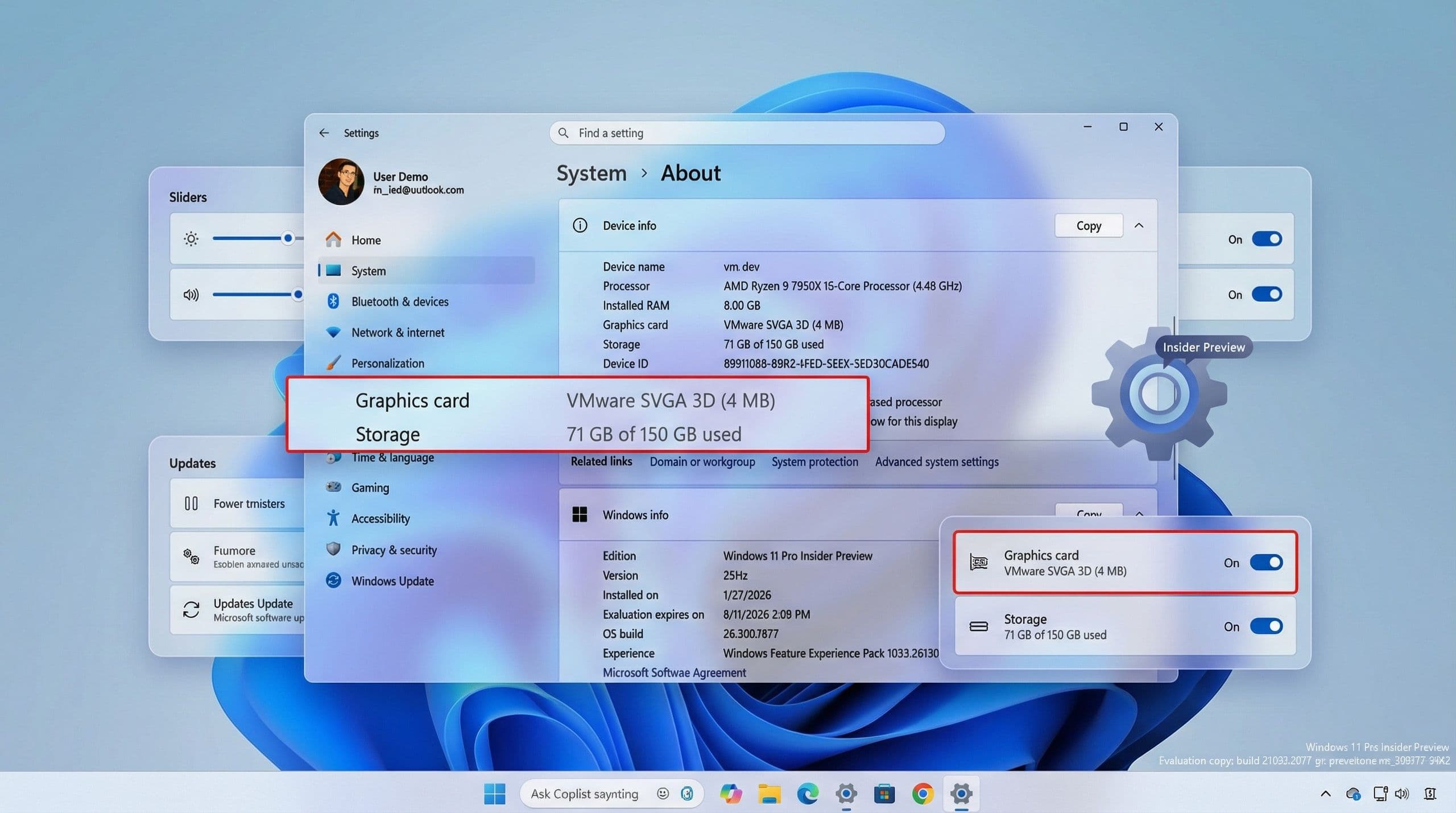
In addition, build 26300.7877 also brings some changes to the "About" settings page.
For example, Microsoft is rolling back the top card views with the details from the top key hardware specifications, including CPU, RAM, GPU, and Storage.
Also, and perhaps the most noticeable change, is the addition of the GPU and storage information under the "Device info" section.
This last improvement really surprised me, because it's the type of information you always expect to be there. However, it's time for Microsoft to include.
The improvements available on build 26300.7877 also apply to build 26220.7872 from the Beta Channel.
Windows 11 build 26220.7859 was only released in the Beta Channel, and it introduced an "Upgrade" option to switch from the Personal to Family plan from the "Accounts" page.
According to the company, this option can be turned off by disabling the feature to suggest content in the Settings app.
Microsoft is making changes to how the system manages batch files and Command Prompt scripts to improve performance and security.
Starting with builds 26300.7939 and 26220.7934, it's possible to enable a new Registry key that enables protected execution mode, preventing batch files from being modified while they are running
This configuration is done at the HKEY_LOCAL_MACHINE\Software\Microsoft\Command Processor path, and setting the LockBatchFilesInUse DWORD to 1 enables protection. The 0 value leaves it disabled.
The development is now also previewing the Shared audio feature with more granular controls and support for more devices.
As part of the improvements, Windows 11 now provides separate volume sliders for each individual when two Bluetooth LE Audio devices are connected.
The main system volume controls appear in the Quick Settings flyout, and the hardware and keyboard controls continue to adjust audio for both listeners simultaneously.
Microsoft is also adding an indicator in the Taskbar to signal that the audio is being shared.
Finally, this feature is now also available for Samsung Galaxy Buds 4, Samsung Galaxy Buds 4 Pro, Sony WF-1000XM6, and the Xbox Wireless Headset.
These changes are also available starting with builds 26300.7939 and 26220.7934.
Microsoft is also bringing the Cross-Device Resume feature to the Canary Channel (build 28020.1619).
The feature lets you resume apps from your Android phone on your computer directly from the Taskbar. Currently, you can resume Spotify playback, work in Word, Excel, or PowerPoint, or continue a browsing session.
The company also notes that resuming browsing sessions works for Vivo phones when using the Vivo Browser on Windows 11.
Furthermore, if you use a phone from HONOR, OPPO, Samsung, Vivo, or Xiaomi, you can also resume online files opened in the Microsoft Copilot app.
Narrator now includes a new personalization feature that gives you precise control over how interface elements are announced while navigating apps. Instead of relying on a fixed speaking order, you can choose which properties the Narrator reads aloud for each control type, including buttons, checkboxes, links, sliders, and text fields. You can also reorder or remove specific details to better match your workflow and preferences.
You can access these customization options with the shortcut "Narrator key + Ctrl + P," where you can select, clear, and rearrange spoken properties for each control type.
The Windows Hello Enhanced Sign-in Security (ESS) experience has only supported built-in biometric sensors. However, starting with this preview build, you'll be able to connect and configure virtually any supported Windows Hello ESS fingerprint reader from the "Sign-in options" settings page.
You can configure this new feature from Settings > Accounts > Sign-in options and enable the "Enhanced sign-in security" option with an external supported device.
The company is also updating Voice Typing to let you set a wait time before a voice command runs.
You can find the option on Voice Typing Settings > Wait time before acting. The options available range from instant to very long (default).
Voice Access brings to the Canary Channel a new wizard to help you set up the experience more easily.
This new experience will help you download the required speech model for your setup language, choose a microphone, and get started with the feature.
The company is also updating the Second Chance Out-of-box Experience (SCOOBE) with a new design to streamline the setup process so you can configure all recommended settings from a single page.
Microsoft is also expanding the AI agent in the Settings app for more languages to German (de-de), Portuguese (pt-br, pt-pt), Spanish (es-es, es-mx), Korean (ko-kr), Japanese (ja-jp), Hindi (hi-in), Italian (it-it), and Chinese Simplified (zh-cn).
Quick Machine Recovery for Pro editions
Quick Machine Recovery has been available for some time, but until now, it was enabled by default only on the Home edition of the operating system.
Microsoft is now (starting with build 28020.1673) expanding that behavior to Windows 11 Pro, automatically turning on the recovery feature by default as well, except for managed devices.