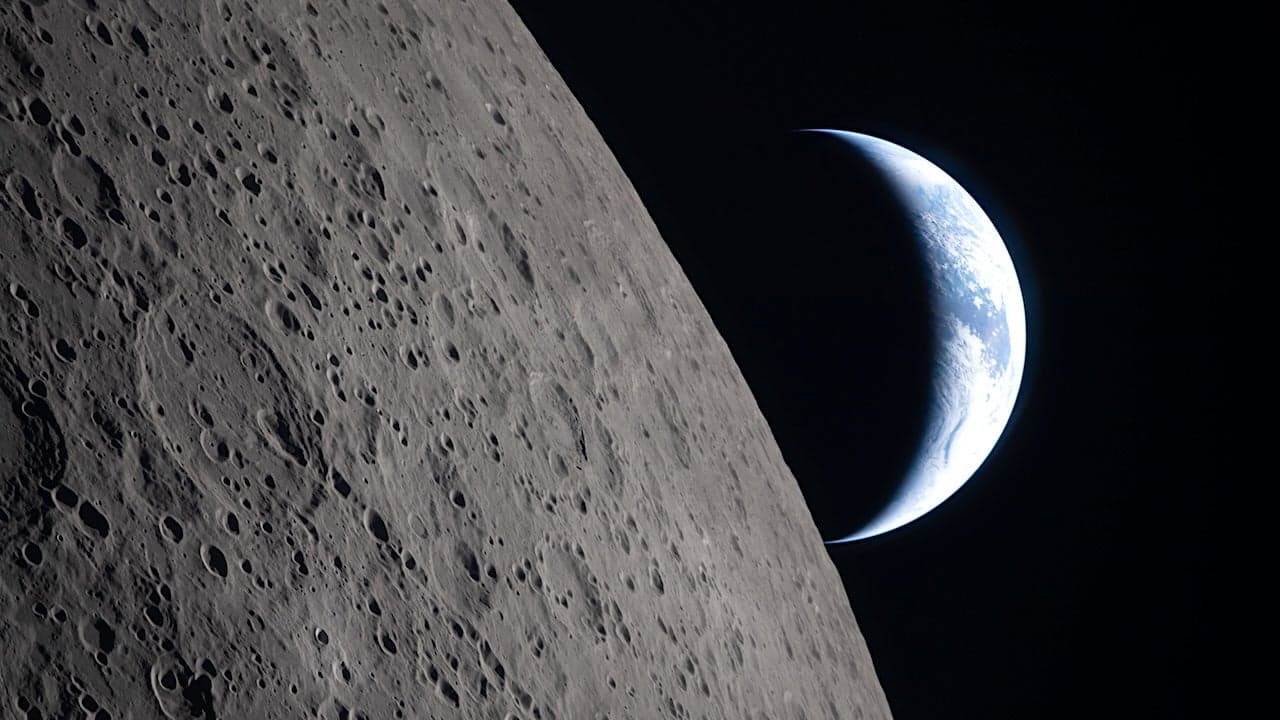
In a deeply personal tribute unfolding 240,000 miles from Earth, the four astronauts of NASA’s Artemis II mission have proposed naming a newly discovered lunar crater after the late wife of mission commander Reid Wiseman. The emotional gesture, announced during a NASA briefing, reflects the crew’s blend of professional rigor and human vulnerability as they prepare to become the first humans to voyage beyond low-Earth orbit since 1972. While the mission marks a historic milestone in space exploration—aiming to test the Orion spacecraft’s systems during a lunar flyby—their decision to memorialize Carroll Wiseman on the lunar surface underscores how personal loss and scientific ambition can intertwine in the cold vacuum of space.
The Artemis II Crew’s Heartfelt Tribute: From Grief to the Stars
On April 1, 2024, NASA’s Artemis II mission blasted off from Kennedy Space Center, carrying Commander Reid Wiseman, Pilot Victor Glover, Mission Specialist 1 Christina Koch, and Mission Specialist 2 Jeremy Hansen. The crew, hailing from diverse backgrounds—Wiseman a veteran of the International Space Station, Glover the first Black astronaut assigned to a lunar mission, Koch the first woman on a moon-bound flight, and Hansen the first non-American on such a mission—shared a moment of raw emotion during a January 2024 NASA press conference. It was there that Hansen, speaking on behalf of the crew, revealed their intention to name one of the craters they would observe a ‘Carroll,’ in honor of Wiseman’s late wife, Carroll Taylor Wiseman, who passed away in May 2020 after a five-year battle with cancer.
- Carroll Wiseman was a dedicated Registered Nurse specializing in newborn intensive care at Children’s Hospital of the King’s Daughters in Virginia.
- She was diagnosed with cancer shortly after Reid Wiseman’s 2014 spaceflight aboard Expedition 41, and passed away at age 46.
- Her death occurred just one month before Reid Wiseman’s mother, Judy, who died from complications related to Alzheimer’s disease.
- Reid Wiseman became a single father to daughters Ellie and Katherine, ages 17 and 20, after her passing.
“A number of years ago, we started this journey in our close-knit astronaut family, and we lost a loved one. … Her name was Carroll. It’s a bright spot on the moon, and we would like to call it Carroll.”
The crew’s announcement followed a poignant walk Wiseman took with his daughters, during which he shared the location of his will, trust documents, and final wishes. Speaking at the same press conference, Wiseman, now 50, reflected on how loss had reshaped his perspective. “I went on a walk with my kids, and I told them, ‘Here’s where the will is, here’s where the trust documents are, and if anything happens to me, here’s what’s going to happen to you,’” he said. That vulnerability, shared under the weight of imminent spaceflight, humanized the mission’s emotional core amid its technological grandeur.
How Lunar Crater Naming Reflects NASA’s Legacy of Honor and Remembrance
The International Astronomical Union’s Role in Celestial Naming
The naming of lunar craters is not arbitrary—it falls under the purview of the International Astronomical Union (IAU), a global authority established in 1919 to standardize the naming of celestial bodies and their features. According to IAU guidelines, craters on the moon are typically named after deceased explorers, scientists, or individuals who have made significant contributions to space science, provided they have been deceased for at least three years. However, the IAU has also accommodated provisional names proposed by astronauts during lunar missions, particularly when those names honor personal connections or historical figures tied to exploration.
A NASA spokesperson confirmed that while ‘Carroll’ has not yet been officially approved, such personal designations have precedent. One of the most famous examples is Mount Marilyn, named after Marilyn Lovell, wife of Apollo 8 and Apollo 13 astronaut Jim Lovell. Though not formally recognized at the time, the name gained cultural traction and was later adopted in lunar maps. Lovell, who passed away in August 2024 at age 97, even recorded a posthumous wake-up message for the Artemis II crew, delivered from beyond the grave: “Welcome to my old neighborhood,” he said, evoking both nostalgia and continuity in lunar exploration.
Why Personal Tributes Matter in a Mission of Firsts
Artemis II represents more than a technical achievement—it’s a mission steeped in symbolism. As the first crewed lunar mission since Apollo 17 in 1972, it carries the legacy of America’s space program while signaling a new era of international collaboration and long-term lunar ambition. The inclusion of a personal tribute like ‘Carroll’ Crater reflects how NASA has evolved in its approach to human spaceflight. Where Apollo missions were framed around national pride and Cold War competition, Artemis embraces a more inclusive narrative, one that acknowledges the emotional and psychological dimensions of space exploration. For Wiseman, a father of two, the crater becomes more than a geological feature—it’s a celestial monument to resilience, love, and the fragility of life.
NASA’s decision to allow such personal naming also serves a psychological purpose. Astronauts, often trained to suppress emotion in service of mission success, are increasingly encouraged to bring their full humanity to the job. Studies have shown that acknowledging grief and personal connections can improve team cohesion and mental resilience during high-stress operations. In naming a crater after his late wife, Wiseman isn’t just honoring a loved one—he’s modeling a form of emotional transparency that could redefine how astronauts are perceived and how they cope with the isolation of spaceflight.
The Emotional and Historical Weight of Naming in Space Exploration
The tradition of naming lunar features after individuals is nearly as old as the Space Age itself. During the Apollo era, astronauts frequently paid tribute to colleagues, loved ones, and even pets. In 1969, during the Apollo 11 mission, Neil Armstrong and Buzz Aldrin famously named a small crater ‘Sleepy Lagoon’ after a jazz standard, though it was not officially recognized. More solemnly, the crew of Apollo 15 named a lunar mountain ‘Hadley Rille Delta’ in memory of a friend who died in a plane crash, illustrating how grief and exploration have long been intertwined.
Carroll Wiseman’s crater, if approved, would join a select group of lunar features named after women and non-astronauts—categories historically underrepresented in space memorials. NASA’s own biography of Reid Wiseman notes that Carroll dedicated her life to helping others as a NICU nurse, a profession predominantly female. Her inclusion in the lunar lexicon would not only personalize the Artemis mission but also highlight the often-unseen contributions of women in space history. As of this reporting, the IAU has not responded to NASA’s proposal, but the precedent for provisional naming suggests that ‘Carroll’ may soon illuminate the moon’s surface as a silent tribute to a life well-lived.
What’s Next for Artemis II and the Legacy of ‘Carroll’ Crater
As the Orion spacecraft continues its 10-day journey around the moon and back to Earth, scheduled for a planned splashdown on April 11, 2024, the crew’s emotional payload carries just as much significance as its scientific data. The proposed crater name has already sparked conversations about how NASA balances personal memory with public symbolism. If approved, ‘Carroll’ Crater would become part of the official lunar geographic record, ensuring that a woman who dedicated her life to healing others will be forever associated with humanity’s return to the moon.
For Reid Wiseman, the tribute is both a farewell and a bridge. Speaking to reporters before launch, he expressed gratitude for the support of his daughters, Ellie and Katherine, who watched their father’s mission from Earth. “They’ve seen me go through some of the hardest moments of my life, and they’ve seen me come out the other side,” he said. “This crater is for them, too. It’s a reminder that even in the vastness of space, love and memory are never too far away.”
Key Takeaways About the Artemis II Crew’s Lunar Tribute
- The Artemis II crew has proposed naming a lunar crater ‘Carroll’ after Reid Wiseman’s late wife, who died of cancer in 2020 after a five-year battle.
- NASA has a history of honoring personal connections in lunar naming conventions, including unofficial names like Mount Marilyn, inspired by Jim Lovell’s wife.
- The IAU governs official celestial naming, but has accommodated provisional names from astronauts in the past.
- Carroll Wiseman was a Registered Nurse specializing in newborn intensive care, highlighting the contributions of women in healthcare and space history.
- The tribute reflects a broader shift in NASA’s approach to astronaut psychology, embracing emotional transparency during high-stakes missions.
Frequently Asked Questions About Artemis II and the ‘Carroll’ Crater Proposal
Frequently Asked Questions
- Has the International Astronomical Union officially approved the name 'Carroll' for the lunar crater?
- As of this reporting, the IAU has not yet responded to NASA’s proposal. The naming process typically takes time, and provisional names from astronauts have been accepted in the past.
- Why do astronauts name lunar features, and is it a NASA tradition?
- Astronauts have proposed informal names for lunar features since the Apollo era. While not all are officially recognized, many—like Mount Marilyn—have entered lunar lore and mapping systems.
- What else is the Artemis II mission accomplishing besides crewed lunar flyby?
- In addition to testing the Orion spacecraft’s systems for deep-space travel, Artemis II is a critical step toward the Artemis III mission, which aims to land the first woman and person of color on the lunar surface by 2026.